


In the news last week: the CPB reports that its estimates show that shortening the duration of unemployment benefit barely affects how long people remain unemployed. And therefore barely affects how quickly people find a job. According to the calculations, even halving the duration of unemployment benefit produces only 8,000 additional full-time jobs.
According to the calculations, even halving the duration of unemployment benefit produces only 8,000 additional full-time jobs.
That did not come as a great surprise to me. But I suspect that many politicians and other policymakers, within and outside the Jetten cabinet (and Eelco Heinen in particular), had to stop and think for a moment. After all, was it not ‘obvious’; did we not ‘know for certain’ that if you give people less money, or give it to them for less time, as replacement income during unemployment (or incapacity for work or illness), they will return to work sooner? Was that not also what all the relevant economic research showed?
Very close to 0
The latter is true. Most research into reducing or shortening social security benefits does find an effect, often a ‘statistically significant effect’. But the fact that this effect is usually ‘verrrrry close to 0’ never really makes it into the popular press. The CPB’s colleagues therefore deserve credit for now prominently communicating that latter finding – ‘there is barely any effect’.
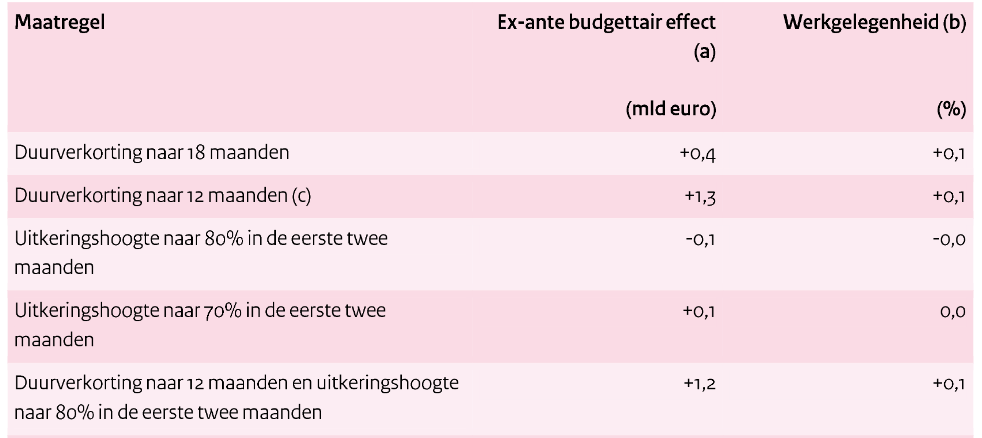
It is also perfectly explainable that halving the duration of unemployment benefit has very little effect on the job-finding prospects of a benefit claimant. In a tight labour market, the majority of jobseekers receiving unemployment benefit find new work within six months anyway. They do not sit around waiting for their entitlement to run out before starting to look. And they do not do so merely because UWV monitors this, but above all because being unemployed is not much fun. Especially not in a society that attaches so much value to having paid work.
The incentive already works
In economists’ terms, we are talking about the ‘incentive to look for work’. For by far the majority of unemployment benefit claimants, this is more than sufficient under the current benefit duration, which is in fact much shorter for many people than the maximum period of two years. So if you increase that incentive by limiting the duration of unemployment benefit to one year, it is completely irrelevant for many people receiving unemployment benefit. The stronger incentive affects only the group at risk of being unemployed for longer than one year.
The idea that unemployed people do not look hard enough for work is a grotesque overestimation of reality.
And the implication of the measure is that this group of long-term unemployed people do not look hard enough for work. But that too is a grotesque overestimation of the real situation. Most benefit claimants (including those receiving social assistance and other benefits) do look hard enough for work, but are simply repeatedly rejected by employers because, for example, they are insufficiently qualified, have too little experience, have too much experience (never because they are too old, because that is not allowed…), do not fit into the team (never because they have the wrong surname or skin colour, because that is absolutely not allowed…).
Do incentives matter?
In other words: whether or not someone finds work quickly does not depend solely on the jobseeker’s efforts in applying for jobs, but equally on employers’ behaviour. So if you incentivise a small proportion of jobseekers more strongly, whilst employers continue to do the same thing, the outcomes will not change much. A negligible proportion of jobseekers will search even harder and therefore find a job just a tiny bit faster. That is ‘barely any effect’, or a statistically significant effect ‘verrrrry close to 0’.
A much larger proportion of jobseekers will not change their behaviour and will find a job just as quickly or slowly as before. And a substantial proportion of unemployment benefit claimants will end up in social assistance sooner, with all the consequences for their income that entails.
It is good that an impartial source has now acknowledged that this risk of over-incentivising exists.
These effects of a measure are much greater, but economists too often overlook them. Because under the motto ‘incentives matter‘, they always think that only ‘incentives matter’. But they forget that incentives have the ‘intended’ effect for only a small proportion of the ‘target population’. And that there are also effects that are not ‘intended’ at all. And sometimes, as an economic policymaker, you incentivise beyond your goal. It is good that an impartial source has now acknowledged that this risk of over-incentivising exists.
About the author

Ronald Dekker is an independent labour economist at RoDeO Labour market intelligence.
Read also
- ‘Generational thinking is rampant weed’
- The 3 most important errors in thinking about labour productivity
- Ronald Dekker: ‘Can the information problem in the labour market be solved?’
- Is Thomas Piketty the new John Maynard Keynes (and will we soon work much less)?
- Ronald Dekker on ‘practical thinking’ and ‘impractical doing’
- Does the love of flexibilisation come from both sides?