Ouch… A candidate applies to department A and receives a response within 2 days, has 2 structured interviews and gets clear feedback. Although she is rejected, she still tells her network: ‘What a professional process.’ Her friend applies to department B at the same company, waits 3 weeks, has 1 chaotic interview and then hears nothing more. He writes on Glassdoor: ‘Unprofessional company, they don’t know what they’re doing.’ Both reviews are about your organisation. But candidates don’t see 2 departments; they see 1 employer. Department A suffers because of what B is getting wrong.
Why do we keep doing this? Why do we ‘accept’ that every department or business unit has its ‘own way’ of doing things, often because the director or manager has their ‘own vision’ of recruitment? Sales recruits quickly and informally, Finance wants 3 interviews and an assessment, and IT conducts technical tests. It looks like local autonomy, but candidates experience it as inconsistency.
With a process that varies by department, nobody knows what your organisation really stands for.
And did you know that 68% of candidates base their impression of an employer on the recruitment process? With a process that varies by department, nobody knows what your organisation really stands for. The employer brand becomes fragmented, and different candidates are exposed to different processes and selection standards.
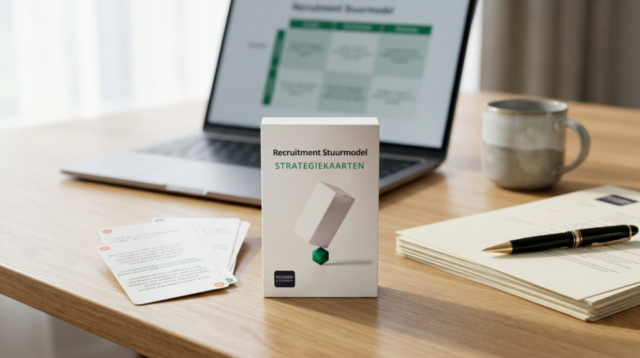
This week’s card
This week’s card addresses this fragmentation: ‘Every department recruits and selects differently: different questions, different speeds, different experiences for candidates. What is the effect of this?’ The question for reflection is pragmatic: ‘What if, from now on, everyone did 3 things in the same way (for example, initial briefings, feedback and communication)? Which 3 would have the greatest impact?’
Why this question works: This question pushes you to move from ‘everything is different’ to ‘the essentials are the same’. We think standardisation means locking everything down. But 3 things are manageable. Not everything has to be the same; focus on what really matters. The team discovers for itself that if we standardise 3 things, all candidates receive the same treatment and we gain better oversight. The rest can vary.
We think standardisation means locking everything down, but it doesn’t have to.
Discuss this with your team for 10 minutes. How do the departments or business unit you work for operate? Examine and discuss the differences. Now choose three things that must be the same everywhere from next month: initial briefings, updates, number of interviews, point at which feedback is given? (4 minutes). The answer to inconsistency and the reason to harmonise are right there in the room. You don’t need a new HR handbook.

The secret of the trade
Inconsistency undermines everything. You invest in employer branding, but candidates experience a different company in each department. You train managers in interview techniques, but department C still has its own format and ‘special’ criteria. And you measure your candidate experience, but the results can’t be compared because it is different everywhere. As long as everyone experiments in their own silo, you can’t discover what works. In 2 years’ time, you’ll still be dealing with the same problems because you never apply what you discover and make it the standard.
As long as everyone experiments in their own silo, you can’t discover what works.
What can you do as soon as tomorrow? Find out why there is so much tailoring. Once you have a clear picture, arrange a meeting with all department heads. Ask 1 question: ‘Which 3 things really matter and will we do for every vacancy or candidate from now on?’ Let them choose. They might choose: (1) Every candidate receives a response within 48 hours, (2) Every vacancy starts with an initial briefing using template X, (3) Every rejection includes a personal sentence. Write this down. These are your 3 non-negotiables. The rest can vary by department.
Script for handling resistance:
- Department head: ‘But our department really is different; we need our own approach.’
- You: ‘Candidates are applying to 1 organisation, not 5 different ones. We’re only standardising 3 basics. Within that framework, tailoring is still possible and necessary.’
Standardisation creates a foundation on which autonomy can flourish.
What is likely to happen? At first, standardisation feels like bureaucracy, but gradually you notice that candidates respond more consistently and that the organisation gets used to the one way of working. Reviews become more consistent. After a few months, departments can compare results and start learning from one another. Analyse the data after 6 months: if you see that the candidate experience score is rising and managers find the process robust, you know it works. Standardisation creates a foundation on which autonomy can flourish.
About the author
Koen Roozen trains and advises organisations on strategic recruitment and coaches managers. His work is based on analysis, clear models, oversight and expertise. He developed the Recruitment management model. With his recruitment strategy cards, he helps recruitment teams strengthen their hiring capabilities step by step. Koen Roozen teaches recruitment strategy at the Academy for Labour Market Communication and writes about recruitment every Tuesday in his newsletter Recruitment with pepper.

Don’t want to wait for the next question? Order your own recruitment strategy card deck. You don’t need any preparation or an external facilitator. Simply draw one card each week, discuss it with your team for 10 minutes and choose 1 concrete action. Step by step, you’ll build a recruitment department that really makes a difference.
Read also
Related event

Leergang Strategisch Recruitment | UITVERKOCHT
Ben je klaar om je recruitmentcarrière naar een hoger niveau te tillen? De Leergang Strategisch Recruitment biedt je de perfecte mogelijkheid om je kennis te verdiepen en je professionele groei te versnellen. Als ervaren recruiter of recruitmentmanager ontwikkel je strategische inzichten en vaardigheden die je een sterke en leidende gesprekspartner maakt voor het management. Je […]
Rotterdam