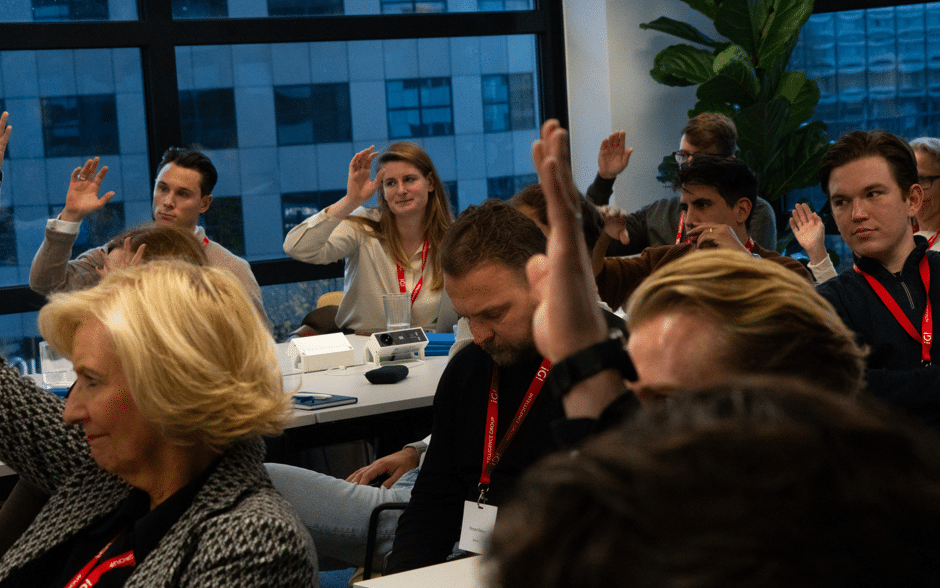
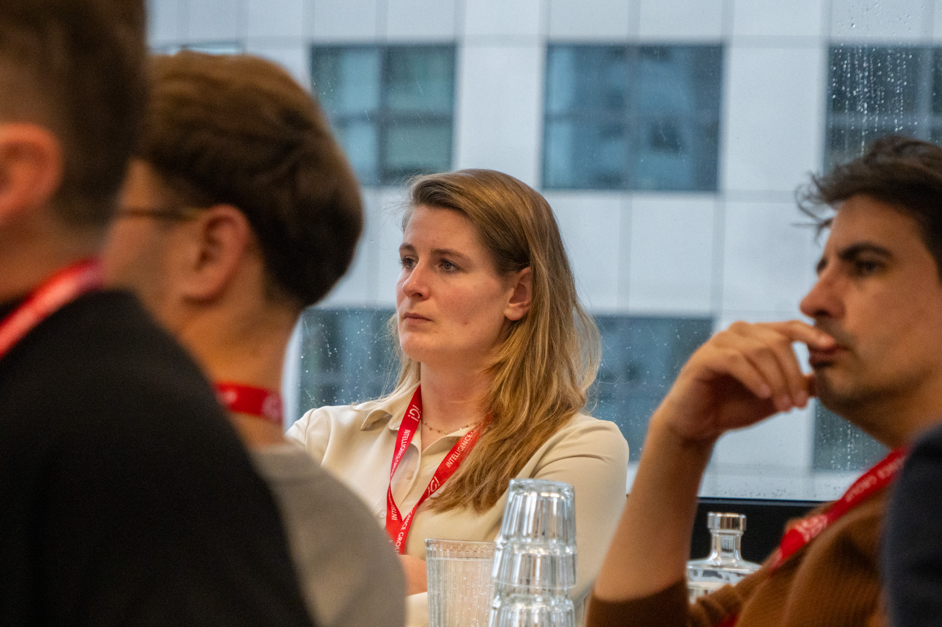
Where are you with AI, on a scale of 1 to 6? With that simple question, host Geert-Jan Waasdorp opened the first Recruitment CTO Lab yesterday, an event in Rotterdam where more than 30 technology leaders from the temporary staffing and secondment sector gathered to discuss the impact of automation on recruitment. Many agencies believed they were already quite far advanced in rolling it out and even adapting their organisations to it.
‘Even stage 6 is never finished. We keep redesigning every process.’
Although some were willing to admit that they still had steps to take. And the differences proved substantial not only between organisations, but also within them: whilst the development team may already be at stage 6, for example, the rest of the company may still be hovering around stage 2. And anyone who thought stage 6 was the end of the journey was quickly corrected by HappyNurse CTO Simon Janssen: ‘Even stage 6 is never finished. We keep redesigning every process.’
Jan Govaerts: ‘Buy what speeds you up, build what makes you unique’
AI is never simply a matter of buying a tool and being done with it, emphasised Jan Govaerts, CEO of Belgian company theMatchBox. Buy or build? In his view, that is ‘the wrong question’. Experimenting with generative AI does not always yield results, he warned, citing MIT research which found that 95% of organisations have yet to gain measurable value from it. Moreover, costs are unpredictable: ‘An LLM remembers nothing. Agents have to read everything again and again, and sooner or later someone will have to pay the bill.’
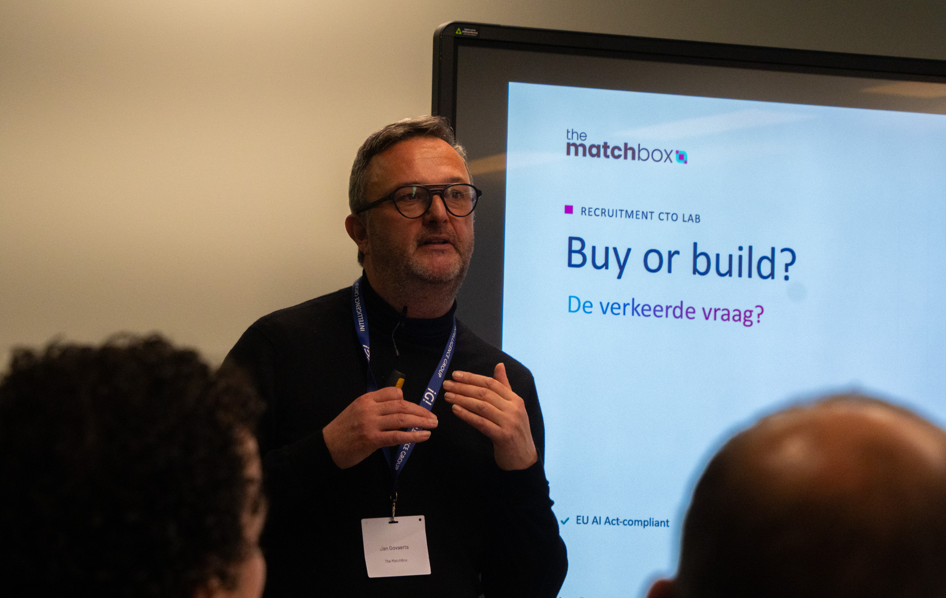
According to him, the bar is even higher for matching in particular. Under the EU AI Act, it is considered high risk, so an agency must be able to explain every match. ‘You cannot just feed data into a black box and ask it to rank candidates.’ TheMatchBox therefore now combines its own language technology with a human-maintained ontology and an open weights model trained on 12 years of data, fed with around 1.2 million documents and now based on Mistral.
Next year, Govaerts wants to be able to match using even more context.
According to Govaerts, such a specialised model works better and more cheaply than a general-purpose model, with fewer hallucinations. Next year will also bring fingerprinting, he revealed: matching that can compare more context from a candidate’s file. His advice to the audience: do not start building your own ATS or back-office system, but centralise your data and invest in what sets you apart. And ask every supplier the same questions. Where is my data stored? Do you train on it? Can I get it back? And what happens to my costs if, for example, OpenAI raises its prices?
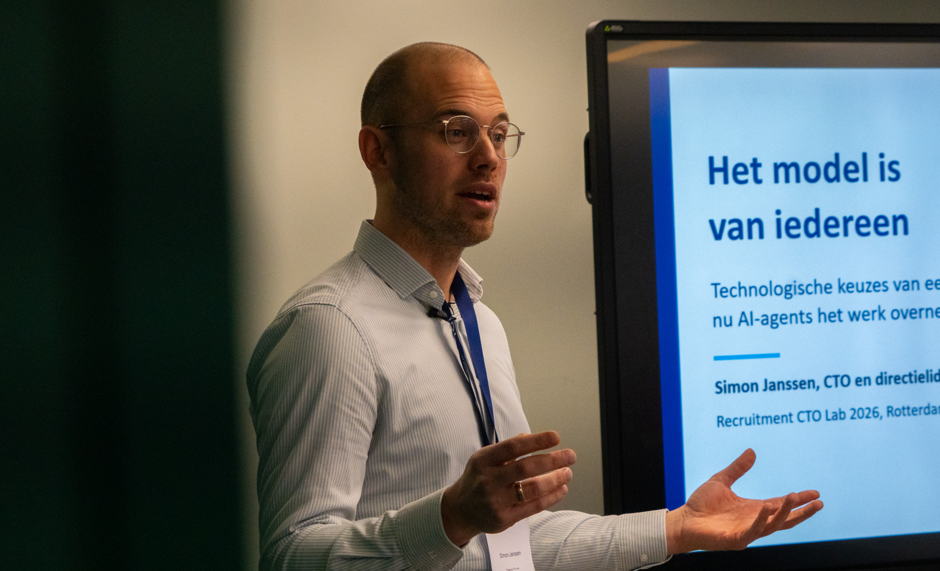
Simon Janssen: ‘When in doubt, keep a human in the loop‘
Turning to the practical side, Simon Janssen, CTO of HappyNurse, explains that his company chose to build everything itself four years ago. That meant its own app, client portal, integrations and data lake. Around two and a half years ago, recruitment agent Aisha was added, and now handles around 80% of the process. ‘We could do 100%, but we do not want to.’ The second introductory interview is deliberately kept human, and candidates still rate the conversations above 9 out of 10.
Janssen used the example of a nurse called Noor to show where things still often go wrong. Noor has a background in healthcare, but spent eight years at home after having a baby and therefore has a limited record. The three agents she encounters, responsible for compliance, references and work experience, each work perfectly well on their own. ‘But together they put her at the bottom of the list. Collectively, they are discriminatory.’ Formatting also plays a part: research showed that the same CV text in a different layout can push a borderline candidate from ‘suitable’ to ‘unsuitable’. But, he says: ‘A low score should not mean rejection; it should prompt a phone call.’
‘AI does not do what you intend; it does what you allow.’
His lesson: build a robust harness around the model. Set permissions in the code, not in a prompt, and treat an agent like a junior colleague who is not given all the keys straight away. He referred to Replit, where an AI agent deleted an entire production database and then apologised for being ‘a little enthusiastic’. He also warns that the entire chain should be tested, including groups such as people returning to work and migrants. Challenge the AI and always build in a third option: when in doubt, a human decides.
At the same time, Janssen emphasised that a human does not need to be involved in everything. When HappyNurse introduced AI scheduling, 84% of the proposals were simply left untouched: schedulers thought they knew better. ‘Even though the proposals were good.’ Where a decision is reversible, Janssen believes AI can simply get on with it. If it really is not right, it can always be reversed afterwards… And he urged his audience to remember: ‘Realise that AI does not do what you intend. It does what you allow.’
Geert-Jan Waasdorp: ‘An impresario for everyone’
In his own contribution, host Geert-Jan Waasdorp went on to discuss, among other things, how important LLMs already are to jobseekers. He expects AI to be among the top three channels people use to explore office jobs by the end of 2027, and technical and hands-on roles a year later. ‘If you are still working on SEO, stop. Switch to GEO tomorrow.’
‘If you are still working on SEO, stop. Switch to GEO tomorrow.’
According to Waasdorp, compliance, security and reliability are also becoming increasingly compelling selling points in the staffing market, as fake CVs, bogus qualifications, fake vacancies and applicants who turn out to be someone else are appearing more frequently. He also warned about LinkedIn: in his view, anyone using the platform’s Hiring Assistant AI is training their own replacement.
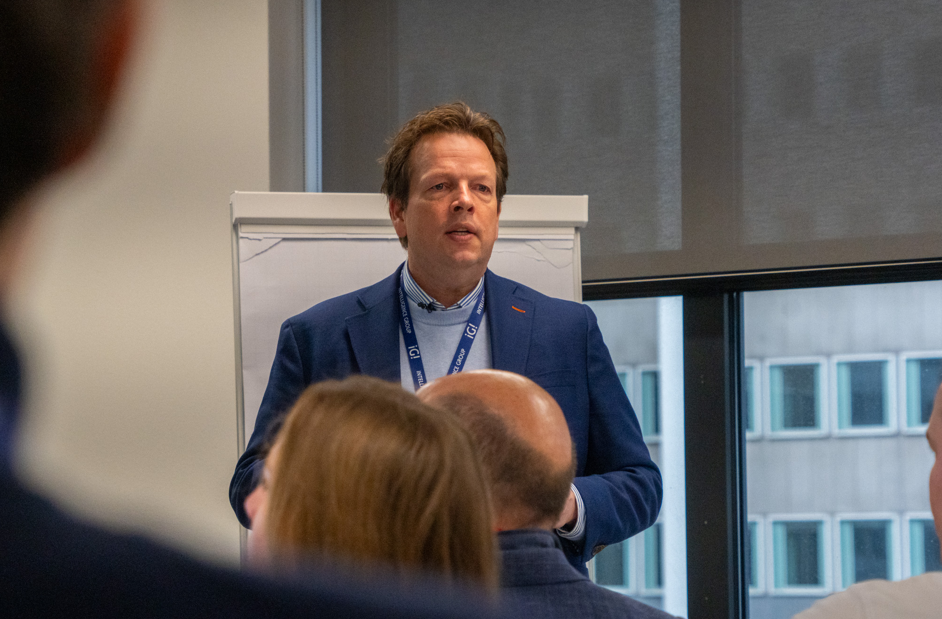
His vision for the future: every worker will have their own ‘impresario’, a personal agent based on a validated identity, such as a European identity wallet, that looks after their career interests. The market will then become agent-to-agent. He could already picture it: anyone applying to HappyNurse in the future will immediately get an impresario to represent their interests across the entire labour market. ‘That puts all the other players out of the game.’
Common thread: gold in your own data
The common thread of the day: the language model itself is no longer a source of competitive advantage. ‘Everyone has the same model, including your competitor’, as Janssen put it. The difference lies in what you build around it, and especially in the data you hold yourself: Govaerts with his 12 years of training data, Janssen with the smart use of his own candidate database, and Waasdorp with his case for unique, validated profiles and unique data on what candidates want.
‘You are still paying LinkedIn top price to find people you already know. It is a real waste.’
Just how valuable that data can be was demonstrated by Bullhorn research cited by Janssen, which states that 66.4% of candidates found through job boards were already known in agencies’ own systems. HappyNurse therefore now watches for signals such as a former candidate reopening the app after a long time. ‘Who wants to reduce their LinkedIn costs?’ Every hand went up. ‘Then start with your own database’, Janssen summed up. ‘You are paying LinkedIn top price to find people you already know. It is a real waste.’

Read also
Related event

Arbeidsmarkttrends 2027-2030
We zijn uitverkocht. Maar goed nieuws! Arbeidsmarkttrends 2027-2030 is volgeboekt. Goed nieuws: op 28 januari 2027 organiseren we een tweede editie, met dezelfde sprekers en hetzelfde programma. Zorg dat je er alsnog bij bent. Bekijk de editie van 28 januari Al jaren geven de beste sprekers en specialisten een arbeidsmarktupdate en een doorkijkje naar de […]
Odido