In January, Chris was still smiling cheerfully at us. The (fictional) new employee of the Dutch tax authority documented all her adventures during onboarding on video. The aim was to give the tax authority ‘a more human face’, but also to encourage others to apply for jobs there. The message was that there was still plenty of work to be done. A quick check of the website shows, for example, that there are currently 70 vacancies open.
Recruiting heavily on the one hand, cutting heavily on the other: a difficult situation for the tax authority…
Meanwhile, however, the Jetten government is sending a very different message. From 2035, the tax authority will have to make do with €438 million less each year. That is €162 million more than previously announced, NRC reported in mid-October. The measure is part of a government-wide savings target: by 2035, the central government must employ around 25,000 fewer full-time equivalents and save €3.5 billion. Implementing agencies such as the tax authority, the Employee Insurance Agency (UWV) and the Immigration and Naturalisation Service (IND) are therefore not exempt.
Billions left uncollected
But is that wise? This week, the response to parliamentary questions from PRO revealed that staff and capacity shortages are leaving substantial potential tax revenue uncollected. The tax authority estimates the so-called compliance gap among SMEs, covering everything business owners knowingly or unknowingly fail to declare, at €5.2 billion a year. The largest share relates to business profits (€1.7 billion) and VAT (€1.4 billion). That does not even include fraud and unknown tax liabilities, because the tax authority cannot measure those reliably.

The older a debt, the less likely it is that the money will ever be collected.
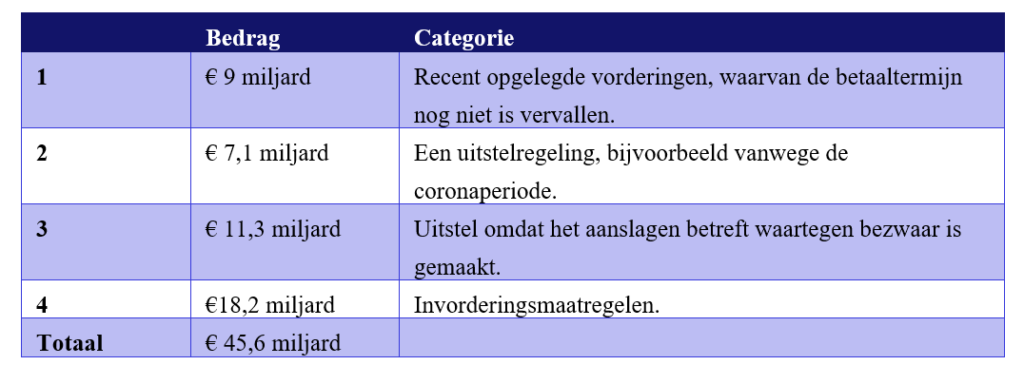
The backlog is also growing in debt collection. The amount for which the tax authority has sent payment reminders rose from €10.9 billion in January 2023 to almost €20 billion in September 2026, according to state secretary Eerenberg. More than a third of that backlog stems from payment arrangements for coronavirus debts that have broken down. But Eerenberg also cites the growing imbalance between the workload and debt collection capacity as a cause. And the older a debt, the less likely it is that the money will ever be collected.
Not a new problem
This is not a new problem. In 2024, the Netherlands Court of Audit calculated that the tax authority would need around 1,000 additional full-time equivalents to tackle all its debt collection work at once, including 400 for coronavirus debts alone. Eerenberg describes that figure as an estimate and points to prioritisation. Extra funding did arrive: €22.5 million, spread across 2025 to 2027. But not beyond that. And when you have vacancies to fill now, you naturally want to look a little further ahead.
The tax authority’s workload is growing faster than its budget.
The way the state secretary describes the staffing problem is striking. ‘The tax authority’s established posts are filled,’ he writes. According to him, there is no longer a staff shortage within the budget allocated to the agency. The workload is simply growing faster than that budget. There are increasing numbers of taxpayers and requests, without a corresponding increase in the budget. Coronavirus schemes and the aim of treating citizens and businesses with a human touch also require a great deal of extra time.
Fewer tax audits
For anyone working in strategic workforce planning, this is a familiar pattern. The shortage is not always in the vacancies, but often in an established workforce that is too small for the workload. And the cuts will make that workforce even smaller. Eerenberg says so himself: efficiency measures affect staff numbers, even though each additional tax authority employee more than pays for themselves on average.

Only 2% of SMEs face a check or tax audit each year.
The number of tax audits shows how this plays out. In 2016, the tax authority examined the books of SMEs more than 27,000 times and conducted 917 audits of large businesses. By 2023, those figures were 9,002 and 501 respectively, a fall of around 66%. The government wants to keep SME oversight at between 7,000 and 10,000 tax audits a year in the coming years. In the 2025 tax monitor only 2% of SMEs say that the tax authority has carried out a check or audit of their business.
Failed departure scheme
Eerenberg gives several reasons for the decline. Part of it is policy: the agency is placing greater emphasis on service and prevention, and a tax audit is its most expensive tool. But he also points to remedial operations, longer investigations, more objections and the large outflow of experienced colleagues, who were replaced by inexperienced newcomers. That began with the failed 2016 departure scheme, under which far more experienced staff left than expected.

Anyone who sees the chance of being caught falling has little reason to follow the rules closely.
That is a shame, because checks pay off. On their Substack Rode Cijfers, Felix Kram and Josha Box calculate that an hour of investigative work brings the treasury at least €1,000 to €3,600. Checks also have a deterrent effect: a business owner who knows they may be checked will complete their tax return more carefully. The reverse is also true. Anyone who sees the chance of being caught falling has little reason to follow the rules closely.
Outbid by the advisory sector
So why not hire more inspectors? That is easier said than done. European research shows that, for every 10,000 inhabitants, the Dutch tax authority employs 13.7 full-time equivalents, compared with 52.9 in tax advice, bookkeeping and accountancy. Each tax authority employee therefore faces more than four people in the private sector (!), who are often better paid and are looking for exactly the same tax specialists, accountants and data analysts.
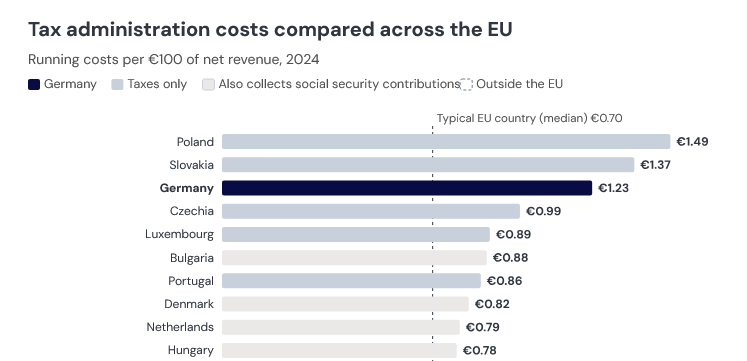
For every €100 in tax collected, the Dutch tax authority spends €0.79 on its own operations. In other words, every euro invested in the agency yields more than €125. That does not make the Netherlands the cheapest in Europe. Malta (€0.19), Estonia (€0.23) and Ireland (€0.33) do it for much less, and the EU median is €0.70. Germany (€1.23) and Poland (€1.49), for example, spend considerably more.
For every €100 in tax collected, the Dutch tax authority spends €0.79 on its own operations.
The Dutch civil service is relatively inexpensive and quite effective in any case, according to OECD research published last month in Binnenlands Bestuur. The Netherlands has 70.9 civil servants per thousand inhabitants. The average for the European Union as a whole is 94 people in government employment. Across the EU, public sector employment accounts for 18.8% of total employment. In the Netherlands, the share is 12.3%.
The recruitment challenge is growing, not shrinking
Meanwhile, staff continue to leave. In 2025, 2,136 full-time equivalents were expected to leave the agency, representing 7.5% of its workforce. Around 34% of those people were over 65. The tax authority has managed to offset departures fairly well recently: in the first half of 2025, it gained 1,615 full-time equivalents, a net increase of 489. That is only possible through continual recruitment, which also costs money.
Cuts that fall mainly on implementation are directly at odds with the desire to deliver more.
The Court of Audit had also previously found that policies are increasingly not being implemented because there are not enough people to do so. It specifically cited the tax authority’s new box 3 levy as an example of legislation that requires a great many additional staff. A savings target that falls mainly on implementation is directly at odds with that need.

A simple calculation
Put the figures side by side and it becomes clear how difficult the message is for the tax authority. On the one hand, there is an annual cut of €438 million; on the other, that is already less than 10% of the SME compliance gap. If the tax authority recovers just 10% less of that gap because of the cuts, the saving will already have evaporated overall. Previous experience has shown that extra inspectors can bring in real money: when oversight was expanded in 2013, it immediately brought in an additional €250 million a year, according to the government, with expected returns of more than €600 million.
Previous experience has already made clear that extra inspectors can bring in real money.
So why not simply do it? The answer lies partly in political choices and partly in the way the government accounts for its finances. According to Eerenberg, an additional debt collection officer or inspector does not pay for themselves ‘for the tax authority’, because budget rules do not allow extra tax revenue to be used for operating costs. An employee who brings in millions therefore appears in the budget only as a cost, whilst the extra revenue goes elsewhere.
Penny wise, pound foolish
The association of senior finance ministry officials warned in 2016, when the tax authority faced a possible reduction from 30,000 to 23,000 employees, that cutting the only department that brings in money was ‘penny wise but pound foolish‘. The staff shortages that followed are still affecting the agency 10 years later.
The staff shortages that arose in 2016 are still haunting the agency 10 years later.
Rode Cijfers also translates the sum into staff numbers. According to the authors, a tax helpline employee on pay scale 6 costs around €59,000 a year. To save €438 million through jobs of that kind, more than 7,000 people would have to be let go. The entire Customer Interaction & Services department employs just 2,133 people, according to the authors. The cuts cannot therefore fall on customer service alone. They will inevitably also affect the tax specialists, inspectors and debt collection officers who bring in the money, precisely the people the campaign launched at the beginning of this year is meant to recruit.
AI as a magic word
The government, for its part, believes it can accommodate the announced cuts by simplifying tax rules and deploying artificial intelligence. State secretary Eric van der Burg (effective government), who is coordinating the government-wide savings target, put it this way: ‘If you can replace some telephone lines with a chatbot, that can save time.’
‘This is not efficiency; this is amputating your leg because you want to lose weight.’
The FNV trade union calls that irresponsible. According to Jasper de Jong, an official at FNV Overheid, the government has failed for years to make the system simpler, and AI is not a credible explanation for hundreds of millions in savings. ‘This is not efficiency; this is amputating your leg because you want to lose weight’, the union says
Eerenberg himself is not entirely optimistic either. Until 2030, the tax authority aims to achieve the cuts through digitalisation, including AI, lower spending on materials and simpler legislation. The plan for the years after that has yet to be drawn up. He acknowledges that ‘there are limits to the savings that can be achieved through efficiency and simplification’, and that other choices will therefore also be needed. The final plans will follow in the 2027 spring budget statement, he writes to the House of Representatives.
The cash register that collects less
According to him, reversing the cuts is not an option: if a cut is scrapped in one place, savings must be made elsewhere to balance the national budget. But that still leaves the question MPs are pressing: what does a feasible plan look like? A tax authority that cannot retain or attract its staff is not a saving, but a cash register that collects less and less.
A promise such as ‘that works for you’ is hard to keep if your job might disappear in a few years’ time.
And of course, it is also a difficult message to send to the labour market, where the tax authority already struggles to find enough suitable, enthusiastic people. A promise such as ‘that works for you’ is hard to keep when a young tax specialist with other options is wondering whether their job will still exist in a few years’ time.
Read also
Related event

Arbeidsmarkttrends 2027-2030
We zijn uitverkocht. Maar goed nieuws! Arbeidsmarkttrends 2027-2030 is volgeboekt. Goed nieuws: op 28 januari 2027 organiseren we een tweede editie, met dezelfde sprekers en hetzelfde programma. Zorg dat je er alsnog bij bent. Bekijk de editie van 28 januari Al jaren geven de beste sprekers en specialisten een arbeidsmarktupdate en een doorkijkje naar de […]
Odido