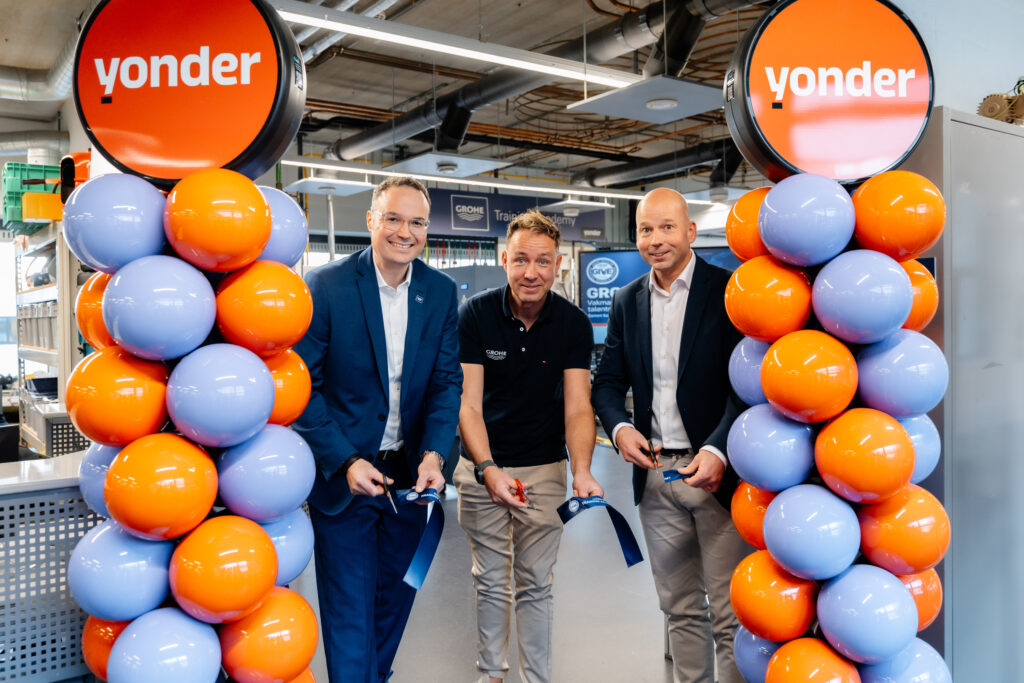
Mayor Fleur Gräper-van Koolwijk made a special visit yesterday for the opening of the GROHE GIVE training programme in Tilburg. Students from vocational education institution Yonder can now make the most of a dedicated practical training workshop. Using equipment including so-called Mini-Rack Workstations, they can learn to work with the latest installation techniques and materials in an environment that closely resembles their likely future workplace.
Here, students can learn to work with the latest materials.
The new workshop is an initiative by bathroom fittings and tap specialist GROHE. The school in Tilburg is the second to launch the programme. At the end of 2025, GROHE also introduced it at Alfa-college in Groningen. There, the first 54 students received their official certificates in June 2026, after which they could start work as installers. Worldwide, the brand now supports more than 70 practical installation training programmes through GIVE (or GROHE Installer Vocational Training and Education).
Learning by doing
For GROHE, it is primarily a matter of necessity, says Northern Europe leader Christian Götter. Without skilled workers, nothing gets built or renovated. ‘Without installers, there are no new bathrooms and no future-proof homes.’ In his view, the way to make a difference is ‘by investing in the people who will be doing the work in the future.’
‘Without installers, there are no new bathrooms and no future-proof homes.’
The figures also show the scale of the problem. At the beginning of this year, there were 74 vacancies for every 1,000 workers in construction, according to the EIB. According to the Bouwkennis annual report 2026/2027, the sector needs around 75,000 more people by 2030, 48,000 of them just to replace those leaving.

Where are the installers?
For installers, the picture is even more stark. Indeed found that the number of vacancies for installation engineers had risen by 80% since 2019, whilst the total number of vacancies across the labour market fell by 10% over the same period. Service engineers (+41%) and electricians (+45%) are also increasingly in demand. At the same time, jobseekers are searching for service engineer jobs 22% less often, widening the gap further.
Whilst the total number of vacancies fell, those for installers rose by 80%.
There is a particular need for specialist skills. In ROVC‘s TechBarometer 2026, for example, 77% of respondents say that developing the knowledge of existing technicians is now just as urgent as recruiting new staff. Anyone looking for a heat pump will also notice the shortage. According to Trustoo, an average of 22% of heat pump installers on its platform had paused new enquiries in the third quarter of 2026 because they were too busy or short of staff. A year earlier, the figure was 13.5%.
Fewer and fewer technical students at school
Meanwhile, the pipeline of new talent is drying up at its source. DUO figures released by Techniek Nederland in August show that the number of hours spent teaching technology in the lower years of secondary education has fallen by 58% in 17 years. Former VVD minister Mark Harbers, chair of the trade association, calls it ‘a development that is heading in precisely the wrong direction’.

He says the energy transition, housebuilding, grid congestion and water scarcity all depend on having enough technically skilled people. ‘The Netherlands is already short of around 30,000 skilled technical workers. Not every child has to become a technician. But every child deserves the chance to discover whether a technical career is right for them.’ Techniek Nederland therefore wants the government to explicitly include technical education in the talent strategy presented earlier this year.
Hoppenbrouwers is doing it too
GROHE is by no means the only company investing heavily in education. More and more employers see the value of training people themselves or contributing to training programmes. One striking example is technical services provider Hoppenbrouwers from Udenhout. The company now has 17 practical training schools of its own, the newest in Middelharnis, and would like one at each of its 40 branches. ‘At Hoppenbrouwers, we believe in developing our own talent and helping people progress from the ground up, and we like to train our own people’, branch manager Cees Kievit said at the opening.

At the heart of this approach is the Hoppenbrouwers Academy, the company’s own training centre. There, electrical and mechanical engineering students on work-based vocational programmes follow an accelerated course: level 2 in one year instead of two, and level 3 in two years instead of three. They begin with three months of basic training, including practical lessons and safety training, and start working on the job after just three weeks. The theory comes to them: teachers from Yonder and Koning Willem I College teach on site at Hoppenbrouwers.
‘Bringing education into our workplace helps teams and practical work connect more quickly.’
‘Bringing education into our workplace helps teams and practical work connect more quickly’, said HR director Ellen Vermeer when the 2025 cohort started. She says anyone with a passion for the trade is welcome, whether they have just left school or choose a technical career later in life.
Also worth mentioning is the initiative at this year’s Intents Festival in Oisterwijk. On the day before the festival, more than 500 secondary school pupils from Brabant attended the technology day, where they could discover the technical work behind such a large event. The initiative was designed to inspire young people to pursue a future in technology.
Aptitude over qualifications
Other installation companies, too, are no longer looking only for people who have already mastered the trade, but also for those who want to learn it. At Kuijpers, recruitment focuses primarily on an aptitude for technology, reports UWV in an overview of solutions to technical skills shortages. It is also possible to join the company through open hiring. The question is no longer whether someone can already do everything, but ‘what can we offer so that this person can still come and work for us?’
‘The question is no longer whether someone can already do everything, but: what can we offer?’
With GIVE, a manufacturer has now joined the effort too. Yonder’s collaboration with both Hoppenbrouwers and GROHE shows where the emphasis lies: on regional partnerships in which schools, employers and suppliers train the installers of tomorrow together. Whether that is enough to solve a shortage of installers on this scale remains to be seen. But the 54 certified students in Groningen at least show that it starts with a well-equipped workshop and skilled professionals to demonstrate the work.
Read also
Related event

Arbeidsmarkttrends 2027-2030
We zijn uitverkocht. Maar goed nieuws! Arbeidsmarkttrends 2027-2030 is volgeboekt. Goed nieuws: op 28 januari 2027 organiseren we een tweede editie, met dezelfde sprekers en hetzelfde programma. Zorg dat je er alsnog bij bent. Bekijk de editie van 28 januari Al jaren geven de beste sprekers en specialisten een arbeidsmarktupdate en een doorkijkje naar de […]
Odido