In the world of Dutch employer branding there are really only 2 true classics. The first is ‘Suitable/Unsuitable‘ from the Ministry of Defence; the second is ‘Suddenly you’ve got it… You become a train conductor‘, the slogan NS used in the late 1990s to recruit, yes, train conductors. It still crops up from time to time in all sorts of guises. In fact, it appears so often that NS event manager Marije Verbeek noticed it too. At one point, she exclaimed: ‘Couldn’t we do something with that? I think it still resonates.’
It happened some time ago during the weekly meeting between the recruitment communications team and the operations team at NS, where all open vacancies are discussed. Among those joining Verbeek was Amber de Kort, recruitment communications specialist and project manager of the NS ambassador programme. She too responded enthusiastically almost immediately. ‘Colleagues still call out the slogan in the corridors from time to time, and it regularly crops up in applicants’ covering letters too. I know it worked back then, so why not now?’
Test first, then create
Even so, NS did not want simply to dust off the classic. When developing a new campaign, the usual first step is to find out what matters to people in the organisation and build an idea around that. This time, the idea was already there. But to see whether it would still work, NS first carried out extensive preliminary research, including panel discussions in which conductors and colleagues from other fields, including engineering, helped explore what a campaign built around the slogan should look like today.
At SteamTalmark, the agency behind the original campaign, which won a Magneet and a Golden Effie among other awards, the request was warmly received. Project manager Stephanie Haesen and copywriter Wouter Schoone were not involved at the time (they were still at primary school), but called the proposal ‘a wonderful compliment’ on behalf of SteamTalmark. It is not often that the client comes up with the idea themselves, they explain.
From experience to skills
The brief to the agency was clear: the slogan could stay, but the campaign certainly could not be the same as it was in 1999. Not even a little. Back then, it focused mainly on experience, humour and a visual trick. ‘There’s much more to being a conductor than just blowing a whistle and closing doors,’ says Schoone. Think of de-escalating situations or staying calm when a passenger falls ill. The creative puzzle: how do you connect those skills to the jobs future conductors are doing now?
‘There’s much more to being a conductor than just blowing a whistle and closing doors.’
The brainstorming session with conductors quickly produced a working title that the team kept in mind throughout: ‘Suddenly you’ve got it, but in 2026 you also have to be able to do it.’ Some of the structure of the earlier videos has been retained: first a close-up of someone in their current job, followed by the moment it becomes clear how that work connects to being a conductor. Whether they work in IT or are a chef. ‘The structure has stayed the same, but the content is completely different,’ says De Kort.
The new campaign videos show that a conductor in 2026 must be able to improvise, adapt quickly, think ahead and make decisions, but also be welcoming and alert, stand their ground, take responsibility and work well with others. Whereas the message in 1999 was that the job is closer than you think, the new version adds that it also demands more of you than you might expect.
More than clipping tickets
Verbeek emphasises that she wants to prevent one misunderstanding. The job has not suddenly changed enormously over the years; it was always more complex than the image of ‘blowing a whistle and closing doors’ suggests. This also emerged from the deep dives with conductors, which revealed that they have been frustrated for years by the image of the ticket clipper. They describe themselves as hosts, improvisers and decision-makers. ‘You’re responsible for the safety of hundreds of people at once.’
‘They describe themselves as psychologists, improvisers and decision-makers.’
According to Verbeek, however, NS has never shown this multifaceted picture quite like this before. Now it has. ‘Campaigns often show the friendly side of the conductor. But it’s so much more than that. We want to make our own people proud by showing what they really do. If they’re happy with how we portray them, we hope to attract the right people too.’
All the video scripts are based on real people and real stories, and were shown to conductors beforehand to check whether the connection to their work rang true. ‘That was a bit of a baptism of fire,’ say the team at SteamTalmark. ‘But they recognised themselves in them straight away.’ It is the second campaign the agency has made for NS this year, following an earlier buddycam campaign for safety and service staff.
Almost everyone is a career changer
The target audience for the new campaign (with its classic twist) is clear: people looking to change. Not change trains, but change careers. Only a handful of conductors come straight from a vocational course in enforcement and security. The rest worked elsewhere first. Anyone seeking to recruit conductors therefore needs to convince people to change careers.
Anyone seeking to recruit conductors needs to convince people to change careers.
A small internal NS study shows just how varied those backgrounds are: from debt relief, banking and mortgage lending to management roles, self-employment and bus driving. The videos therefore feature both office jobs and more playful occupations, as well as young and old, men and women, all mixed together.
A qualification is not required, but candidates need to be able to work and think at Dutch vocational education level 3, as that is the level of the internal training programme. During the application process, the recruiter assesses competencies through interviews using the STAR(R) method, supplemented by an external psychological and medical assessment. It is often the capacity of the training programme, rather than the number of applicants, that is the limiting factor, says De Kort.
It’s OK to have doubts
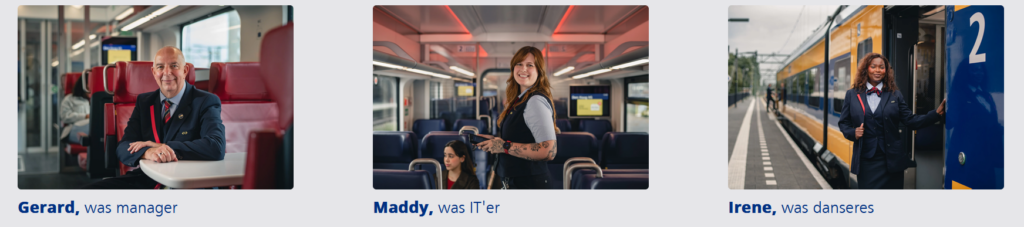
Someone who works at a bank and has a mortgage will not change direction on a whim. Perhaps ‘suddenly you’ve got it’, but even then. ‘It’s a huge step,’ Verbeek acknowledges. That is why, she says, the campaign does not urge people to apply straight away. First comes the landing page, with stories from career changers such as Gerard, who was previously a manager, and former dancer Irene. This is followed by online information sessions, where interested people can speak to conductors who made the switch before them and hear what the training and terms of employment involve. The landing page says it plainly: it’s OK to have doubts.
Managing expectations is at least as important as attracting attention, says De Kort. Throughout the process, NS sees where candidates drop out or leave after starting, often because they had a different idea of the work. ‘We need to address that at the outset,’ she says. ‘We want to avoid attracting people whose expectations don’t match the reality.’ That is why, she says, the landing page is at least as important as the videos.
From YouTube to screens on trains
From 2 November, the videos can be seen on Facebook, Instagram, YouTube and Amazon Prime Video, as well as on screens on trains. The internal reception has certainly been good: the videos are being widely shared among conductors. According to client director Onno Gout, the fact that the line remains in the collective memory after 27 years demonstrates ‘the power of the idea’. He is therefore especially proud that this power is still being discovered more than a quarter of a century later. He says he still sometimes thinks back to when the idea was first conceived. ‘Suddenly you’ve got it…’