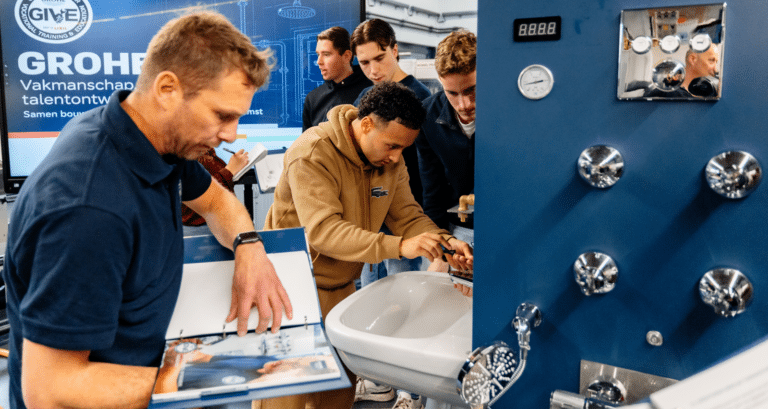
Yes, it may lead to splinters, sticky fingers and perhaps even a blister or bruised thumb. But if we do not want to miss out on the fitters, installers and makers of the future, we need to let children do things again from an early age, argues Kees Jan ’t Mannetje, Business Developer at ABB, the Swedish-Swiss multinational, which has 17 locations in the Benelux and is mainly active in products for electricity transmission and automation. So, he says: ‘Bring practical work back to primary school. Not as nostalgia, but as a strategic response to an acute shortage of practical talent.’
‘Craftsmanship begins with a bruised thumb or a bent nail.’
As long as we educate new generations mainly digitally and theoretically, we perpetuate the structural shortages in practical professions. ‘After all, craftsmanship does not emerge behind a screen; it starts with a bruised thumb or a bent nail,’ says ‘t Mannetje, who himself joined ABB at the age of 19 after completing an MBO course in electrical engineering, and now works, among other things, on smart solutions to make better use of existing grid capacity. ‘Jigsaw work, or engraving letters with a soldering iron, that kind of practical skills activity is no longer found in many schools,’ he observes.
Read this article in full
Become a Werf& member for unlimited access to all articles, research and exclusive insights into the labour market.
No obligations Cancel anytime Secure payment