Many educational institutions have long expressed concern that fewer and fewer employers are offering placements to interns. Their concerns have now been borne out by Indeed: an analysis of vacancies posted on the platform between February 2020 and August 2026 shows a fall of no less than 36% (!) in the number of internship vacancies in the Netherlands since the start of 2023. The longer-term trend is also negative: compared with February 2020, the last month before the coronavirus pandemic, the number of internship vacancies is now 19% lower.
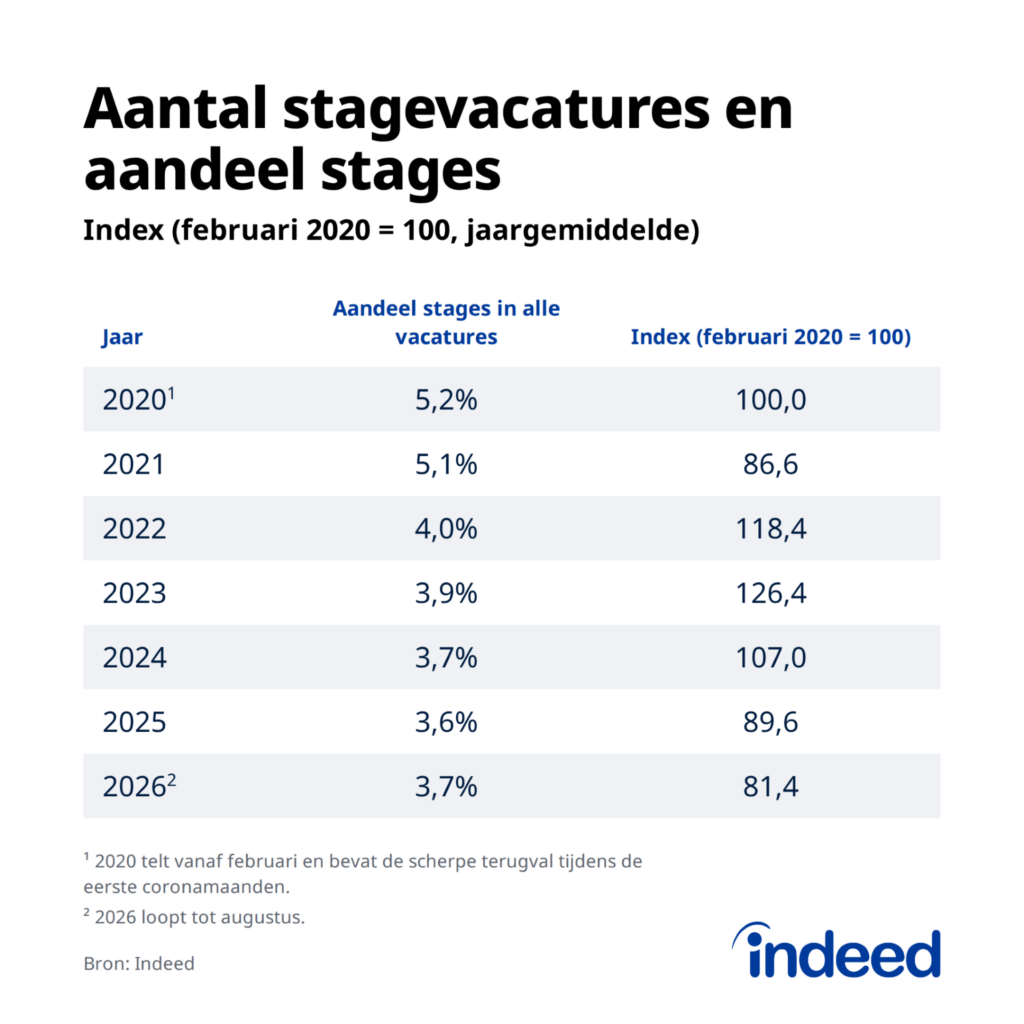
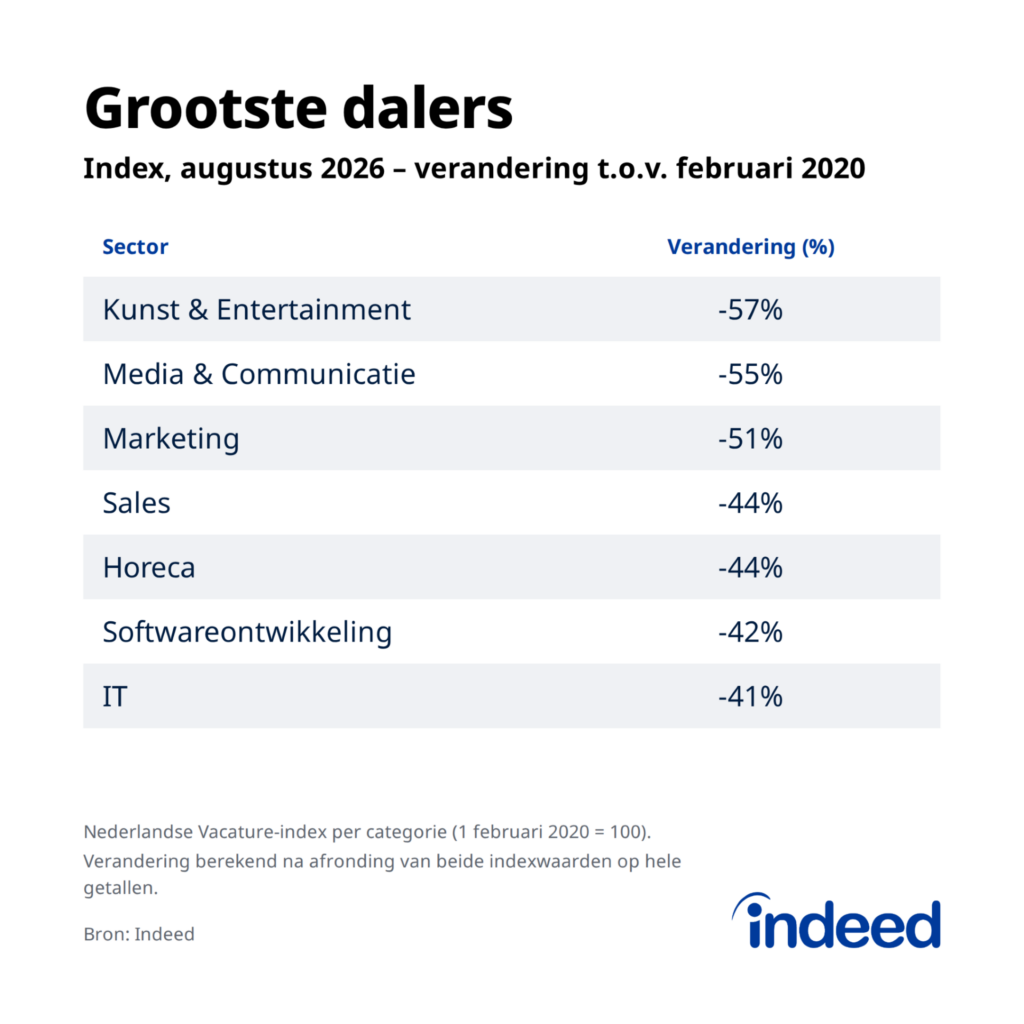
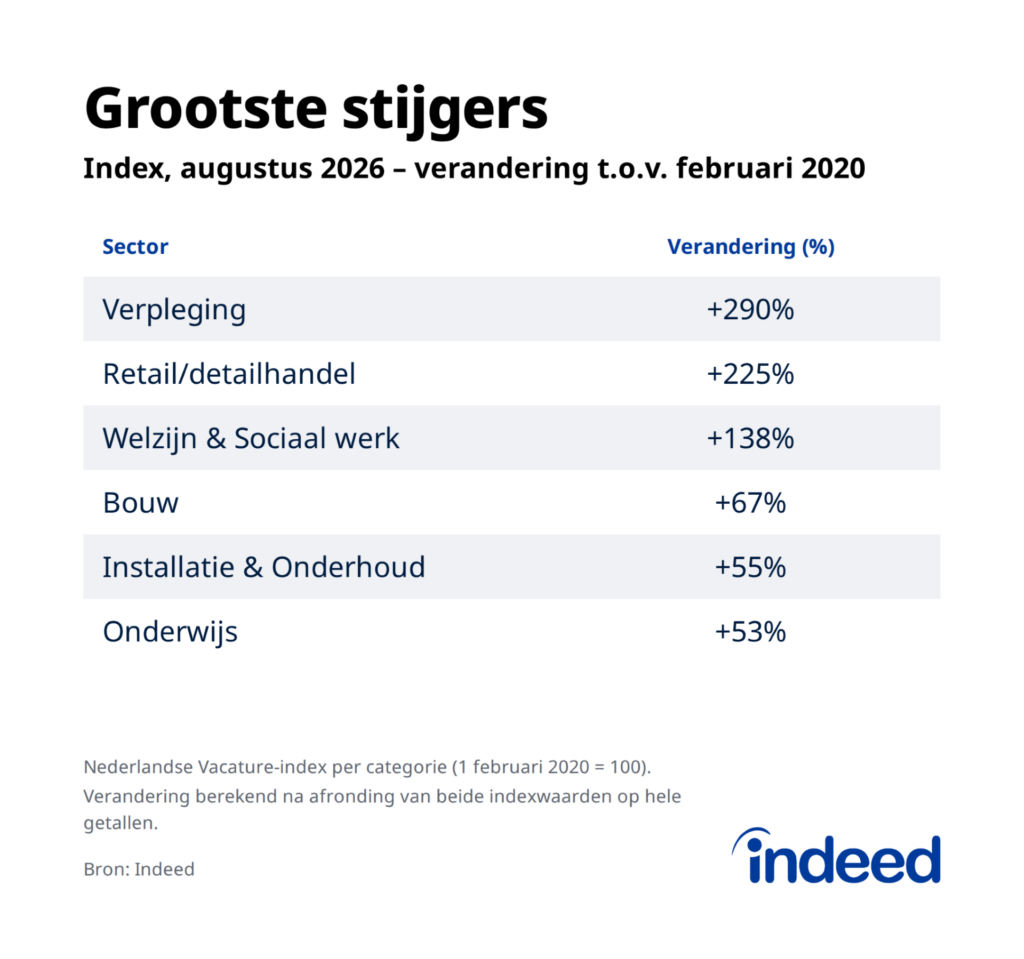
The national average conceals 2 opposing trends. Internships are disappearing ever faster in office-based and creative occupations such as marketing, media and IT, whilst the number on offer is growing in practical occupations with severe staff shortages, such as nursing and construction. Notably, office internship vacancies are not just following the wider market: they are often declining faster than the total number of vacancies.
Marketing relies heavily on interns
In management, the total number of vacancies has grown by 38% since February 2020, whilst the number of internships has fallen by 4%: a difference of more than 40 percentage points. The gap is similarly large in administration (39 percentage points) and IT (36 percentage points). Healthcare and construction saw precisely the opposite effect. In construction, the number of internships grew nearly 70 percentage points faster than the total number of vacancies, whilst in nursing the difference rose to more than 200 percentage points.
Despite the steep decline, the creative sector remains relatively dependent on interns. Internships account for 24% of all marketing vacancies, by far the highest share of any sector. Arts and entertainment (11%) and data & analytics (9%) follow. In nursing, by contrast, the share is minimal (0.6%). Although the absolute number has risen sharply, the relative increase is much smaller because the total number of vacancies is so large.
Healthcare: more placements, but few supervisors
The increase in healthcare internship vacancies does not mean that students can easily secure a placement. According to the Cooperation Organisation for Vocational Education, Training and the Labour Market (SBB), for example, the shortage of placements in secondary vocational education (mbo) has doubled in recent years, with healthcare the most affected sector.
Without a placement, there is no qualification, and without qualified graduates, there is no solution to the staff shortage…
A major cause is the lack of staff available to supervise interns. As a result, some mbo courses are already limiting the intake of new students. This creates a vicious circle: without a placement, there is no qualification, and without qualified graduates, there is no solution to the staff shortage. In June, the House of Representatives therefore asked the government through a motion to work with mbo providers and sectors facing shortages to find ways of creating more placements.
Median: 800 euros
Indeed’s figures also show that the median internship allowance advertised in vacancies is around 800 euros per month, compared with a median salary of 3,638 euros across all vacancies. That is almost 78% less. In many sectors, the allowance is set at 750 euros per month, whether in marketing, sales, management or administration. The legal profession is the exception. Interns there are mainly trainee lawyers: newly qualified legal professionals earning a median of 3,885 euros per month.
An internship is sometimes unpaid learning, sometimes an entry-level job with a different label.
An internship is sometimes an unpaid training placement and sometimes a genuine entry-level job. That can make comparisons difficult. What is clear is that the figures come amid a debate about a legally mandatory internship allowance. On 3 July, education minister Letschert sent an outline of the proposals to the House of Representatives: the intention is that every student undertaking a placement as part of their course will be entitled to an allowance. A placement agreement will also become mandatory in higher professional education (hbo) and university education (wo), as it already is in mbo.
No minimum amount
Short placements and placements abroad are excluded from the scheme. There will be no minimum amount. This is a deliberate choice, according to the minister. Sectors or placement providers can determine the amount themselves, because the government fears that employers would offer fewer placements if a statutory minimum were introduced. The law will, however, allow a minimum to be set later if voluntary sector agreements achieve too little. The bill is expected to go out for online consultation in early 2027.
Collective labour agreements often specify an internship allowance of 400 euros per month.
The proposed law is driven primarily by the position of mbo students. According to Statistics Netherlands, 43% of mbo students received an internship allowance in 2025, barely more than a year earlier (42%). The figure is around 75% in hbo, whilst 65% of wo students undertaking a placement receive an allowance. Provisions in collective labour agreements are becoming more common: from 10% of agreements in 2023 to 24% in 2025. These often specify an amount of 400 euros per month.
Who can still find a placement
This is where Indeed’s figures also touch on the wider public debate. The government sees the risk of losing placements as a reason not to set a minimum amount, but the number of office placements on offer is already shrinking, even without a mandatory allowance. At the same time, the number is growing where staff are needed most, yet supervisors are in short supply there. As a result, whether students can easily find a placement increasingly seems to depend on their chosen field.
‘Supervising an intern takes time and resources, but can bring considerable rewards in the long term.’
That is why Stan Snijders, managing director at Indeed Benelux, is once again urging employers to open their doors wide to interns. ‘Supervising an intern takes time and resources, but that investment can bring considerable rewards in the long term,’ he says. ‘Interns bring a fresh perspective and new knowledge, and employers get the chance to get to know young talent.’
Read also

Indeed
Op Indeed vinden meer mensen een baan dan waar dan ook. Indeed is de nummer 1 vacaturesite (SimilarWeb, totaal aantal bezoeken, juli 2024), niet alleen in ons l…