
When it comes to the impact of AI on the world of work, new studies seem to appear daily. Some are dystopian, others highly optimistic, and many are framed rather heavily around the authors’ own interests. But what happens when you compare a few of these studies? Can you find a common thread (apart from the frequent use of blue in the charts)? First, let’s look at some of the new findings:
#1. AI rewrites jobs more often than it cuts them
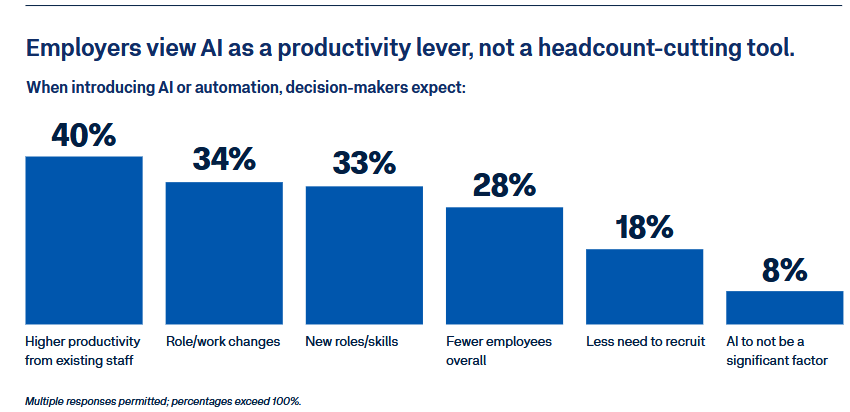
The image of AI as a great destroyer of jobs is inaccurate – at least for now – according to the Global Workforce Report from Workday, based on surveys of more than 6,000 employees and HR data from its own customers. Only 28% of decision-makers surveyed expect to need fewer staff because of AI, whilst 40% primarily expect higher productivity. Roles are changing, however: demand for basic AI skills (such as prompting) peaked in January and then fell by 25%, whilst demand for applied AI skills (building tools and automating workflows) rose by 51% instead.
For recruiters, another figure in the report is at least as relevant: 84% of jobseekers say they already use AI when applying for jobs, and the median number of applicants per filled vacancy rose from 58 to 69 over the past year. Yet time-to-hire remained at around 60 days. So there is more volume, but no more or faster matches. ‘Workers may not be changing jobs, but their jobs are changing around them,’ concludes Workday VP Phil Willburn .
#2. Demand for people is growing, but for different talent
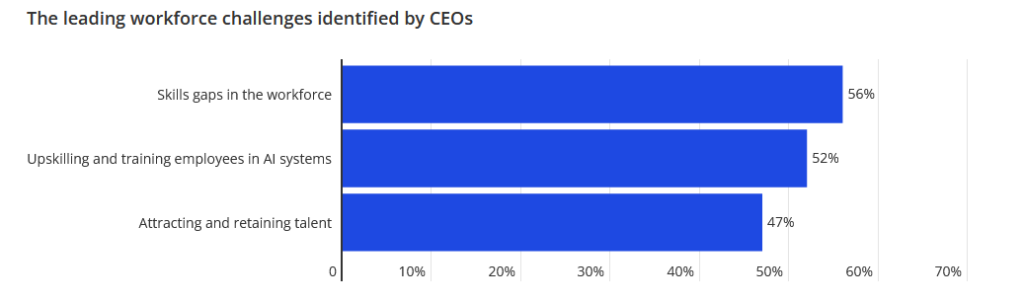
Other research also seems to suggest that AI is not shrinking the workforce (again, for now). For example, 9 out of 10 Dutch CEOs (50 of the 1,400 respondents to the Global CEO Outlook from KPMG) expect their workforce to grow over the next 3 years. At the same time, 58% cite a shortage of knowledge and skills as their biggest workforce challenge, and 84% are reconsidering what they ask of new entrants because of AI.
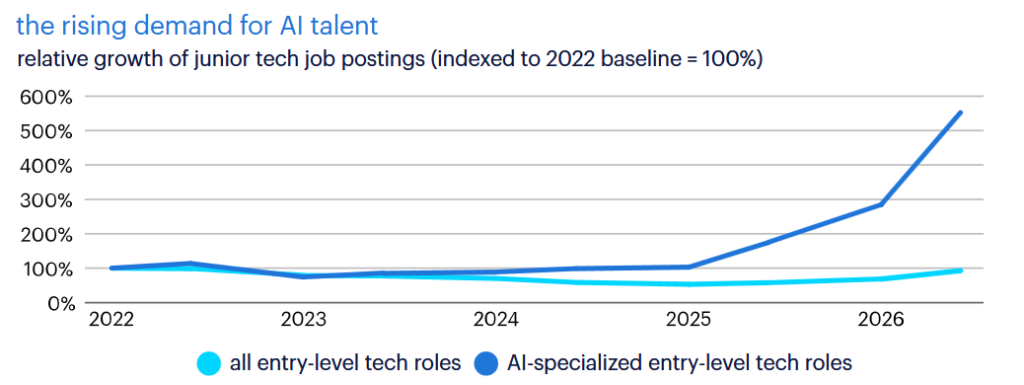
In the report Tech-talent in transition, Randstad sees much the same: 86% of the 1,100 organisations surveyed worldwide want to expand their teams. A bidding war has broken out to attract AI expertise. According to the report, banks pay software engineers an average salary premium of 13% , whilst healthcare and life sciences pay as much as 17%. IT new starters with specific AI competencies earn up to 79% more than their peers without that knowledge, according to Randstad.
#3. Junior work ends up with seniors
This is where the friction begins. According to the STEM Workforce Report 2026 from SThree, based on a survey of more than 4,000 science and technology professionals, 40% of Dutch respondents see senior staff having to do work that used to fall to juniors, because AI is increasingly taking over entry-level tasks. That is considerably more than in the United Kingdom (29%) and the United States (27%), for example.
More than half of Dutch professionals fear growing dependence on AI.
More than half of Dutch professionals (51%) also see a risk that growing dependence on technology such as AI will reduce the intake of junior staff – the group that should eventually succeed today’s senior experts.
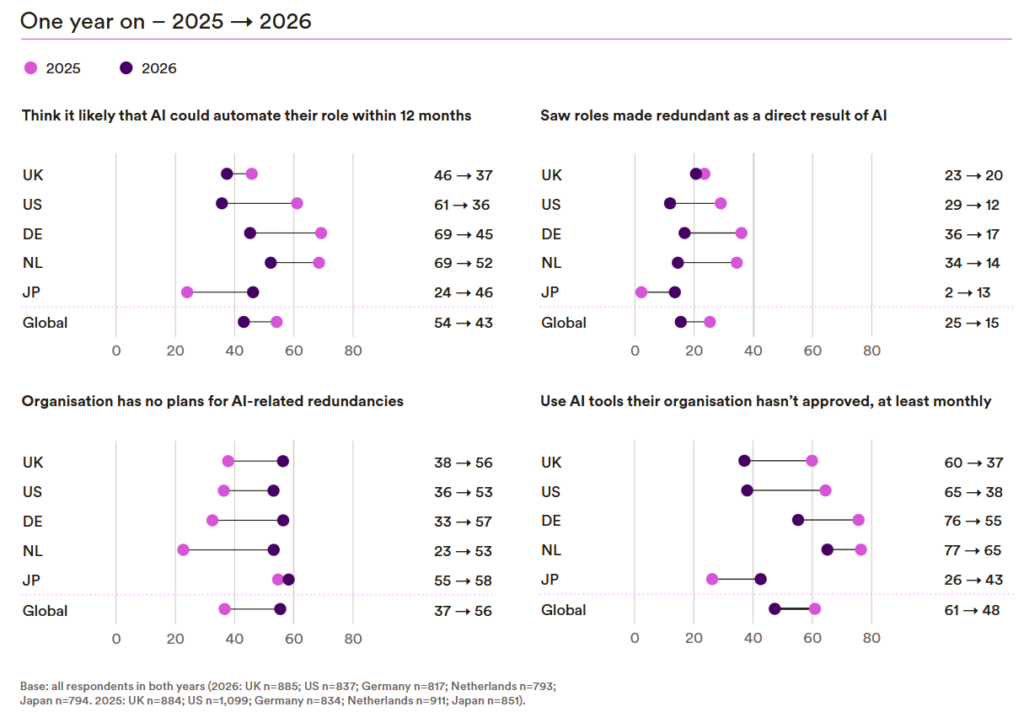
Notably, this study also finds that organisations are not hiring fewer juniors. More report an increase in junior recruitment (42%) than a decrease (12%). The problem lies more in the work those juniors are still given. The work through which they once learned their trade is increasingly going to AI, with seniors left to check it: 52% spend more time checking AI-generated work than they did 2 years ago.
‘When AI takes over junior work, it is not just a task that disappears – a learning opportunity disappears too.’
‘Junior professionals learn their trade by doing precisely this kind of work: it is where they make mistakes, ask questions and build experience under the guidance of senior colleagues. If all that work shifts to AI, checking it shifts to those same seniors, leaving them less time to mentor juniors. When AI takes over junior work, it is not just a task that disappears – a learning opportunity disappears too,’ says Margot van Soest, managing director of SThree Netherlands.
#4. Those who do less themselves learn less
Among software developers, this learning problem is already being keenly felt. A study by Adaptavist of 1,000 developers, 200 of them in the Netherlands, found that 57% of Dutch developers are now concerned about their long-term careers. In addition, 70% fear that juniors are becoming too dependent on AI, and 65% say they are learning less themselves because they write less code. Work is shifting from creating to managing: for 61% , directing AI agents is now part of their daily work.

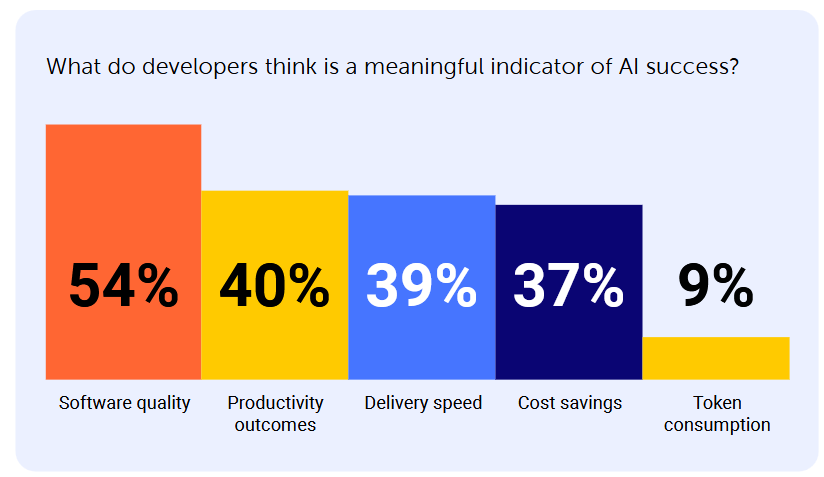
One figure from the international report says a great deal about the current culture. Half (50%) of all developers surveyed say they use AI mainly to show management that they are using it, rather than because they believe it will deliver better results. And 58% say AI use is even becoming a formal KPI, whilst only 22% consider it a meaningful measure.
#5. The early adopters bear the heaviest burden
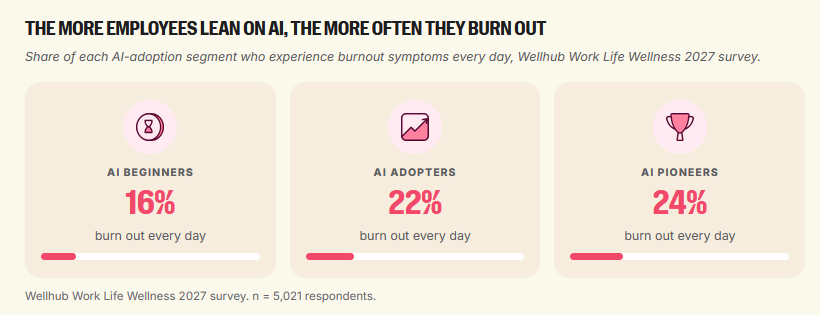
The extra checking that comes with AI also comes at a cost, according to the latest State of Work-Life Wellness study from wellbeing platform Wellhub, which surveyed more than 5,000 employees in 10 countries. It found, for example, that 40% of the most intensive AI users experience a heavier workload, compared with 15% of those who rarely use AI. Among these so-called AI pioneers, 24% even experience symptoms of burnout daily.
The study suggests that the very people organisations need most in their AI transition are at the greatest risk of taking sick leave or leaving: 87% of them would consider leaving an employer that pays too little attention to wellbeing. Clear communication does seem to help. Where AI policy has been clearly communicated, 77% of employees feel able to cope with change. Among those who do not even know whether a policy exists, the figure is just 39%.
#6. Frontline staff have no say
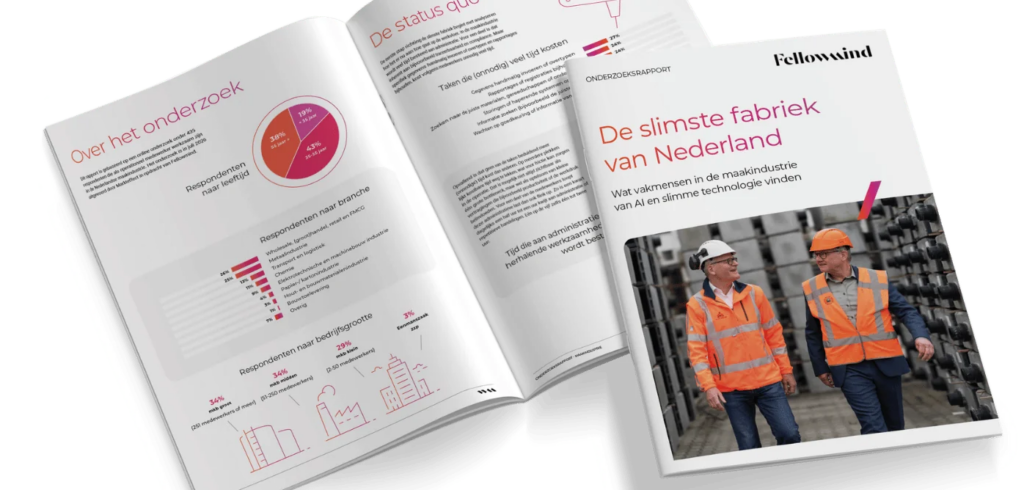
Friction in the workplace is therefore not just down to the technology itself, but also to how it is introduced. In manufacturing, for example, 34% of operational employees see AI as a threat to their professional skills, according to The smartest factory in the Netherlands, a recent report from Fellowmind based on a survey of 435 employees, mostly in operational roles.
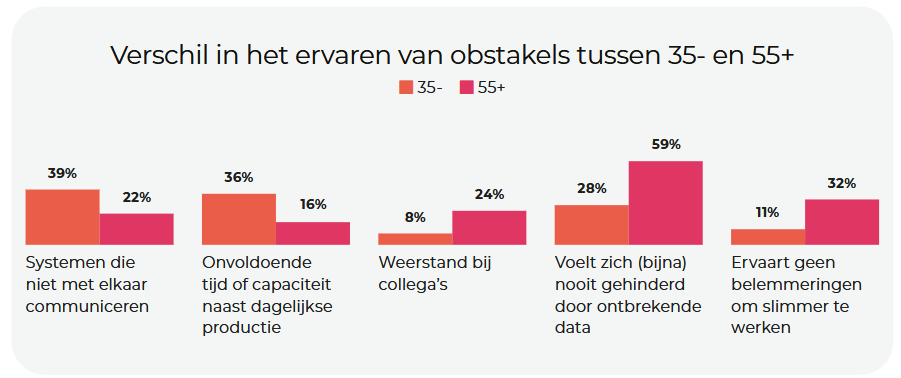
The problem appears to lie primarily in implementation. For example, 58% say frontline staff are not given enough consideration in decisions about digitalisation, 45% receive too little training and only 22% say their organisation actually has an AI policy. Here too, young, intensive users feel the most pressure: 41%, compared with 23% of those aged 55 and over. On the lack of a say, this study echoes Randstad’s findings, in which 31% of Dutch employees said they had no say at all in the introduction of AI into their work.
#7. Employers seek judgement, not AI use
And then there is the study that brings it all more or less together. HR platform HiBob recently asked 1,200 AI decision-makers, 106 of them in the Netherlands, how they see the current situation. It found, for example, that 48% of Dutch employers now factor AI skills into promotions and performance ratings.
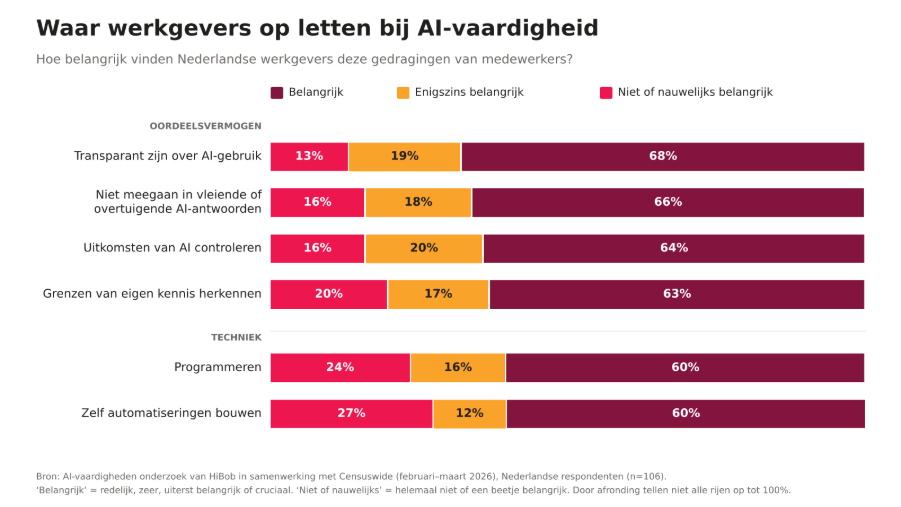
Around 1 in 4 say they attach little importance to programming or building automations themselves. Employers do, however, want employees to be open about their AI use (68%), resist being swayed by flattering AI responses (66%), check the results (64%) and recognise the limits of their own knowledge (63%).
‘Managers are generally not strong behavioural interviewers.’
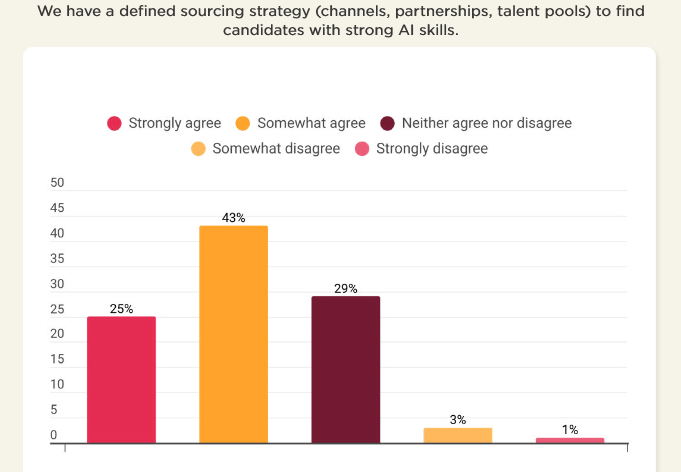
Notably, 69% say managers can reliably assess those skills in performance reviews and appraisals. But only 25% of managers actually probe them in those conversations, and an equally small proportion of employers train their managers to do so. They would be better off providing that training, says Ken Matos of HiBob. ‘Managers are generally not strong behavioural interviewers.’
The common thread: judgement is becoming scarce
Put the 8 studies side by side and a clear common thread emerges. AI is still cutting few jobs, but it is shifting work from doing things yourself to checking and evaluating. That checking falls mainly to the people who already know how to do it and are doing it: seniors and early adopters, who consequently experience heavier workloads. At the same time, the work through which juniors once developed that judgement is disappearing. And it is precisely that ability, not the ability to type a prompt, that employers say they are looking for.
Everyone says they are looking for AI talent, but what they are really looking for is human judgement.
For those considering AI in recruitment, this means that the question is increasingly whether someone can learn quickly enough to solve the next problem. Internal mobility also deserves a second look: according to Workday, internal moves fell at 57% of employers, whilst Randstad found that 49% of employees believe their manager is fixated on their job title. And anyone wanting to assess AI skills should focus on learning to ask questions that reveal judgement. When did you deliberately choose not to use AI? And what error in AI output have you spotted in time?
Read also
Workday
Workday is a leading provider of enterprise cloud applications for finance and human resources, helping customers adapt and thrive in a changing world. Workday…