If vacancies asking for A.I. skills were excluded, measured vacancy growth in the Netherlands over the past year would have been 3.1% rather than 4.4%, according to a new analysis by Intelligence Group. The research also shows that A.I. has long since ceased to be the exclusive preserve of IT specialists (as previous findings also showed). More than 15% of vacancies for marketing staff now ask for A.I. skills, almost as often as vacancies for programmers.
The analysis shows that, in the first 3 quarters of 2026, the total number of vacancies was 4.4% higher than in the same period in 2025. Of that increase, 1.3 percentage points can be attributed mathematically to the rise in vacancies explicitly asking for A.I. skills.
‘Demand for A.I. skills is appearing in occupations where they were rarely requested a few years ago.’
However, this emphatically does not mean that as many as 29% of the additional jobs are thanks to A.I., stresses Geert-Jan Waasdorp, founder of Intelligence Group. ‘Those vacancies might also have arisen without A.I.,’ he says. ‘But the fact remains: employers are asking for people who can work with A.I. in an increasing number of areas. The skill is appearing in occupations and sectors where it was rarely requested a few years ago.’
Marketers almost on a par with programmers
In the third quarter of 2026, for example, 15.1% of vacancies for marketing staff asked for A.I. skills. The figure for programmers was only slightly higher, at 17.3%. A.I. knowledge is also being mentioned explicitly more often in vacancies for legal professionals (6.9%) and financial managers (6.6%). Only 26% of all vacancies asking for A.I. skills are now in IT occupations. In 2022, the figure was 40%. Demand is therefore clearly spreading to non-technical roles too.
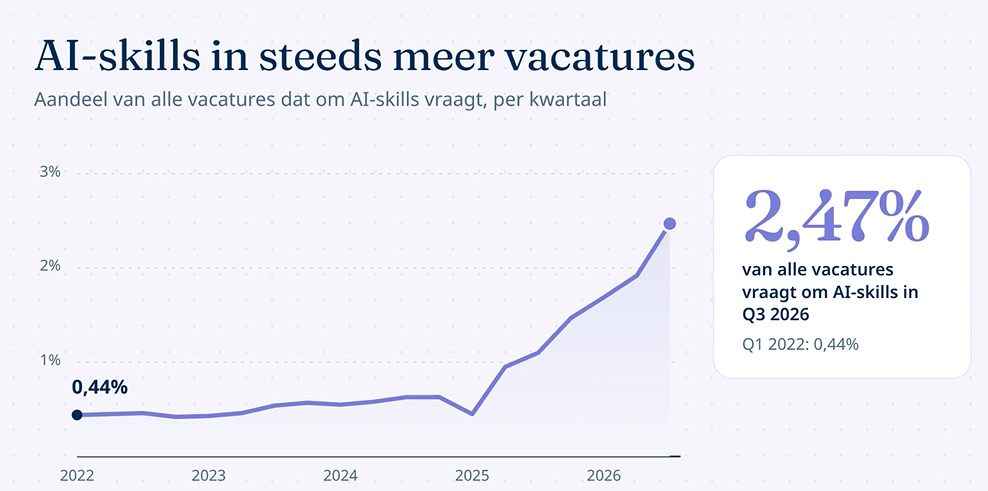
Vacancies in the ICT sector – covering all ICT companies combined – still ask for A.I. skills most often (in 12.8% of vacancies in the first 3 quarters of 2026). But media (7.1%), financial services (6.9%) and business services (5.8%) are emerging as sectors seeking A.I. skills. Since 2022, media has even seen the strongest relative rise in the share of vacancies asking for A.I. skills. Demand is also growing in government, although the overall share there remains substantially lower at 3.1% .
‘This is also changing what employers understand by professional competence.’
‘For employers, A.I. is no longer a matter solely for the IT department,’ says Waasdorp. ‘A marketer, legal professional or financial manager does not need to become a software developer, but they do need to learn which A.I. applications can improve their work. This is also changing what employers understand by professional competence.’
Read also

Intelligence Group
Intelligence Group: empowering recruiters to help them find the right talent Intelligence Group is een internationaal Data & Techbedrijf op het gebied van a…