Bus drivers are already difficult for every transport operator to find. But it is even more difficult when you are also a relatively young transport company, which in 15 years has nevertheless managed to secure 4 concession areas, including the operation of a considerable number of regional and city routes. So, in short: when you have a rapidly growing need for drivers, even without taking an impending wave of retirements into account. And when you also have to do so with a name that will not yet ring a bell for everyone, especially in the areas where you do not have buses running.
Bus drivers are already difficult for every transport operator to find. But EBS faced a few additional challenges.
This, in brief, outlines the major challenge that transport operator EBS has faced in recent years. With a total workforce of around 2,000 drivers at present, there was a need for at least 15% new drivers. How could they be found? Preferably within a short period too, because having buses cancelled due to staff shortages is the last thing you want as a transport operator. And most newly recruited employees first have to complete a training programme before they can actually get behind the wheel.
Pitch
‘The need was so great that at a certain point we held a pitch among a number of agencies specialising in employer branding,’ says Andrea Verdonk, customer and communications manager at the bus company. ‘The assignment was essentially twofold. On the one hand: provide sufficient drivers. But on the other hand: build EBS as an employer brand. So, both a short-term goal and one for the longer term.’
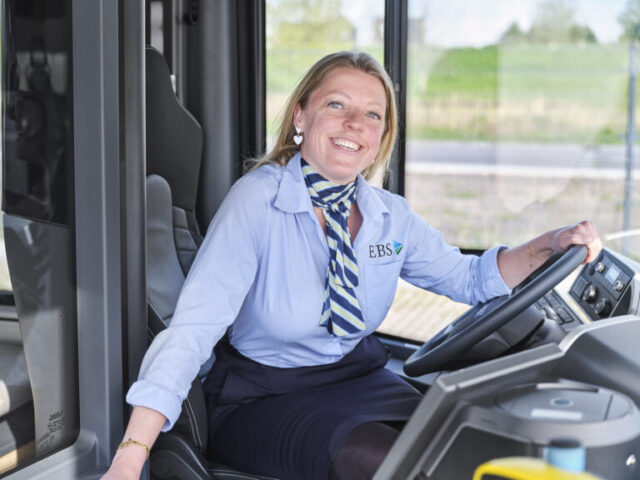
The Eindhoven/Amsterdam-based agency Goals Nonstop Employer Branding emerged as the winner of the pitch. They got to work energetically, recalls Erik Broeder, co-owner of the agency, which has existed for 20 years. And that was necessary too, ‘because direct conversion and market visibility were priorities 1, 2 and 3 for EBS, and perhaps 4 and 5 as well. The recruitment pressure was so great that the focus had to be on immediate recruitment. Whilst naturally wanting to tackle the broader long-term issue at the same time.’
From hospitality to parcel delivery drivers
The solution subsequently came in several forms. For example, 6 very specifically defined target groups were identified: hospitality employees, coach and lorry drivers, parcel delivery drivers, people in construction and the broad target group of parents/carers. ‘These target groups were determined based on EBS’s previous recruitment results, the likelihood that they would be willing to switch and demographic factors,’ says Broeder. ‘We also wanted to think a little out-of-the-box, partly because we did not want to target the staff of other transport operators. We did not want a back-and-forth battle for territory.’
For each target group, Goals devised a ‘practical message to drive conversion’, according to Broeder. ‘We really looked at it from the candidate’s perspective: what could be an incentive to make the switch? We could speak generally about the wonderful profession of being a driver and give a number of examples. But that would not be convincing enough, we felt. So we really had to create a different approach and address people with more relevant messages.’
Hebbus!
Another major boost for the campaign was the discovery of the overarching pay-off Hebbus! ‘We were immediately very pleased with it,’ says Verdonk. ‘I remember well the first time we saw the campaign concept together. It does not happen often, but everyone was immediately enthusiastic. It has an incredibly positive drive and fits perfectly with our core values and how we want to be seen as an organisation.’
‘Our creative team really put in the hours to come up with something good,’ Broeder adds. ‘But ultimately, something good can sometimes lie in something very obvious. It is, of course, a very practically minded target group, what you see is what you get. That message fits them very well. And what was also very important to us: it can be translated for all target groups. Even for target groups we do not yet have in mind. It is also a pleasingly short core message that immediately lands. It could hardly be shorter.’
An average of 1 per day
The assignment was to recruit a total of 365 drivers in 1 year. An average of 1 per day, therefore. ‘And you also have to bear in mind that we need to get them into training on time, because many people joining us do not yet have the qualifications to be a bus driver,’ says Verdonk. But at the time of the interview, the count already stands at 346. So it can already be called a great success, she says. ‘The pressure in the market is high. Which makes it all the more phenomenal that this campaign has converted so well. Across the board and throughout the market, really.’
For Broeder, part of the explanation for the success also lies in its authenticity. ‘We did not use models, but our own employees. As a result, it did not become too much like advertising, and it creates social evidence, social proof, an important asset when it comes to influence and persuasion. Like: “hey, that person has switched. And they think switching was a good choice. Maybe it could be something for me too.” Because they are real employees, it has remained very credible.’ Add to that the success of the internal referral programme, which has been given the euphonious name AmBUSsadeurs, and the success becomes increasingly understandable.
Onboarding optimised
The biggest challenge in developing the campaign? Creating internal support for the need for a campaign, according to Verdonk. ‘But once we were under way, it fortunately became clear fairly quickly that it was bearing fruit. Then, naturally, everything becomes a lot easier.’ Broeder agrees. ‘It was quite new for EBS to work with employer branding on this scale. There is always some hesitation. Fortunately, we noticed quite quickly that the campaign was being very well received. That also gets the management team on board straight away.’
‘It is certainly not the case that the hospitality sector has no vacancies of its own.’
And it also helped that the Recruitment department at EBS ‘considerably optimised the application and onboarding process, which also contributed greatly to the campaign’s success’, according to Verdonk. ‘The necessity was more than clear to everyone,’ Broeder adds. ‘But, of course, you operate in a very competitive market. So you also have to deliver on it. And we targeted groups such as hospitality and construction, which currently also have plenty of opportunities in their own sectors. It is certainly not the case that the hospitality sector has no vacancies of its own. Which makes it all the more pleasing that we have managed to convince people in virtually every target group with our story.’
Read also

Goals
Wie bouwt aan een dreamteam, zorgt dat employer branding niet ophoudt bij de voordeur. Want werving is zinloos als je talent zich niet ontplooit. Of binnen de k…