Can you measure how attractive a particular organisation is as an employer? At first glance, it may seem a rather odd question. But it becomes much less so when you spend every day building attractive employer brands, as Goals Nonstop Employer Branding does. After all, you naturally want to know whether what you are doing makes sense, and whether you are pulling the right levers. To answer that question, the agency entered into a partnership with scientist Eveline van Zeeland, who specialises in marketing & design. She was keen to investigate it further.
Attractive employment appears to consist of 6 pillars.
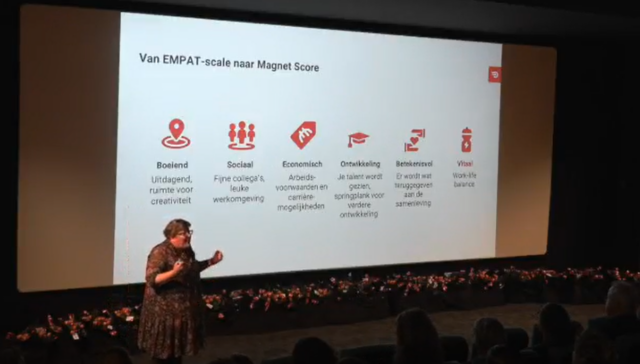
This eventually resulted in the so-called Magnet score, which she spoke about last year at the 20th anniversary celebration of the employer branding agency based in Eindhoven and Amsterdam. This measurement tool builds on Berthon’s so-called EmpAt scale from 2005 and looks at 6 pillars of ‘irresistible employment’:
- Engaging. How inspiring and motivating is the work you offer?
- Development. Do you offer sufficient opportunities for personal and professional development?
- Social. A pleasant working atmosphere and good relationships between colleagues contribute to happiness at work. How well does your organisation align with this?
- Economic. Market-rate and transparent remuneration is a basic requirement. Are you competitive in what you offer?
- Meaningful. Meaningful work that contributes to the wellbeing of customers, patients or society as a whole gives employees deep satisfaction and strengthens their commitment to the organisation.
- Vital. Healthy employees are more productive. What initiatives do you have to support their physical and mental health?

Distinctive strength
Do you really want to distinguish yourself as an attractive employer? Then it is important to know where your distinctive strength lies, according to Van Zeeland. ‘Where are you attractive? And where are you not?’ After all, the areas in which your organisation scores above average are precisely those you can use to attract talent, she says. Of course, you also need to know what your target group considers important. ‘But you can also gain insight into this with the Magnet Score measurement. It then helps you determine your direction: in which area do you want to further strengthen your employer brand in the coming years?’
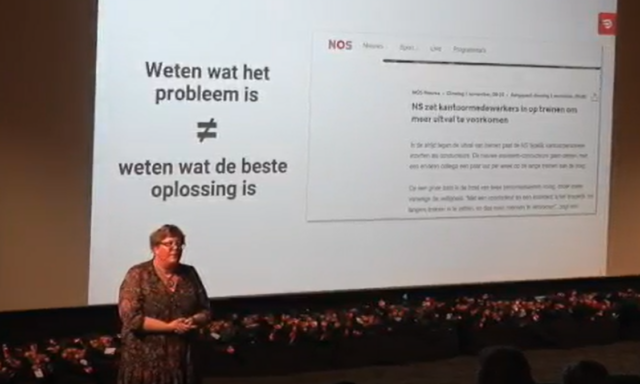
‘Knowing where things are not going well is not the same as knowing where you can improve.’
It is a clear and practical methodology for building a strong employer brand, she explains. But the winner of the PIM Marketing Literature Prize in 2020 and regular columnist for Innovation Origins also has some lessons for employers who want to get started with it. ‘Because if you measure everything, do you also know everything? At the same time, I also believe that if you know exactly how things are, you still do not know exactly how to make them better. For me as a scientist, that is where the difference lies. Where are things going well? Where not? That is not the same as knowing where you can improve.’
A creative brain is needed
She refers to Albert Einstein when explaining that ‘measuring room for improvement does not mean you know how to use that space.’ Sound a little abstract? Consider NS, for instance, which 2 years ago decided to deploy office staff more often when trains were cancelled. ‘This shows that they knew what the problem was. But that does not mean you also know what the best solution is. Solving a problem is different from turning the problem around. You do not so much need an analytical brain for that, but rather a creative one. It is a different kind of mindset, one you can train yourself in.’
‘Do not ask: how does it work? Ask: how could it work?’
To think creatively, 4 things are important, she says. For example: being able to come up with many different ideas very quickly, being able to switch perspectives easily, being out-of-the-box and original, and above all: being able to build on the ideas of others. There are various methods for teaching yourself this. Everyone is creative, she says, but you do need to give yourself the space for it. ‘Yes, solving problems is a skill, but also a mindset. Do not start from: what is the problem?, but ask: what is the solution? Do not ask: how does it work? Ask: how could it work? And then learn by creating.’
Thinking from the solution
It really is a different paradigm, a completely different approach from how we normally tackle problems, she emphasises, precisely because so many people are trained in that more analytical approach. But if you have trained as an engineer, industrial designer or even in medicine, you are already much more inclined to think ‘from the solution’. And you can tackle the challenges in your employer brand in the same way. ‘For example, how could we ensure that your employer brands score extremely highly on vitality? That people come in with energy every day, and leave with energy too? Let us come up with some ideas for that.’
‘It is only at idea 4 that your brain really starts working. That is when the truly creative ideas get going, that is where you want to get to!’
Van Zeeland herself starts every day with the ‘Crazy 8‘, she says, a method for coming up with no fewer than 8 ‘nicely crazy ideas‘ in 8 minutes. ‘Usually, the first 3 solutions come quickly and are relatively predictable. Think of a solar panel for more sustainable living. It is only at idea 4 that your brain really starts working. You have to draw from a different well. Then the truly creative ideas get going, that is where you want to get to!’ And if you cannot immediately think of new ideas, think of things or people who inspire you, and try to build on that. She calls it ‘creative meditation’.
The splits
It is a mental exercise that you really need to train, she says. ‘Compare it with doing the splits. You cannot do that immediately either; you have to work at it if you want to be able to do it: a little further every day.’ Research shows that when you have sketched out 8 ideas in this way, ‘on average, we later consider idea 5 or 6 to be the coolest idea.’ An important insight, she says. ‘Because what usually happens around the management table? A question arises, someone calls out the first idea that comes to mind, and then everyone has an extensive discussion about that idea. Whereas it would be better to take some time to come up with more ideas.’
The first ideas often come from a drawer you can simply pull open, she says. But what if that drawer is empty? ‘That is why I also said: think of things that inspire you. Then you open a new drawer, a drawer containing the truly creative ideas. But they never come out of your head if you have not sketched out the first idea. That is why it is so important to write down or draw the first idea, so that you really create space in your head again for new ideas’, she explains the science behind creative thinking.
Making use of room for improvement
You can go through all the elements of the Magnet score in this way, she says, and look for possible improvements. All based on the idea that, if you know where the room for improvement lies, you still do not know how best to use that space. ‘For that, you need a design mindset, a way of creative thinking based on fluency, flexibility, originality and elaboration.’
‘You do not solve cognitive biases by minimising the biases themselves, but by minimising their impact.’
It is a way of thinking that can be applied to all sorts of aspects of life, she says. Consider, for example, bias in job applications. Preventing it is very difficult. But according to her, you can come up with solutions for preventing its consequences. ‘You do not solve cognitive biases by minimising the biases themselves, but by minimising their impact. Trying to solve cognitive biases is virtually impossible. But you can organise your process in such a way that you learn to circumvent those biases.’ Which, in her view, brings genuinely attractive employment ever closer.
Want to know more?
In the ongoing pursuit of building the most powerful employer brand, Goals has scientifically investigated how it can create even sharper employer brands and Employee Value Propositions based on facts. It also helps determine the ambitions surrounding your employment proposition. Discover more about the 6 pillars of attractive employment that this has produced:
WhitepaperRead more
Related event

Masterclass Employer branding
Neem een voorsprong met een sterk werkgeversmerk. Om nieuw talent binnen te halen én om te verbinden met jouw huidig talent. Ontdek in 1 dag alle ins & outs over employer branding. Van ontwikkelen tot uitbouwen. Duurzame voorsprong creëren op de arbeidsmarkt? In de krapper wordende arbeidsmarkt maakt een sterk werkgeversmerk het verschil. Maar hoe bouw […]
Rotterdam
Goals
Wie bouwt aan een dreamteam, zorgt dat employer branding niet ophoudt bij de voordeur. Want werving is zinloos als je talent zich niet ontplooit. Of binnen de k…