
In 8 experiments, researchers recently asked more than 1,700 full-time managers from the US and the UK to assess an employee. Some did so in a simulated online reference check for a potential new employer, whilst the others did so only for their own records. What did they find? In the reference check, the employees concerned scored higher on overall performance and on so-called organisational citizenship behaviour: work that goes beyond the job description. Managers also reported less problem behaviour.
Managers report less problem behaviour in a reference than in an internal assessment.
The difference between an assessment for a new job and a general assessment is 0.3 to 0.4 points on a 5-point scale. That may seem modest, but according to researcher Kathryn Jacobson, ‘even small differences can influence hiring decisions’, especially when candidates are closely matched. What makes it particularly worrying is that the effect occurred even when nothing was at stake. This suggests it happens automatically and may be even stronger in real recruitment processes.
A helping hand?
The obvious explanation is that managers want to give their people a helping hand as they take a new career step. But according to Kathryn and Ryan Jacobson, who collaborated on the research with Carl-Johan Holmberg of Refapp, a Swedish provider of online reference checks, something else is probably at play. They call it vicarious self-promotion: promoting oneself through another person. Managers see their employee’s success as evidence of their own leadership, and are therefore more complimentary externally than internally.
‘A glowing reference also reflects well on the manager.’
One reason they draw this conclusion is that managers who were highly invested in their employees’ careers did not give them higher scores. It also aligns with what the managers themselves reported. During reference checks, they were more concerned about how they came across, particularly whether they appeared competent. The effect was strongest among managers who felt closely connected to their team.
One question makes the difference
The good news is that, according to the researchers, the effect is relatively easy to correct. In the final experiment, they asked some managers first to consider what the hiring manager reading the reference would want to know, including any potential concerns. As a result, their average performance rating fell from 4.34 to 3.95, and they were more candid about problem behaviour. Managers who were instead asked to put themselves in the candidate’s shoes did not change their scores.
The good news is that, according to the researchers, the effect is relatively easy to correct.
The researchers therefore recommend that recruiters routinely add such a short question to written reference forms. It costs little and requires no training. They also suggest that managers who want to give an honest reference should separate their employee’s performance from their own ability as a leader. According to the researchers, the same mechanism may also play a part in annual appraisals.
A weak predictor
The fact that references are often positive in practice is not news in itself. However, selection psychology has traditionally explained why referees often give more favourable assessments than performance warrants mainly by pointing to the fact that candidates usually choose their own referees. The Jacobsons’ research now adds a second explanation: the referee’s own self-interest.
Australian researcher Timothy Bednall had already set out the objections to reference checks in 2024 in a summary. Referees often give very different assessments of the same candidate, he noted, and almost every applicant can find a former colleague willing to speak positively about them. There is also a question of equal opportunity: people from higher socio-economic backgrounds are more likely to be able to put forward senior referees.
Letters of recommendation for women are more likely to contain reservations and lukewarm praise.
And letters of recommendation for women are more likely to contain reservations and lukewarm praise, which can lead to harsher judgements. With a structured questionnaire, that gender bias disappears. Bednall does not believe reference checks need to be abandoned altogether, however. He argues that they should be more structured and used as a final step, alongside better-supported methods such as structured interviews and work samples.
A case for stopping
Job application expert Aaltje Vincent goes a step further. In a recent blog post she calls on employers to stop requesting references altogether. In her view, how someone performed at their previous employer says nothing about how they will perform at their next one. ‘We are all different people in different circumstances,’ she writes.
‘References provide a sense of certainty that means nothing.’
She uses herself as an example. At 2 large corporate organisations, she was out within a year because it was not a good match. After her third job, she chose a start-up, where she flourished. ‘If my fourth employer had made enquiries with those 3 previous employers, I would definitely have been rejected.’
According to Vincent, performance depends on far more than the size of a company. Consider a boss who micromanages everything or, by contrast, a good leader, as well as financial pressure and rapport with colleagues. She refers to research by Harvard professor Boris Groysberg: success depends to a considerable extent on the environment in which someone works.
Even the day on which a referee is called can colour the picture.
Even the day on which a referee is called can colour the picture. Vincent therefore believes that references offer little more than a false sense of certainty. Nevertheless, she advises jobseekers in her outplacement programmes to have their referees ready, as many employers still ask for them. The Jacobsons’ research also supports her view in an unexpected way: the referee also plays a part.
Backdoor and fake references
Other recent research shows that both parties manipulate the system. CV platform Zety surveyed more than 1,000 American workers. Of those, 37% said a potential employer had contacted a former manager or colleague who had not been listed as a referee. Zety career expert Jasmine Escalera describes such backdoor references as a wild card in the process: candidates have no control over who is called and often do not even know the conversation took place.
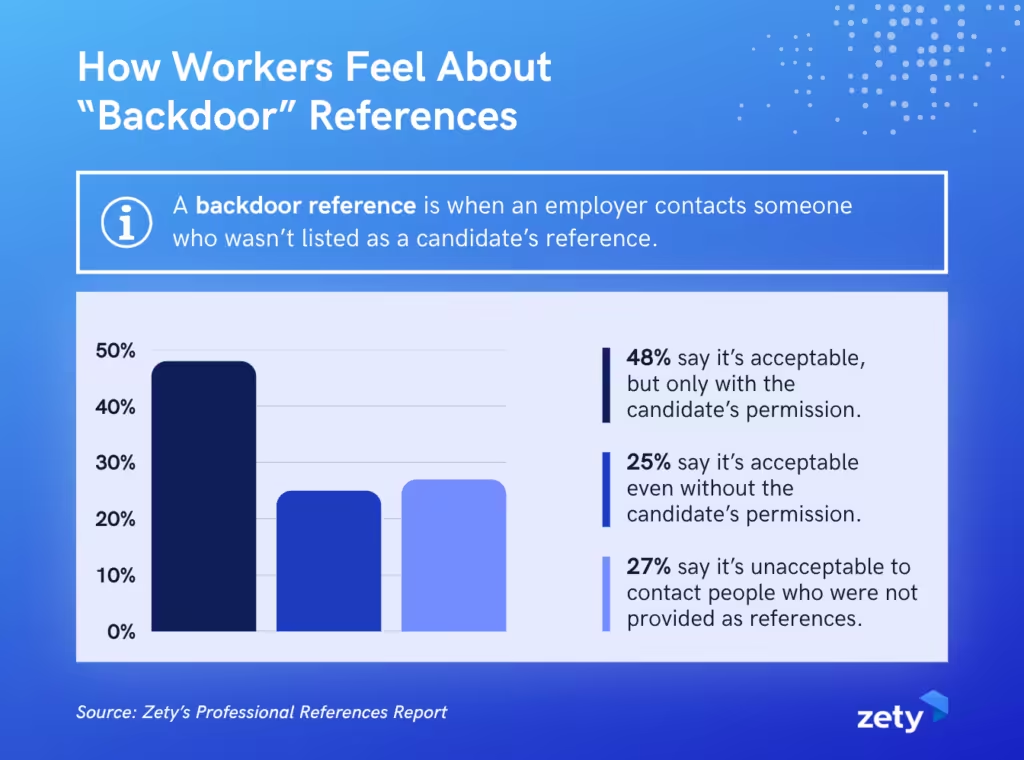
Candidates play the game too. Of those surveyed, 39% deliberately chose referees who would speak positively about them, 11% left out a former manager for fear of a negative reference, and roughly 1 in 10 had at some point asked a friend or family member to pose as a former colleague or manager. Referees are not foolproof either: 52% had been asked to recommend someone they did not support, and 22% nevertheless gave a positive reference. It is therefore no surprise that 42% of respondents believe references should have little or no influence on the final decision.
Fraud makes reference checks relevant again
At the same time, there is a countervailing trend. As candidates use AI to polish their CVs and sometimes apply under a false identity, the need for verification is growing. For its report The Hiring Hoax 2026 (image above), screening company Checkr surveyed 3,000 American managers who had been involved in recruitment over the previous year. Of those, 40% had spoken to a candidate who was later found to be using a false identity, compared with 31% a year earlier.
There is also a countervailing trend, driven by fears of fraud.
In that context, the reference check takes on a different role. Not so much as a predictor of performance, but rather as a check on whether someone is who they say they are and has done what they claim. Of course, the referees themselves must also be real, and the check must be more than a courtesy call. Anyone who uses a reference merely to confirm a decision already made can mainly expect a compliment in return. For the candidate, but at least as much for their former boss, as we now know.