It is painful to see. And it also seems to be happening quite quickly. There have already been reports about the falling number of vacancies for people entering the labour market, but new figures from Intelligence Group seem only to confirm that trend. Two years ago, nearly 23% of all vacancies for university graduates were open to people with less than 2 years’ work experience; now, that figure is just over 18%.
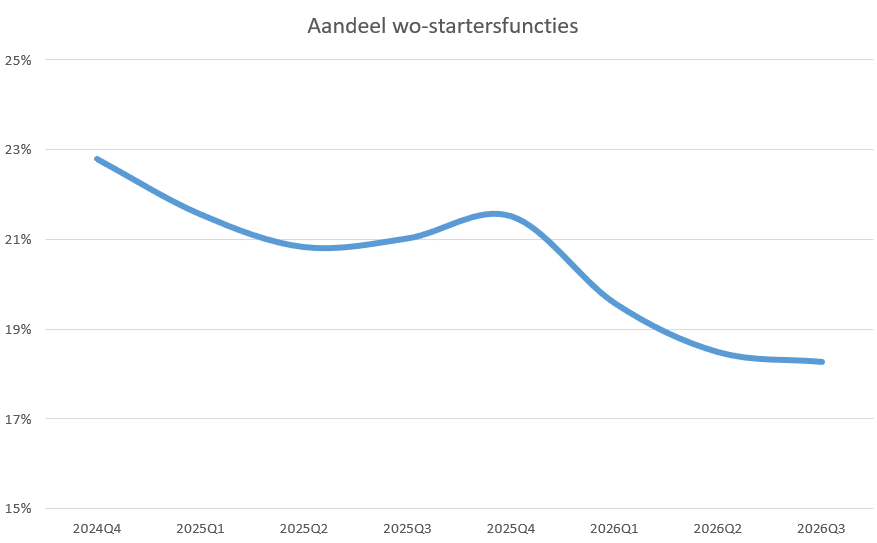
The number of vacancies specifically aimed at university graduates has also been falling for several quarters, although the trend is somewhat less clear here: at the end of last year and the beginning of this year, vacancies specifically requiring a university degree accounted for a larger share of all vacancies than ever before.
| Share | 2024Q4 | 2025Q1 | 2025Q2 | 2025Q3 | 2025Q4 | 2026Q1 | 2026Q2 | 2026Q3 |
| University degree / Dutch total | 10.4% | 12.0% | 11.9% | 10.8% | 13.6% | 13.2% | 10.6% | 9.6% |
| Entry-level / university degree | 22.8% | 21.6% | 20.8% | 21.0% | 21.5% | 19.6% | 18.5% | 18.3% |
| Internships / university degree | 6.4% | 4.4% | 5.5% | 4.7% | 5.6% | 3.9% | 5.1% | 4.2% |
| Traineeships / university degree | 2.3% | 2.2% | 2.3% | 2.5% | 2.1% | 2.2% | 2.4% | 2.1% |
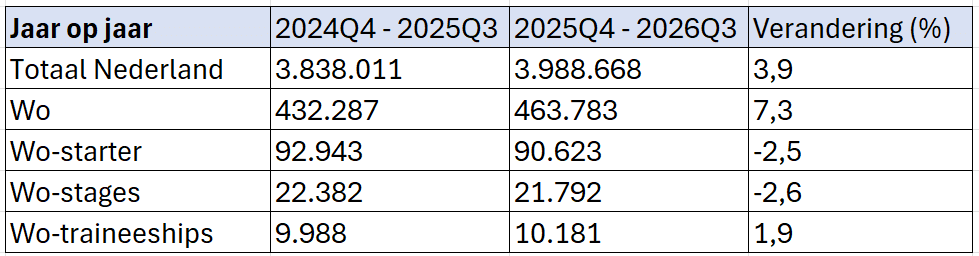
It is clear, however, that whilst the number of traineeships for university graduates seems to be remaining reasonably constant, the same cannot be said for the number of internships available to university students: the number of potential placements appears to be falling in line with overall demand for people entering the labour market. This also contrasts sharply with the total number of vacancies for university graduates, which has accounted for an increasingly large share of the overall labour market in recent years.
More opportunities in healthcare and education
Whilst the share of vacancies for recent university graduates is still growing in sectors such as healthcare, education, culture, and research and science, there has been a sharp decline in areas such as accountancy and finance, policy roles, the legal sector and quality management. HRM has not been spared either: the number of vacancies for people with less than 2 years’ work experience fell by nearly 10% last year.

All 12 sectors offering the most entry-level positions saw a decline last year, with IT consultancy (-20.5%) and ‘other activities of head offices’ (-32%) standing out.
Is AI to blame?
The key question behind this decline is, of course: is AI to blame? Or is it more a case of general caution and the calm before a looming economic storm? It is difficult to say on the basis of the figures. What the research does show is that working university graduates estimate the amount of work currently replaceable by AI to be higher than the Dutch average, with graduates under 30 estimating it to be higher still.
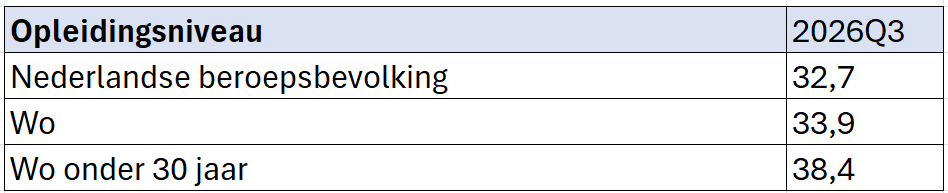
Notably, people in occupations focused on helping others, such as healthcare and education, are least concerned that AI could take over their work, whilst those in procurement and marketing see the greatest chance of their current work being replaced. Also notable: the fields with the largest decline in vacancies rank in the middle when it comes to the extent to which employees believe AI could already replace their work. This suggests that AI may be a factor in the decline in vacancies in these fields, but certainly not the only one.

Another change is that university graduates used to be slightly less concerned than the average Dutch worker about their jobs being replaced in the long term. This has changed, however: since mid-2026, graduates have been more concerned than average, according to the latest figures. This is particularly true of young graduates, who are experiencing the falling demand for labour market entrants first-hand.