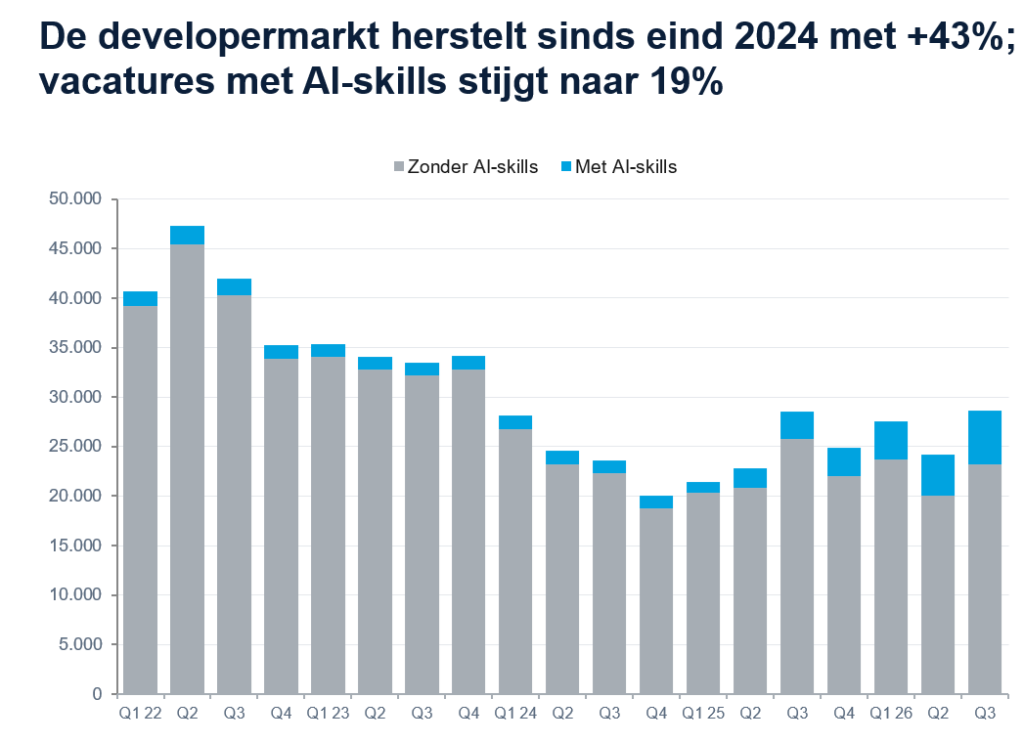
As a software developer in the Netherlands, you have probably worried about your future at some point in recent years, hearing all the stories about what AI can do and how it could threaten your job. But the world seems to have changed again: after an initial decline, the number of developer vacancies is rising sharply once more, according to an analysis by Intelligence Group: this year, the number was around 3% higher than a year earlier.
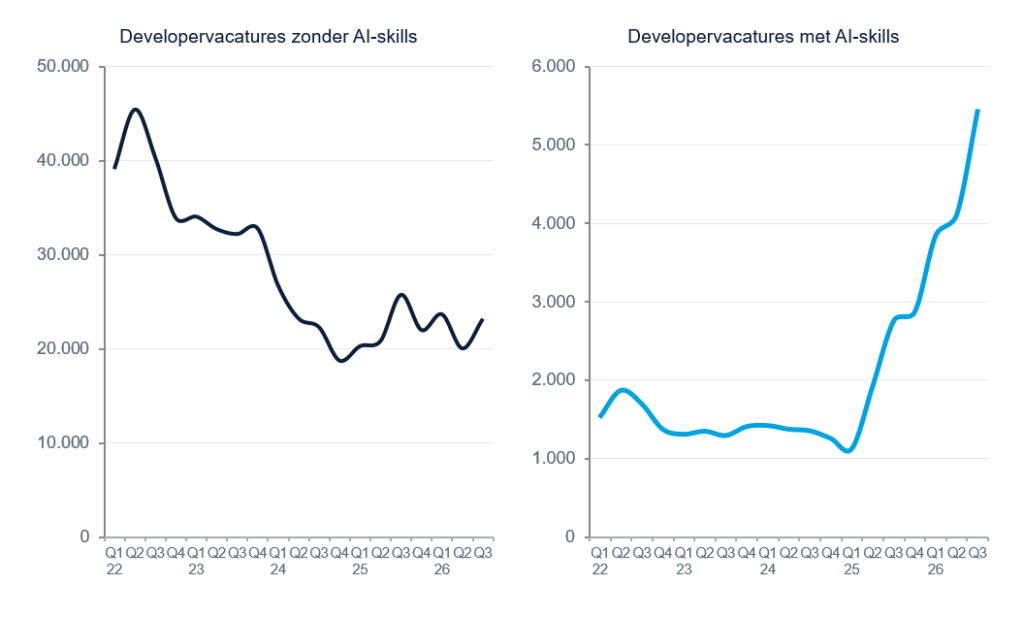
Strikingly, the growth comes entirely from vacancies that explicitly require AI skills.
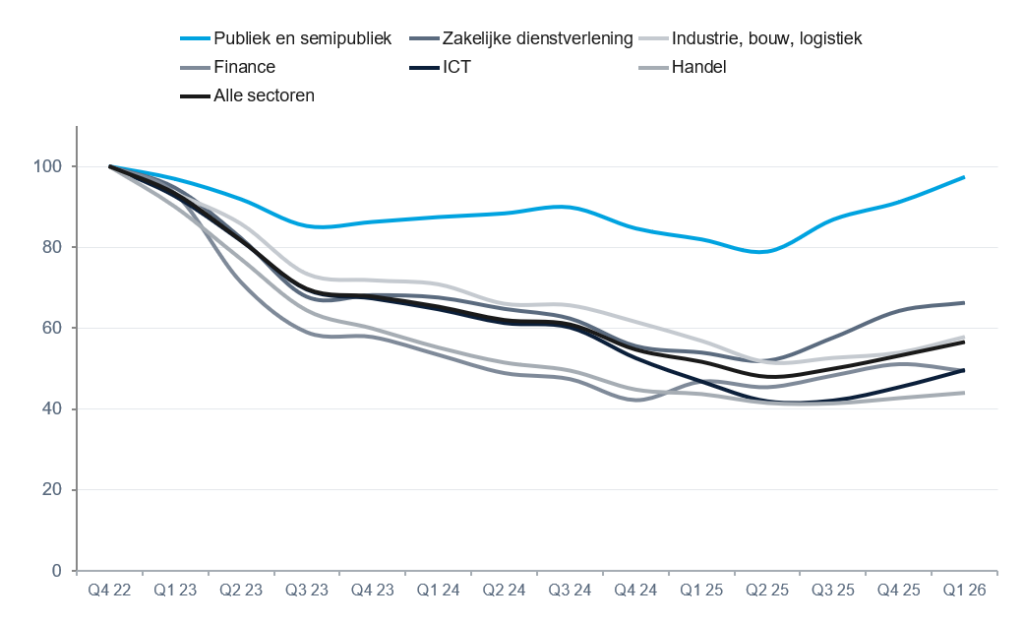
One striking detail in the figures is that the growth came entirely from vacancies in which employers explicitly require AI skills. The number of developer vacancies with no AI requirement actually fell. Meanwhile, 70% of demand for developers now comes from outside the ICT sector, compared with 65% in 2022. The public sector is chiefly responsible: government accounts for 5.0% of demand for developers this year, whereas in 2022 it accounted for ‘only’ 2.7% of developer vacancies.
Climbing out of the trough
At the end of 2024, demand for developers reached a low of around 20,000 vacancies per quarter. By the third quarter of 2026, that figure had risen to nearly 29,000: a recovery of 43%. Even so, the number remains around 40% below its peak in the second quarter of 2022. The market is picking up, but the previous level of demand for developers has not simply returned.
‘When ChatGPT broke through, the expectation was that AI would take over a large share of programming work,’ says Geert-Jan Waasdorp, founder of Intelligence Group. ‘The expectation was that fewer developers would be needed as a result. But we are now seeing a different trend: AI makes it easier to produce code, but that code still needs to be reviewed, tested and integrated. And that requires developers. Developers are not disappearing; their work is changing.’
‘Developers are not disappearing; their work is changing.’
The employers looking for developers are changing too: it is becoming less and less a job performed exclusively at ICT companies. ‘More and more organisations are building and maintaining their own digital applications. Software development has long since ceased to be something that happens only within an IT company,’ says Waasdorp. ‘For developers, that offers new career opportunities. For employers, it means they are competing for the same technical professionals, even if they do not see themselves as tech companies at all.’
More and more AI jobs
What is clearly changing is the role AI plays in many jobs . The number of vacancies requiring AI skills has increased fivefold (!) over the past 4 years, with growth accelerating further since mid-2025. For example, at the end of 2024, fewer than 4% of all ICT vacancies required knowledge of AI; that figure has now risen to more than 14%. Demand for AI skills is also increasing significantly in other sectors, particularly in the media and in finance roles.
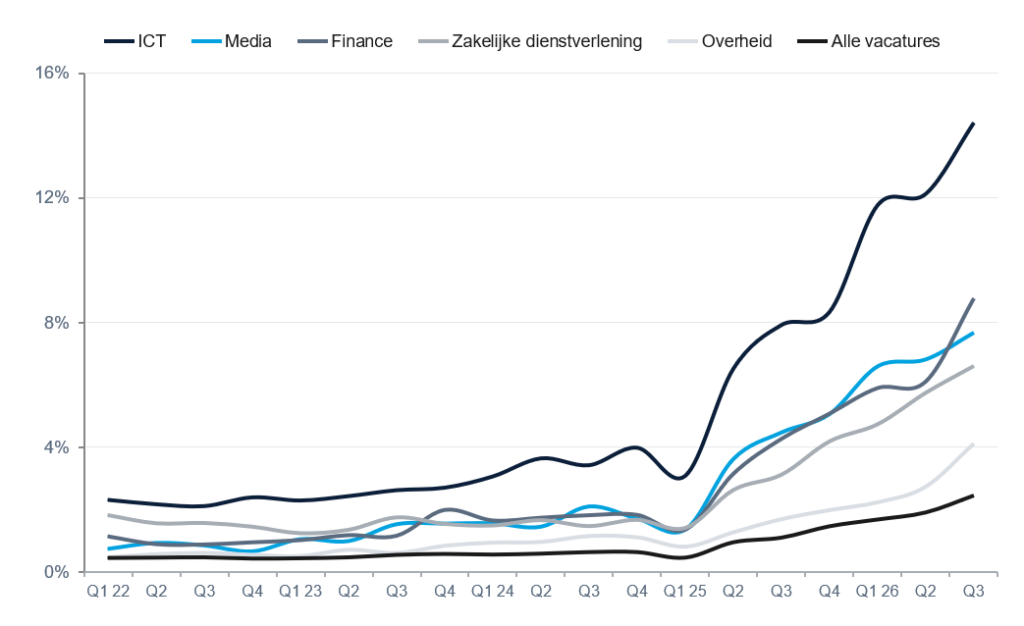
The researchers have identified 2 simultaneous developments: employers are increasingly looking for developers with explicit AI skills, and demand is coming from a broader range of industries. ‘The market for developers is not simply recovering. It is reinventing itself,’ says Waasdorp.
‘The market is not simply recovering. It is reinventing itself.’
‘AI is changing what employers ask and expect of developers, whilst more and more organisations want to build up their own technological expertise. As a result, competition for developers will be less confined to IT companies than before. Government bodies, financial institutions and other organisations will also become more active in this labour market.’
AI accounts for all growth
Strikingly, all growth in developer vacancies comes from roles that specifically require AI skills. The number of vacancies without such a requirement is actually falling. The same is true of demand for programmers, consultants and accountants, for example. The opposite is true for roles such as head of IT and HR staff: here, vacancies requiring AI skills account for less than half of the growth in demand.
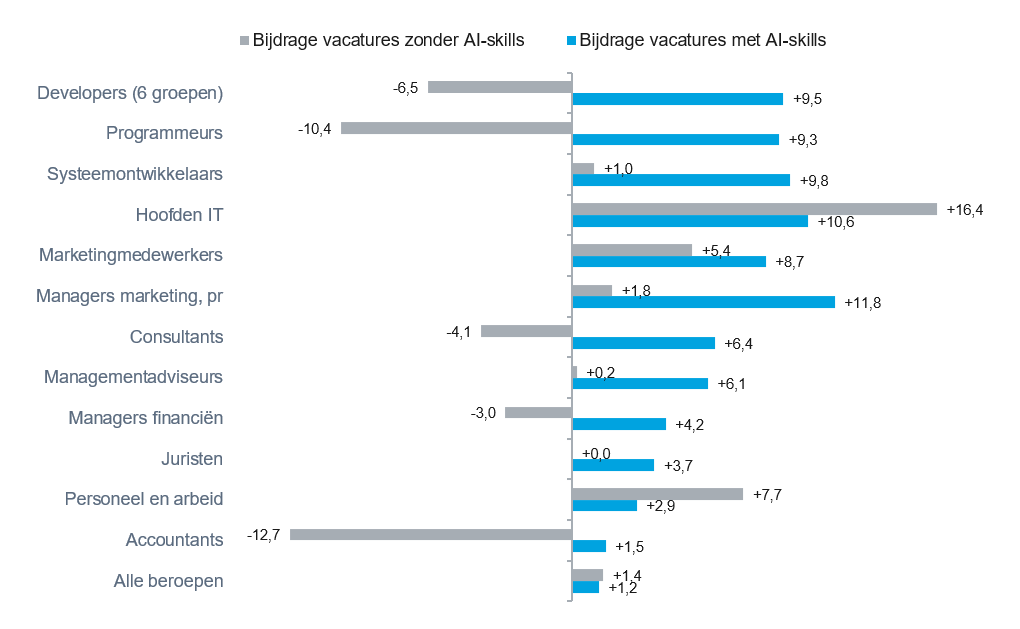
It is also striking that demand for AI knowledge and experience is rising in every industry identified by Intelligence Group. But the contribution of vacancies mentioning AI skills is greater than that of vacancies without such a mention in only 2 industries: the ICT sector and recruitment.
In recruitment, only a handful of vacancies require AI skills.
Only 0.8% (!) of all vacancies in the latter sector specifically require AI knowledge (compared with an average of 2.8% across all other industries), but in relative terms this figure is rising faster in the sector than the number of vacancies that do not mention a need for AI knowledge.
Read also
Related event

Intelligence Group – Eindejaarsactie 2026
Weet waar je doelgroep zit en wat ze willen Krijg 15 doelgroepanalyses in Giant en betaal er slechts 10. Alleen van 1 november tot en met 15 december 2026. Deze actie is maar 100 keer beschikbaar, dus wacht niet te lang.