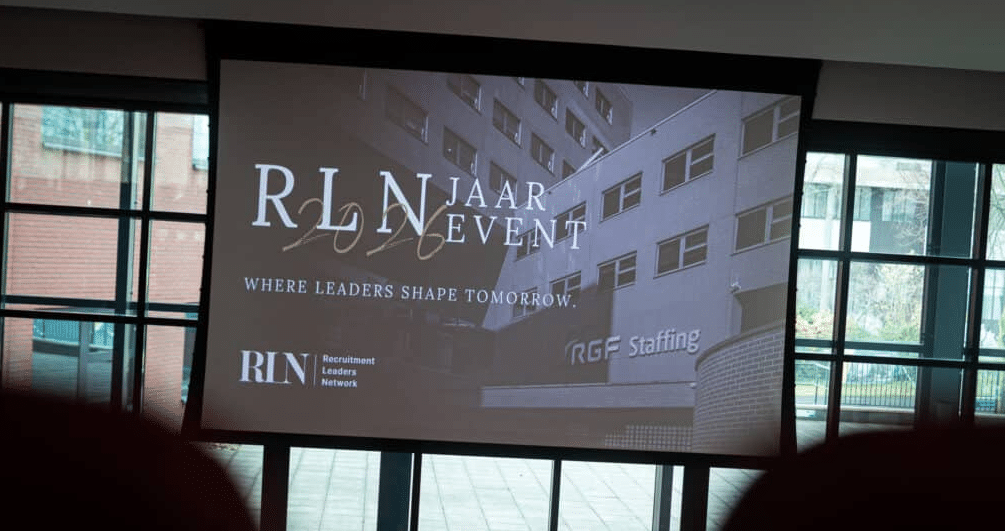
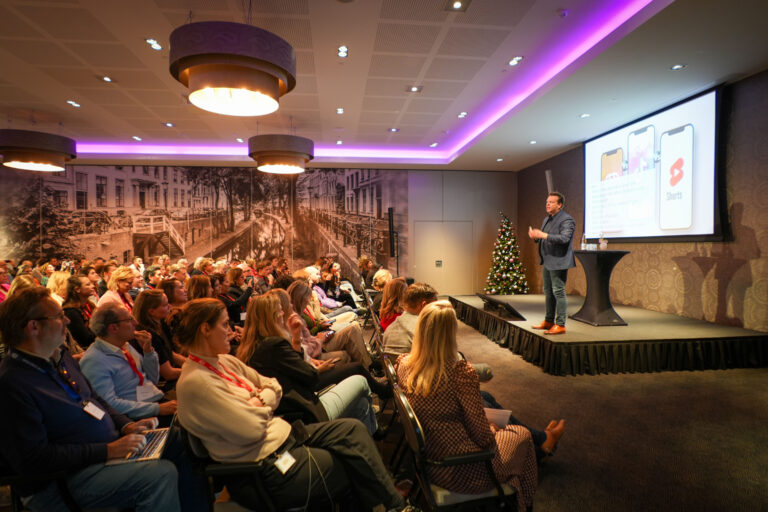
The theme of yesterday’s annual event of the Recruitment Leaders Network was, inevitably, AI and its impact on recruitment strategy for 2027. But as the presentations progressed, it became clear that next year will really be about something quite different: the age-old question of what talent actually is. What is the role of recruitment as the organisation’s front door? And where does that role end? An overview, in photos and insights.

After chair Bjorn Luijters (Ahold Delhaize) skilfully kicked off the programme, RGF Staffing Netherlands CEO Maximilian Krijgsman was the first to speak. After all, the event was being hosted at ‘his’ office in Almere. He immediately talked about the sleepless nights the day’s subject had caused him. How does a fairly large organisation remain relevant in 10 or 20 years’ time if AI handles ever larger parts of the process better and, above all, faster?

‘The most important lesson: it will never again be a one size fits all approach at the front door.’
To reassure himself, he shared 3 studies. One was American research from earlier this year showing that 2 in 3 adult jobseekers would not apply if AI handled more than half of the application process. There is, however, a big difference between generations. Among Gen Z and Gen Alpha, only 15% object. ‘The most important lesson is that it will never again be a one size fits all approach at the front door to our vacancies.’
AI turns out to be less biased
The second study came from within the company. In every country where the group operates, RGF filled the same vacancies using both AI and human recruiters. Those who applied through AI were 18% more likely to get the job. Recruiters’ reasons for rejection often turned out to be based on unfounded prejudices, despite years of training and workshops on discrimination. ‘In conversations with the teams, comments came up like “that bus connection is always a nightmare”. It is not necessarily intended as prejudice, but it does happen,’ said Krijgsman.

Is a terrible bus connection a good reason to reject someone?
The third study he cited showed the other side. When someone wanted to move into a different sector, the human recruiter made the better match in 92% of cases. ‘You feel it in your gut: you can pull this off. But your CV does not add up.’ According to Krijgsman, the key question is therefore how to improve ‘the dance between humans and technology’. His advice to the audience: tailor the candidate experience. ‘We come from an era when we focused on efficiency and one size fits all. That really is no longer possible, and AI is accelerating that change.’
From football dreams to brain scans
At the start of his contribution, Wouter van den Berg, founder of BrainCompass, talked about his childhood dream of becoming a professional footballer. Many boys share that dream, but he really did come close. He played in Excelsior’s youth academy and even for the Netherlands youth team. Then the technical director told him he might be better off focusing on a career outside football. That was where ‘passion and pain’ arose around 3 questions that still occupy him: what is talent, how do you measure it reliably and how do you activate it?

‘The same boiling water that hardens an egg softens a potato.’
For his doctoral research, he studied around 150,000 people, including brain scans and DNA from saliva. Yet he keeps coming back to a simple image: ‘The same boiling water that hardens an egg softens a potato.’ It is not about being suitable or unsuitable, but about the match between what an organisation needs and what someone has to offer.
Once too often rather than once too seldom
Van den Berg asked the audience what they would say if their 6-year-old child wanted to become a professional basketball player in the NBA, whilst their physical growth curve offered little hope. Someone called out ‘Iverson‘, after the relatively short NBA star. When thinking in terms of volume, an employer does not mind rejecting people who could have done the job, as long as the successful candidate performs well. But for the individual, such a false negative is a dream cut short. ‘Whether you are 60%, 80% or 99% certain, the dilemma remains. Do I put my faith in a candidate once too often or once too seldom?’

In such a case, he prefers to choose once too often. The recruiter’s task then becomes what he calls raising the floor: systematically increasing the chances of success through matching, onboarding and development. Van den Berg added that we are currently living at the highest of 4 levels of complexity: you no longer even know which way things are heading. He compared it to a bat emitting sounds in the dark and learning where not to go. ‘There are no solutions, only trade-offs.’
‘There are no solutions, only trade-offs.’
Difficult choices involve weighing one good thing against another, or one bad thing against another. Just as children first believe 100% in Sinterklaas and later stop believing altogether, people and organisations must dare to say: this is our strategy now, and tomorrow we may go in the other direction. According to him, that maturity is rarely taken into account in how we assess candidates.
The eggshell effect
Van den Berg talked about one of his children, who used to love scrambled eggs until there was a piece of eggshell in them. After that, he never ate eggs again. Major emotional events become generalised across time and place, and the same thing happens with hiring managers: someone who once hired a successful candidate with a moustache will want only people with moustaches from then on. He himself built a large predictive model for the top performers of the future, but discovered it did not work. ‘I sell assessment tools. I would like to say they provide a watertight answer to the question of whom to give a chance, but it all comes back to that first dilemma.’

‘Our brains, with 100 billion brain cells, operate largely on autopilot.’
Our brains, with 100 billion brain cells each connected to around 10,000 others, operate largely on autopilot. They filter out data all day and fill in the gaps themselves. As a result, biases creep into every conversation, he said. One example is the idea that measurement equals knowledge. According to Van den Berg, beneath skills, personality and culture lies something more fundamental: belief in yourself and trust in others. In complex organisations, growth depends on how much people dare to rely on one another. Working with a top performer lifts performance by around 15% , whilst one toxic colleague can reduce a team’s performance by as much as 30% .
7 starting points for tomorrow
Van den Berg concluded with 7 starting points. Organise the work, not the people: an AI legaltech company looking for an impossible-to-find profile could instead divide the work among a team of tech-savvy junior staff and 1 experienced specialist. Challenge the criteria, not the candidate, and ask yourself whose eggshell you are following. Likeable candidates are not necessarily good candidates. In 1 case, it was the headstrong, less personable employees who stayed the longest, because the role called for it. When looking at a CV, consider the steps someone has taken and what they could become, and give 1 person too many a chance rather than 1 too few.

‘When you give someone a chance, you connect their future with yours.’
Use an assessment report not to reject someone, but to find the ‘thin ice’ you want to discuss. Compare it to viewing a house in 45 minutes: you do not want to see everything, but to know where the risks and potential lie. You can automate, but the responsibility remains yours. And once you say ‘I believe in you’, stay involved in onboarding and support. His advice to candidates was to first decide what they are optimising for: money, flexibility or something else. ‘In practice, candidates often have no idea either.’
Traffic to your careers site is disappearing
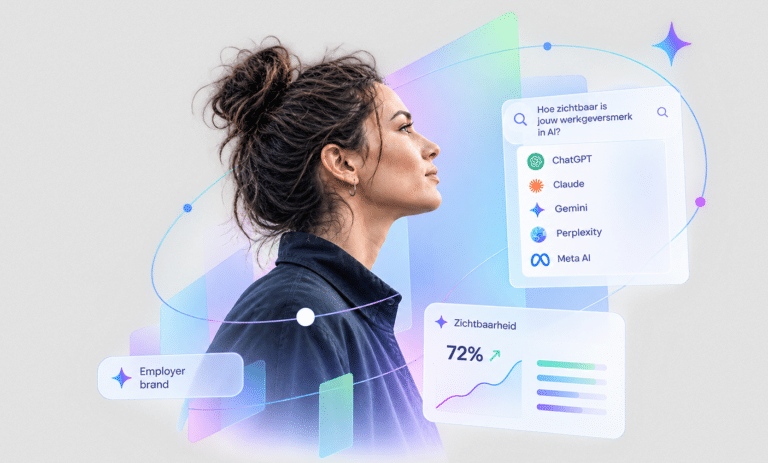
Bryan Peereboom, founder of AI Rebels, began his contribution by showing 25 careers sites. ‘Each one is a piece of craftsmanship, built with years of blood, sweat and tears.’ But they are also all based on 1 assumption, he said: that you draw candidates to your site and convince them there. Yet that traffic is increasingly disappearing because of LLMs. As an example, he cited government websites that have lost 35% of their traffic. ‘The intent remains the same, but the route changes.’

For 20 years, we have optimised our sites for 1 player: Google. Now generative engine optimisation (GEO) is joining the mix. Peereboom: ‘If you take 1 thing away today: there will be no click any more.’ In that zero-click environment, a candidate still goes through 5 stages within the language model, right up to the decision, he explained. A prompt such as ‘compare the salary and working-from-home policies of companies X and Y’ immediately produces a table, a summary and a verdict, where previously 8 tabs would have been open. ‘If you are not included, it becomes a difficult contest.’
Enough with the buzzword bingo
Terms like ‘dynamic work culture’ and ‘competitive salary’? According to Peereboom, they are worthless to LLMs. Language models run on quantifiable data: a salary range, the annual training budget, staff turnover figures and the technology stack you work with. And that information is held not by the website developer or the marketer, but by recruiters, who have the conversation with the hiring manager . You also lose a great deal of control over your story, because AI places considerable value on what others write about you. A robust PR and content strategy thus becomes a significant part of your employer branding.

Those who get started now still have a first-mover advantage, Peereboom explained. ‘But there is no on switch like there is for a search engine advertising campaign.’ He also warned against focusing too heavily on cost per hire: organic traffic to job boards is drying up, so clicks are becoming scarcer. ‘If you do not write about what it is like to work for you, AI will make it up. Or it will find a forum or a review from 4 years ago.’ His tip for tomorrow: ask different language models what they say about your organisation, and look at the sources they use through the candidate’s eyes.
‘A robust PR and content strategy becomes a significant part of your employer branding.’
Are careers sites therefore redundant? No, Peereboom answered clearly in response to a question from Luijters. The recruitment mix remains diverse, but a new player has joined it. He expects more search traffic to go through language models than through Google by around June next year, and smartphones and apps to give way within 2 to 3 years to devices with an AI agent as standard.
150,000 applications a year
After the break, it was time for practical examples. Daphne Olde Dubbelink of Hunkemöller and Fleur Melkert, co-founder of Equalture, explained how they overhauled recruitment for the shops. Hunkemöller has existed since 1886 and has around 700 shops in 11 countries, receiving approximately 150,000 (!) applications a year, of which around 3,500 ultimately lead to a hire.

Previously, candidates submitted a CV and a video interview, which recruiters and store managers assessed manually. This led to subjective decisions and mismatches, many candidates dropped out at the video stage, and store managers lost time. The new process therefore needed to be based on the competencies and potential of current employees, offer an inclusive and positive candidate experience and give shops time back. All guided by the principle: ‘A candidate today is a customer tomorrow.’
Measuring success in your own workforce
Melkert explained that work experience and education are poor predictors of job performance, whereas cognition and behaviour are good ones. But what predicts success differs by organisation and role. That is why a large proportion of current employees first played Equalture’s gamified assessments. Managers identified who performed well, supplemented by data such as contract renewals and internal progression.

‘If you see no difference in a competency, you should not assess it.’
By comparing high and low performers in this way, they could see which competencies really make a difference over time. Among shop employees, for example, a combination of high cognitive flexibility and openness to feedback proved to be a strong predictor. ‘If you see no difference in a competency, you should not assess it.’
Store managers get their time back
AI assistant Bowy now responds immediately via WhatsApp and asks a few basic questions about minimum age, language and availability. This is followed by the game-based assessment. The AI assistant immediately schedules candidates with a high or average fit for an interview in the shop.
‘When the candidate arrives at the shop, that is now the first time a store manager spends time on them,’ said Olde Dubbelink. Candidates do not see their fit score, but they do receive insight into their own results. More than half rate the process 5 out of 5, and 30% give it a 4. In addition, 70% say they now enjoy the process and 27% appreciate being assessed on potential rather than experience.
Candidates do not see their fit score, but they do receive insight into their own results.
In the Netherlands, the new process reduced time-to-hire from 21 to 11 days. Candidates with a high fit also turn out to stay longer than those with an average fit, and productivity, measured in turnover per hour, increased. In Germany, staff shortages sometimes meant that candidates with a low fit were also hired, simply because the shop would otherwise have had to close. But that too provides useful data, according to Olde Dubbelink. The biggest challenge now appears to be the internal change itself. ‘We have store managers who have worked for us for 20 years and hardly ever open a laptop on an average working day.’

More than twice as many intake interviews
Next came the final keynote speaker of the day, Jeroen Selten, who, as director of digital, e-commerce & CX at RGF Staffing and Unique, was on home ground. His team builds technology for all the group’s brands in a market with more than 20,000 staffing and recruitment agencies, thin margins and increasingly complex legislation. Yet the number of intake interviews more than doubled over the past 3 years, partly thanks to technology, he explained.
Analysis showed that recruitment consultants do 60% of the talking during an intake interview.
He also took his audience through a live job interview with Eva, the AI voice assistant the agency now uses. Because analysis showed that recruitment consultants do 60% of the talking in such interviews, explaining the role and the client, it has deliberately been designed as a two-way conversation. Afterwards, the system combined all the data, from the interview and previous conversations to any CV, into a fit evaluation with a score, strengths and points for attention.

The AI system also noticed that Selten had said in the interview that he would like to travel by helicopter. Its advice to the recruiter on duty was: ‘We do not guess which source is correct. Check it yourself and call the candidate if necessary.’ Video and transcripts are retained for 30 days, and personal data such as health information is filtered out. The video also helps prevent fraud, Selten explained. Candidates have previously appeared whose AI voice spoke fluent English whilst their mouths did not move. Anyone who does not want an AI interview can still choose the traditional route.
The secret sauce: Noa Brain
The system is now being piloted with 4 clients, mainly for high-volume vacancies. The turnaround time is falling from 4 days to 1, with a target of 4 hours, Selten explained. And nearly half of the interviews take place outside office hours, whilst the number of candidates interviewed has more than doubled. He spoke about a candidate without a CV who was nevertheless put forward to UWV because the interview was convincing.

‘Technology is no longer the problem. It comes down to change management.’
According to him, the secret lies in Noa Brain: the knowledge about clients that resides in recruiters’ heads rather than in the ATS. By recording it, junior staff can now benefit from that knowledge too, which also helps address high turnover among recruitment consultants. ‘Technology is no longer the problem. It comes down to change management.’ His advice: be selective, roll it out in phases and invest plenty of time in talking to your employees about what they need.
What members will do in 2027
In the closing panel discussion, 4 RLN members shared the choices they want to make for next year. Lonneke Schagen (DHL Express) said she was already using AI, chatbots and Equalture’s games, but still saw opportunities in GEO and back-end automation. ‘That information is already there, so why is someone still entering a start date manually?’

Claire Willekens (KVK) is exploring where AI is and is not permitted within government. She too wants to focus on GEO, an AI chatbot at the start of the process and objectively identifying internal talent. She also sees a risk if existing employees do not develop their AI skills, both for their own careers and for attracting new talent.
What does she hope a language model will say about Schiphol? ‘Just the real story.’
Joost Bakker (Bergman Clinics) focused on what can be done with the time automation saves: engaging with the market more actively and making more of referrals. And Natasja Freijer (Royal Schiphol Group) said she wanted to inspire her team without making people feel threatened. Together with an internal AI specialist, she will identify the tasks her recruiters enjoy least so they can be automated. What does she hope a language model will say about Schiphol? ‘Just the real story.’
From recruiter to talent adviser
It was striking that all the panellists saw their roles broadening. At DHL, internally developed processes became so successful that they are now being rolled out across Europe and the rest of the world. At KVK, the focus is increasingly on data and strategic workforce planning. At Schiphol, Freijer is now responsible for external hiring as well as recruitment, and has recently taken on internal mobility too. Her recruiters draw up an annual plan for each target group, attend management team meetings and work with HR business partners to assess capacity and the entire workforce.

This led Luijters to conclude with satisfaction that ‘there has never been more momentum to explain at the boardroom table why all of this is so important.’ He immediately added a few words of advice, calling on the recruiters present to reflect on their own performance too. And not just by looking in the mirror more often. ‘Besides the fact that you are judging your own work, it is good to ask your candidates too, and preferably your hiring managers as well.’ Or your colleagues, for which there was thankfully ample opportunity over drinks at the end.

Read also
Related event
Arbeidsmarkttrends 2027-2030
We zijn uitverkocht. Maar goed nieuws! Arbeidsmarkttrends 2027-2030 is volgeboekt. Goed nieuws: op 28 januari 2027 organiseren we een tweede editie, met dezelfde sprekers en hetzelfde programma. Zorg dat je er alsnog bij bent. Bekijk de editie van 28 januari Al jaren geven de beste sprekers en specialisten een arbeidsmarktupdate en een doorkijkje naar de […]
Odido