Could it finally be over for a mainstay of decades of recruitment practice? Has the cover letter really fallen out of favour? Could the tipping point have been reached? It is probably still too early to conclude that. But research by Selection Lab among just over 800 active job applicants does reveal a striking development: 26% did not write a cover letter at all for this application. ‘Whether the employer did not ask for one or the candidate chose to leave it out themselves, we cannot say on the basis of these data,’ according to the researchers.
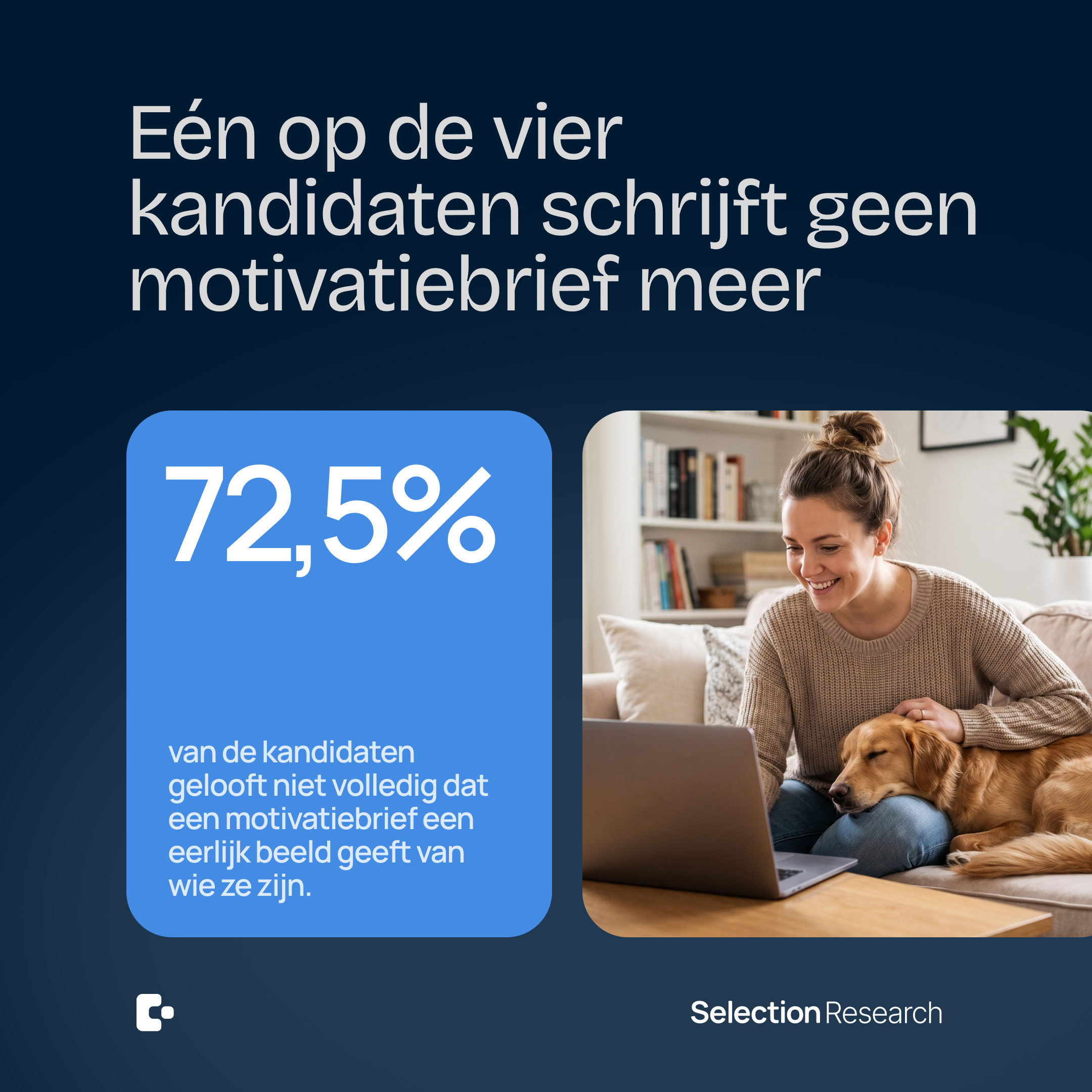
72.5% of candidates do not (fully) believe that a cover letter gives a fair picture of their suitability.
But what they do know for certain is this: a quarter of the job applicants (all of whom were in the middle of a real application process involving an assessment) went through the entire process so far without the cover letter that had been considered indispensable for years. And: of the candidates who do not believe that a cover letter gives a fair picture, 41% did not write one at all. Yet even among those who say they do believe in it, this was still 15%. In total, 72.5% of candidates do not (fully) believe that a cover letter gives a fair picture of their suitability.
Not a Gen Z story
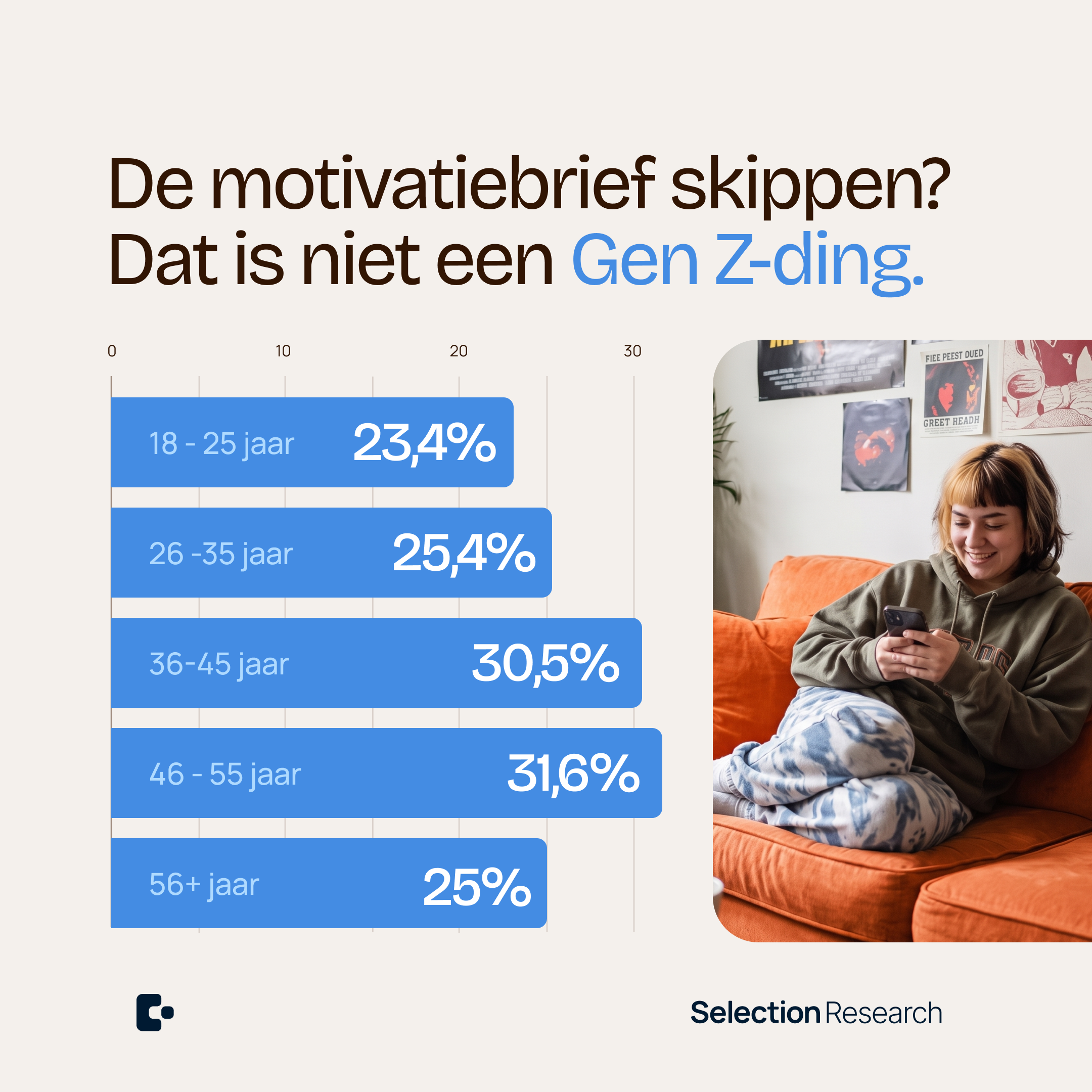
‘The cover letter is not dying because of a decree from experts. It is dying because candidates are dropping it one by one,’ the researchers conclude. And it is certainly not just a Gen Z story. In fact, the data may show the opposite. Among the 18- to 25-year-olds studied, 23% omitted the letter. Among 36- to 45-year-olds, this was 31%, and among 46- to 55-year-olds it was 32%. You could therefore conclude that older candidates are more likely to stop using cover letters than younger ones.
25.5% of candidates used AI to write or improve the letter.
When it comes to AI use, the results also certainly do not show a simple generational story. Candidates aged 56 and over were even more likely to say that AI wrote most of their letter (7.5%) than 18- to 25-year-olds (2.5%). Scepticism about the cover letter, and the ease with which people turn to AI to write one, is therefore not a ‘young person’s thing’. It is widely shared across all age groups. What is also striking is that 25.5% of candidates used AI to write or improve the letter. Only 3.5% had AI write most of it; 22% used AI to improve their own text.
Predictive value
The cover letter never measured motivation, the researchers conclude. ‘It measured writing skills and the willingness to sell yourself on paper. Now that AI removes that barrier, a polished letter says even less than it already did. And candidates know that best themselves: the less they believe in the letter, the more often they simply drop it. Organisations that take a different approach select faster, more fairly and more objectively. Not on the basis of how well someone writes a letter, but on the basis of who someone is and what they can do…’
‘Now that AI removes the barrier associated with cover letters, a polished letter says even less than it already did.’
The research by Selection Lab aligns with earlier research by Tilburg University and publisher Rendement, which shows that 80% of organisations still ask for a cover letter, but are also increasingly realising that such a letter has hardly any predictive value. And language models such as ChatGPT, Copilot and Gemini have reinforced this further, the research shows.
The letter: better, but says less
A recent controlled experiment by Tilburg economists underlined this once again. Job-seeking students were either given or not given access to ChatGPT when writing their cover letter. Recruiters from Philips, PwC, Rabobank and VodafoneZiggo then assessed the letters without knowing which had been written with AI and which had not. What did they find? With AI, the average quality rises: fewer spelling mistakes, more formal sentences, better introductions and closing sentences. But the very 2 things a cover letter was once about, namely personal motivation and a clear individual writing style, are hardly strengthened by AI.
Sometimes ChatGPT even makes a cover letter more complex and less readable…
Sometimes ChatGPT even makes a text more complex and less readable, the conclusion was. The tool becomes more polished, not more distinctive. Even more tellingly, in a second experiment recruiters could not determine better than chance whether a letter had been written with AI. The signal that a cover letter once claimed to provide – making genuine motivation visible – has therefore effectively become unreliable. Only when recruiters were told in advance that a strong letter was entirely human work did they rate it noticeably more positively.
Read also
Related event
Arbeidsmarkttrends 2027-2030
We zijn uitverkocht. Maar goed nieuws! Arbeidsmarkttrends 2027-2030 is volgeboekt. Goed nieuws: op 28 januari 2027 organiseren we een tweede editie, met dezelfde sprekers en hetzelfde programma. Zorg dat je er alsnog bij bent. Bekijk de editie van 28 januari Al jaren geven de beste sprekers en specialisten een arbeidsmarktupdate en een doorkijkje naar de […]
Odido