A ‘competitive’ or ‘market-rate’ salary: these are words that will hopefully soon disappear from our recruitment vocabulary. For employers across Europe, D-Day is drawing ever closer. In just under 18 months, on 7 June 2026, the EU Pay Transparency legislation will officially come into force. Employers will then be required to state the (starting) salary or salary range in job vacancies, or at least before the job interview. Employers will also no longer be allowed to ask candidates about their salary history.
In just under 18 months, the EU Pay Transparency legislation will officially come into force.
Even stricter rules will apply to large companies with more than 250 employees. For example, they will be required to report annually on the pay gap within their organisation. If the difference between men and women is greater than 5% (and cannot be explained), the organisation concerned must jointly formulate an ‘action plan’. Companies with fewer than 100 employees are exempt from this reporting requirement. For now.
Closing the pay gap
All of this should ensure that Europe takes steps to finally genuinely close the pay gap. The gap between men and women in Europe still averages 13%. In other words: women earn an average of 13% less per hour than men for the same work. This also has significant longer-term consequences: the pension gap between men and women currently stands at around 30%.
‘Employers are particularly reluctant to share salary information in highly paid roles, where the pay gap is greatest.’
‘Salary transparency is an important step towards equal pay across ethnicity, gender and other divides,’ says Lisa Feist of Indeed’s Hiring Lab. ‘Employers are still particularly reluctant to share salary information in highly paid roles, where the gender pay gap is greatest.’
Stagnation over the past year
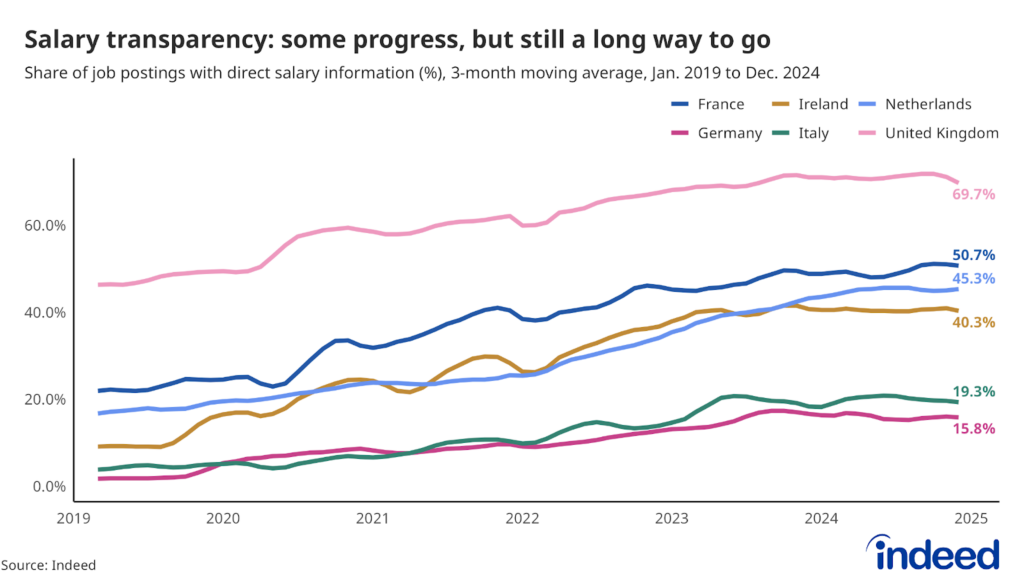
Looking at the latest Indeed data, there is both good and bad news. Starting with the good news: the Netherlands is doing considerably better than in 2019, when Indeed first published its research on salary transparency. At that time, around 19% of vacancies stated a salary range — now that figure is 45.3%.
Source: Indeed Hiring Lab
Now for the bad news: that relatively favourable percentage has remained virtually unchanged over the past year. This applies not only to the Netherlands, but also to Germany, Italy, France, Ireland and the United Kingdom — the six countries for which Indeed collected data — and which in many cases also performed far less well. ‘This suggests that the initial momentum, possibly driven by discussions around transparency and a tight labour market, has weakened,’ Feist reports. ‘For jobseekers, this stagnation means that they are still left in the dark for many vacancies. This makes it difficult to assess whether a role matches their salary needs or expectations before they apply.’
High pay, little transparency
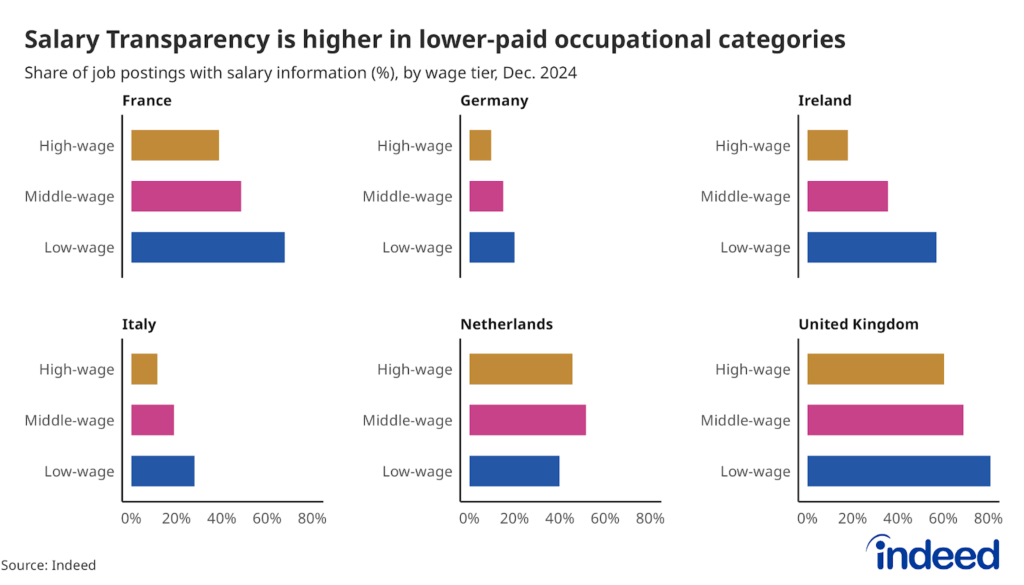
The extent to which employers disclose salaries varies greatly by occupational category. The most transparent category across the 6 countries surveyed by Indeed at the end of last year was cleaning & sanitation, ranging from 20% of vacancies in Italy to 92% in the UK. Other categories with relatively high percentages of vacancies containing salary information include transport (between 30% in Italy and 84% in the UK), education & training (from 22% in Germany to 85% in the UK) and hospitality (between 17% in Germany and 78% in the UK).
Source: Indeed Hiring Lab
‘Employers in high-wage sectors appear less inclined to disclose salaries.’
Roles in industrial engineering, software development, information design & documentation, project management and law were on average the least transparent. In Italy, Germany and Ireland, fewer than 10% of vacancies in these sectors contained salary information. In the other three countries surveyed, at least a quarter of vacancies in the same categories were transparent about salaries at the end of 2024. ‘This points to a broader phenomenon: employers in high-wage sectors appear less inclined to disclose salaries,’ according to Feist.
Little sectoral difference here
Remarkably, the Netherlands is an exception to this. Whilst other European countries show a clear divide between highly and low-paid sectors, Dutch employers show a similar degree of transparency across all sectors. Only the retail sector in the Netherlands receives a light-blue rating from Indeed: in considerably fewer than 25% of vacancies, we see a salary indication.

Source: Indeed Hiring Lab
Reaping the benefits now
Meanwhile, the EU clock continues to tick. Member States have until June 2026 to transpose these rules into national legislation. So far, however, no EU country, with the exception of Austria, has done so. In 18 months’ time, a lack of salary information could cause serious problems. And, even more unpleasantly: fines. The first examples from America have already emerged: a transport company there had to pay around 4.2 million dollars to more than 2,000 applicants for failing to state a salary range.
‘Employers who are already transparent about salaries will immediately reap the benefits.’
Feist’s — and Indeed’s — message is therefore clear: do not wait until the 2026 deadline forces you to be transparent. ‘Employers who are already transparent about salaries will immediately reap the benefits,’ Feist concludes. ‘They attract talent more effectively, shorten their recruitment cycle and build a reputation for fairness and trust.’
Read also:
- Pay transparency in the Netherlands still has a long way to go
- No salary stated in your vacancy? That could prove costly
- Stating the salary in a vacancy? It can generate up to 285% (!) more conversions
Related event

Leergang Strategisch Recruitment | UITVERKOCHT
Ben je klaar om je recruitmentcarrière naar een hoger niveau te tillen? De Leergang Strategisch Recruitment biedt je de perfecte mogelijkheid om je kennis te verdiepen en je professionele groei te versnellen. Als ervaren recruiter of recruitmentmanager ontwikkel je strategische inzichten en vaardigheden die je een sterke en leidende gesprekspartner maakt voor het management. Je […]
Rotterdam
Indeed
Op Indeed vinden meer mensen een baan dan waar dan ook. Indeed is de nummer 1 vacaturesite (SimilarWeb, totaal aantal bezoeken, juli 2024), niet alleen in ons l…