
Diversity policy is coming under considerable fire – particularly in America. Whilst the newly inaugurated President Trump recently placed all employees of the so-called DEI programmes on paid leave within central government, major companies such as Meta, McDonald’s and Amazon joined the growing group of organisations overhauling their diversity policies. Facebook’s parent company, for instance, abandoned recruitment through the so-called Diverse slate protocol, an approach intended to guarantee fair recruitment by always including a diverse pool of candidates for open vacancies, a kind of extension of the Rooney Rule.
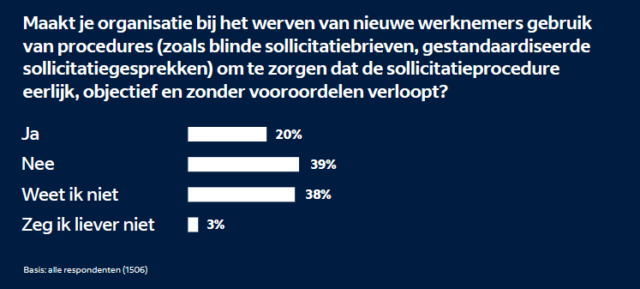
But, entirely against the spirit of the times, job site Indeed is trying to put diversity back at the top of the agenda. Among other things, through research showing that we are nowhere near as far along as we might think. The survey of more than 1,500 Dutch respondents (1,304 employees, 100 senior managers and 102 HR decision-makers) found that only 20% say their organisation uses processes to ensure fair recruitment, whilst a large proportion barely make use of simple techniques for creating diversity.
‘Blind’ applications and recruiting without CVs: it still hardly happens.
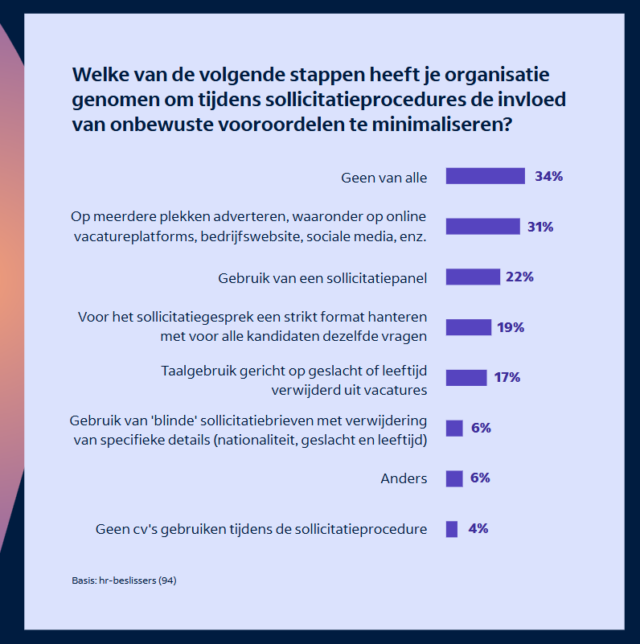
A slightly larger proportion (28%) of the HR decision-makers surveyed believe their organisation practises fair recruitment. Yet only 17% of them say they remove gender- or age-related language from job advertisements, and only 19% use structured interviews with identical questions for all candidates. Other effective measures to counteract bias, such as blind applications (6%) and recruiting without CVs (4%), are used even less by this group, the research shows. And more than half (51%) report that their organisation takes no measures at all to address prejudice in the recruitment process.
‘Significant progress still needed’
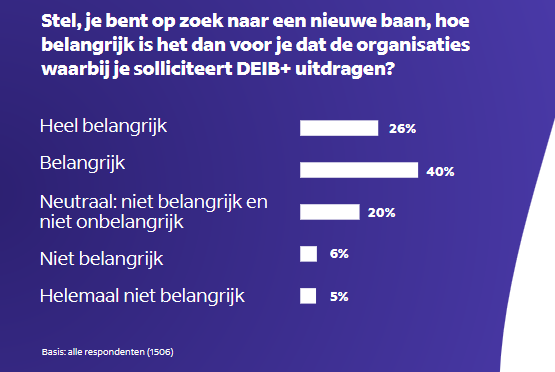
‘Fair recruitment is a crucial part of inclusion in the workplace, but practice shows that many companies can still make significant progress in this area,’ says Stan Snijders, Managing Director Benelux at Indeed. ‘With simple adjustments to the recruitment process, organisations can already make a major difference.’ He says this is also urgently needed for employer attractiveness. The research shows that no fewer than 66% of all respondents consider it important for their potential employer to promote diversity and inclusion. With 77%, Gen Z places the greatest value on this.
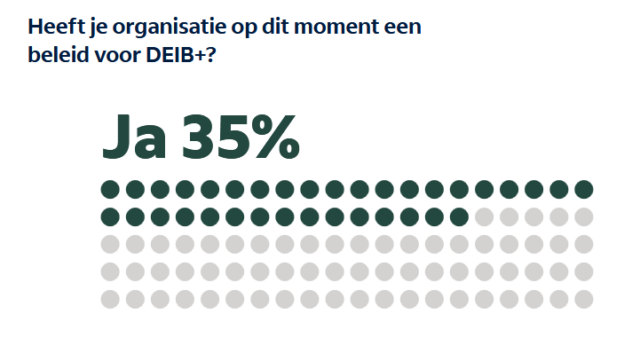
But in practice, it is different, Snijders observes. Applications without personal details such as nationality, gender and age, or even recruitment procedures without CVs? According to him, they remain a rarity. ‘It is clear that improved recruitment strategies are still in their infancy at many organisations.’ Whilst the Indeed research shows that only 35% of organisations have a concrete diversity policy, ‘talent is increasingly expecting this from employers’, says Snijders.
And it is not only a matter of employer branding, he emphasises. ‘There are frontrunners already reaping the benefits. Our research shows that employers with a well-considered diversity policy and fairer recruitment tap into a broader talent pool and also achieve better business results.’
Want to know more?
Read the full research
Read also

Indeed
Op Indeed vinden meer mensen een baan dan waar dan ook. Indeed is de nummer 1 vacaturesite (SimilarWeb, totaal aantal bezoeken, juli 2024), niet alleen in ons l…