More than 90% of American employers now use automated systems to screen applicants. But what if virtually all those employers use the same algorithm? A large-scale Stanford study provides a first look behind the scenes – and its findings are worrying.
The system reinforces racial inequality and repeatedly excludes the same people everywhere.
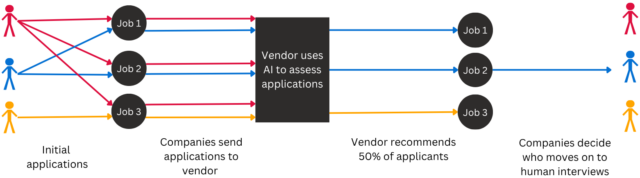
Researchers at Stanford University analysed 4 million applications from 3.4 million candidates across 156 employers in 11 sectors. All applications were assessed by the A.I. hiring platform Pymetrics – now part of the originally Dutch company Harver. The conclusion of this study, entitled Algorithmic Monocultures in Hiring: the system reinforces racial inequality and repeatedly excludes the same people everywhere.
Same algorithm, same rejection
This is precisely what the researchers mean by ‘algorithmic monoculture‘: when many employers use the same algorithm, they are no longer really making autonomous, independent decisions. A candidate rejected by the algorithm at employer A is highly likely to be rejected by employers B, C and D too – because it is the same assessor. Even though the job requirements may differ greatly.
Read this article in full
Become a Werf& member for unlimited access to all articles, research and exclusive insights into the labour market.
No obligations Cancel anytime Secure payment
Related event

Arbeidsmarkttrends 2027-2030
We zijn uitverkocht. Maar goed nieuws!Arbeidsmarkttrends 2027-2030 is volgeboekt. Goed nieuws: op 28 januari 2027 organiseren we een tweede editie, met dezelfde sprekers en hetzelfde programma. Zorg dat je er alsnog bij bent.Bekijk de editie van 28 januariAl jaren geven de beste sprekers en specialisten een arbeidsmarktupdate en een doorkijkje naar de arbeidsmarkt van de […]
Odido