Uh… Two managers interview the same candidate. Afterwards, you ask: ‘What did you think?’ Manager A says: ‘Good energy, clever answers, definitely an 8.’ Manager B says: ‘I don’t know, something didn’t feel right, no more than a 5.’ You ask: ‘What are you basing that on?’ Both fall silent. They have no criteria. No scoring system. They went with what felt right at the time. The result: you disagree and the candidate is left waiting uncertainly whilst you try to reach consensus based on a feeling.
We often forget that unstructured interviews are the worst predictor of job performance.
Why do we keep doing this? We conduct unstructured interviews because we think a good conversation is enough. We want to get to know the candidate, so we talk. But what we forget is that unstructured interviews are the worst predictor of job performance. Research shows that only structured interviews are good predictors. That means: in an unstructured conversation, a guess is almost as good as an interview. Yet we continue to have conversations instead of interviewing in a structured way.
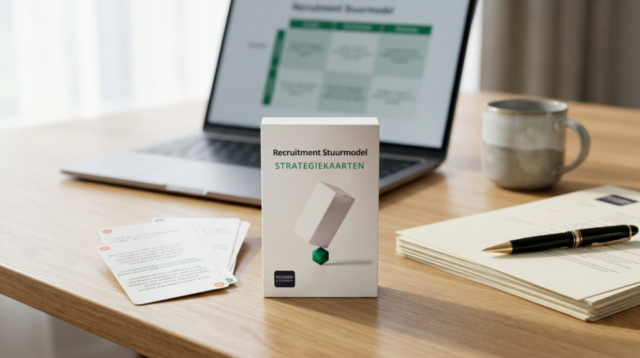
This week’s card
This week’s card cuts through this illusion: ‘Our interviews are often unstructured: everyone asks different questions and we do not score systematically. Why do we do that?’ The reflection question is confronting: ‘What if we created 5 fixed questions and a scoring matrix for every role? What would that deliver in terms of candidate comparability?’
Without structure, we compare apples with pears.
Why does this question work? This question forces your team to move from intuition to a systematic approach. We think structure kills spontaneity. But by asking ‘What does it deliver in terms of comparability?’, you shift the conversation towards fairness. The team discovers for itself: without structure, we compare apples with pears. One candidate received easy questions, the other difficult ones. That is neither fair nor reliable.
Discuss this with your team for 10 minutes. Take your most recent vacancy (2 minutes). Ask everyone to write down which questions they asked (2 minutes). Compare the lists (3 minutes). Are they the same? Or did everyone ask different questions? Choose 1 concrete action: for which vacancy will we create 5 fixed questions next week? (3 minutes). The answer is already in the room, not in an HR handbook.
The secret of the trade
An unstructured interview leads to inconsistent decisions. One candidate gets a job because she came across as likeable. Another is rejected because she seemed nervous. But likeability and nerves do not predict job performance. Meanwhile, you build a team based on who can talk best, not who can work best. The result: your hires perform inconsistently. Some are brilliant, others disappointing. You cannot learn what works, because every interview was different.
Likeability and nerves do not predict job performance.
What can you do tomorrow? So, tomorrow morning, take your next vacancy. Write down 5 fixed questions that every candidate receives. Create a simple scoring matrix: what is a good answer (4 points), what is mediocre (2 points), what is weak (0 points)? Share this with all interviewers. Say: ‘We will all ask these 5 questions and score on this scale. Afterwards, we will compare scores.’ It takes 20 minutes to create. It saves you hours of discussion afterwards.

Resistance script:
- Manager: ‘But then it becomes so rigid, I also want room for a normal conversation.’
- You: ‘Completely agree. That is why there are only 5 questions. The rest of the conversation can be free. But these 5 ensure that we compare like with like. Otherwise, we will not know later why we chose candidate A rather than B.’
What will probably happen? The first time you conduct a structured interview, it will feel unfamiliar. But after the conversation, you will notice something: the evaluation takes 5 minutes instead of 30. You reach agreement more quickly. The scores speak for themselves.
After the conversation, you suddenly notice something: the evaluation now takes only 5 minutes instead of 30…
Step by step, you see that you are making better decisions. After a few months, you analyse the data: candidates with a score above 15 stay, on average, longer than candidates below 10. You now have a real predictor. That is the moment when you know: this works. Interviews are no longer a lottery; they are measurements.
About the author
Koen Roozen trains and advises organisations on strategic recruitment and coaches managers. His work is based on analysis, clear models, direction and craftsmanship. He developed the Recruitment management model. With his recruitment strategy cards, he helps recruitment teams strengthen their recruitment capability step by step. Koen Roozen teaches recruitment strategy at the Academy for Labour Market Communication and writes about recruitment every Tuesday in his newsletter Recruitment with pepper.

Do you not want to wait for the next question? Order your own Recruitment strategy card deck. You do not need any preparation or an external facilitator. Simply draw one card each week, discuss it with your team for 10 minutes and choose 1 concrete action. This is how you build a recruitment department that truly makes a difference, step by step.
Read also
Related event

Leergang Strategisch Recruitment | UITVERKOCHT
Ben je klaar om je recruitmentcarrière naar een hoger niveau te tillen? De Leergang Strategisch Recruitment biedt je de perfecte mogelijkheid om je kennis te verdiepen en je professionele groei te versnellen. Als ervaren recruiter of recruitmentmanager ontwikkel je strategische inzichten en vaardigheden die je een sterke en leidende gesprekspartner maakt voor het management. Je […]
Rotterdam