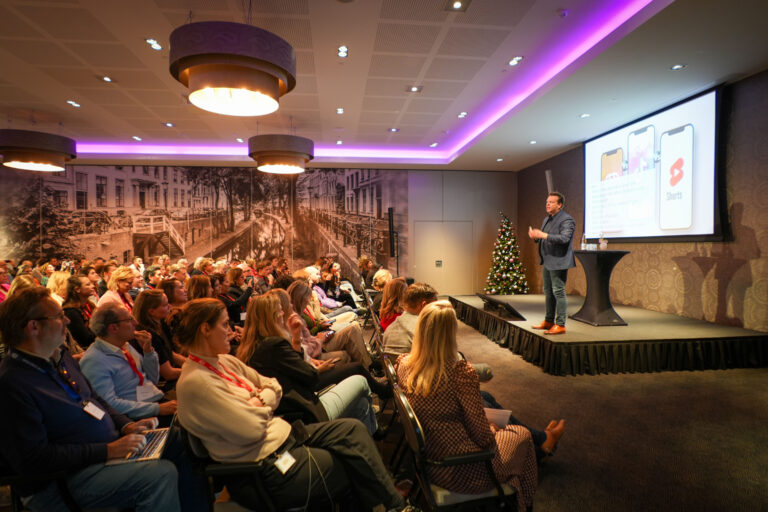
The world is changing ever faster, faster than expected, and that places considerable demands on employer brands. If there was one common thread running through SteamTalmark‘s Irresistible Employer Branding Event on 26 November, that was it. It concerns how candidates search today and what they expect from an employer, but also how to reach more diverse audiences and bring your own people along in a changing organisation. A report in 5 sessions.
#1. ‘Life stage says more than generation’
Bert Kok, strategy director at SteamTalmark (right in the photo), and his colleague Michael Raven kicked off with ‘Irresistible insights‘ about the labour market. Their message: the greatest opportunities are still where they have always been, off the beaten track. They based the 4 insights they presented on the many interviews the agency conducts with public-sector and commercial employers, and compared them with existing research.

The first insight concerned generations. There are plenty of clichés about Gen Z, from purpose and flexibility to a lack of loyalty. But there are already considerable differences within that generation. People with vocational qualifications, for example, place more value on a permanent contract and a professional workplace, whilst those with academic qualifications attach more importance to meaningful work. The advice: use age as background information and focus your campaign instead on motivations and life stage, where the differences are clearer.
‘87% of employers expect a sideways move to become as important as a promotion.’
The second insight: the shortage is shifting from people to skills. SteamTalmark is therefore finding that its concepts increasingly centre on mindset and skills, rather than just the work itself, according to Kok. Raven then built on this with his case for more internal mobility, an area in which the Netherlands scores particularly poorly by international standards. At the same time, 87% of employers expect sideways moves to become as important as promotions. According to Raven, academies, retraining and development pathways in job adverts are ways to close that gap.

#2. ‘A language model doesn’t generate clicks’
Last week they were in Almere addressing the Recruitment Leaders Network audience. This time, AI Rebels Nigaio Wijnen and Bryan Peereboom were in Amsterdam-West to explain why employers need to make sure they are visible in LLMs too. Wijnen (left in the photo) explained, for example, why websites are now seeing up to 35% less traffic. ‘Not because fewer questions are being asked, but because people are asking a language model,’ he said. And that no longer generates clicks.
‘We need to think now about what we should have done yesterday.’
Nevertheless, he said, a careers website remains essential, just with a new role: as a source for language models. That takes some getting used to, because the industry has been measuring the same things for years: visitors, clicks on vacancies and applications per channel. As long as those figures remain in the green, that holds back change. ‘Yet we need to think now about what we should have done yesterday.’

‘An end to bullshit bingo‘
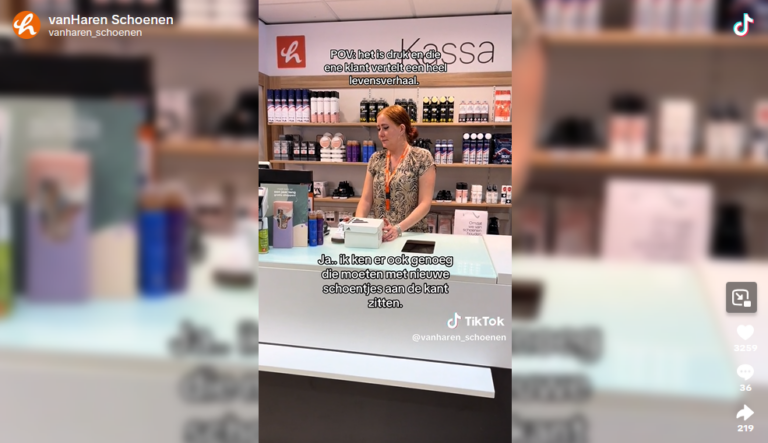
Peereboom (right) then spoke about the candidate prompt journey and how LLMs are putting an end to what he calls bullshit bingo: hollow terms such as ‘competitive salary’, ‘dynamic work culture’ and ‘no nine-to-five mentality’. Technology plays a part too. Many organisations automatically feed vacancies from their ATS into their careers website, often using JavaScript. But AI crawlers struggle to read it. The same applies to the salary calculators that supermarkets, for example, use to show people in part-time jobs what they will earn. ‘And when AI can’t read it properly, it starts making things up.’
‘When AI can’t read it properly, it starts making things up.’
In other words, if you don’t explain what it is like to work somewhere, you leave AI to look for the answer elsewhere. ‘AI hates silence. Doing nothing is truly deadly.’ A negative post from 2012 could suddenly shape perceptions of your employer brand. His tip: tomorrow, ask ChatGPT, Google AI Overviews or AI Mode, and Claude 5 questions, and ask not only about the advantages of working for your organisation, but also about the disadvantages. ‘That’s often where the story emerges that you really need to do something about.’

#3. Resistance has a name: Bruno
After the break, SteamTalmark’s client director Rick Geven and creative director Maarten Kuipers asked whether employer branding can also play a role in major changes within an organisation. The discipline usually looks outward, but during reorganisations, internal mobility initiatives or the introduction of AI, you are asking your own people to change. And communication is important in that too, they said. The good news, according to Geven: resistance is not the same as unwillingness, but an emotional response. ‘And if you can understand that emotion, you also know how to deal with it in your communication.’
‘If you can understand the emotion, you also know how to deal with it in your communication.’
Geven gave resistance a name, Bruno, and identified 3 faces of it. Passivity (inertia): I’m perfectly happy where I am. Doubt: is what they’re saying true, and can I actually do this? And defiance (reactance): you say I have to do this, but I don’t want to. Their approach consists of 3 steps: diagnosing where resistance and motivation lie, developing a shared story and activation, using the right tools, moments and places. For that story, they look for common ground, just as José Mourinho, according to Geven, manages to bring teams full of egos together around a shared ambition.

The COM-B model
Kuipers (right) then explained the behavioural theory behind it. The so-called COM-B model identifies 3 levers: motivation (wanting to), capability (being able to) and opportunity (having the chance). Many campaigns focus solely on wanting to, with an enthusiastic call to take part. But you can also influence behaviour through capability, Kuipers explained: do I understand how to do it, and do I have the skills? And through opportunity: is there time, are there resources and room, and does the culture support it?
‘You influence behaviour not only through wanting to, but also through being able to.’
They then brought this to life playfully with a change game based on the card game UNO and a campaign that does not urge people to develop, but instead provides opportunities: giving them confidence that it is possible and showing them which paths are open. Examples include an internal jobs fair, speed dates between departments, work shadowing and normalising uncertainty. ‘We understand that you find it daunting. Everyone finds this daunting.’ According to the 2 speakers, employer branding is not really all that different from change communication. And that is urgent, they say, because the best talent often leaves first during major changes.
#4. ‘There isn’t necessarily a shortage of talent’
But first, of course, you need to know how to attract that top talent. And organisations still fish in a very small pool far too often, argued Ilias Spanjer, who founded the agency 4Flowers with Chantal Lo-A-Tjong to help organisations reach more diverse talent. Among other things, he said that 27% of people in the Netherlands now have origins outside the country, and that this proportion is growing to between 34% and 42%. ‘There isn’t necessarily a shortage of talent, but there is a mismatch between employers and talent.’

His advice starts with recognising your own bubble. Who is on your recruitment team, where are your vacancies advertised, whom are you not reaching and who drops out of the process? The more diverse your team, the easier it is to attract diverse candidates. ‘We all want to belong somewhere, and that’s easier when people are like us.’ So don’t look for more of the same, he advised, but consider what would make a team complete. Talk to your target audience rather than about them, ask colleagues from different backgrounds for their input and bring in external partners where necessary.
‘We all want to belong somewhere, and that’s easier when people are like us.’
He illustrated how this works with a focus group for Coca-Cola. The young people loved the idea of a competition to win tickets to Lowlands, but it turned out they had never seen that it had been running for years via QR codes on cans. One conversation with 5 Gen Z participants was enough to adjust the approach. Another example was a campaign for Maggi that fell during Ramadan. Instead of avoiding it, 4Flowers drew on it with a sketch by an influencer who was taking part in a campaign for the first time. According to Spanjer, it exceeded all KPIs by a wide margin.
According to Spanjer, the opportunities are considerable: a larger talent pool, more perspectives at the table and greater relevance to new audiences. Among other things, he said that 76% consider diversity important when choosing an employer, and that 32% would not apply to a company with too little diversity. But employers must also be willing to choose different channels to spread their message, he added. ‘There’s no shame in stepping outside your bubble.’
#5. The audience as a panel
Ricardo Risamasu, managing director of SteamTalmark, concluded with a discussion with the audience about, for example, the usefulness of chatbots and whether candidates mind if a campaign has been made with AI. He said he had noticed a shift on the latter: last year, for example, major brands proudly announced that their Christmas campaigns had been made entirely with AI, whereas this year they emphasised that people had been involved.

Some in the audience saw it as a transitional phase, comparable to the rise of CGI and green screens, which also initially met with resistance but now go unnoticed. Another person observed that it depends on the purpose: when telling the story of the police as an employer, you want to see real colleagues. And young people quickly spot when something has been made by AI, Risamasu said from his own experience. When his wife recently shared a video in the family group chat, his youngest daughter immediately reacted disapprovingly, saying ‘it was AI’.
‘Everyone says they embrace inclusion and diversity, but AI now shows what things are really like.’
The final proposition was: ‘AI makes recruitment fairer’, with Risamasu referring to research showing that AI matching reinforces gender bias. One attendee, however, turned this around: AI was not to blame; it was a mirror of our own data and systems. ‘Everyone says they embrace inclusion and diversity, but now that system shows what things are really like.’ In his view, this makes now the very moment to adjust those systems and make recruitment and selection fairer. Plenty to continue discussing over drinks, then.
Read also
- How do you make employer branding irresistible? ‘It’s about making people fall in love with you’
- SteamTalmark: ‘If you’re so great, why aren’t those people working for you yet?’
Gesponsord door SteamTalmark