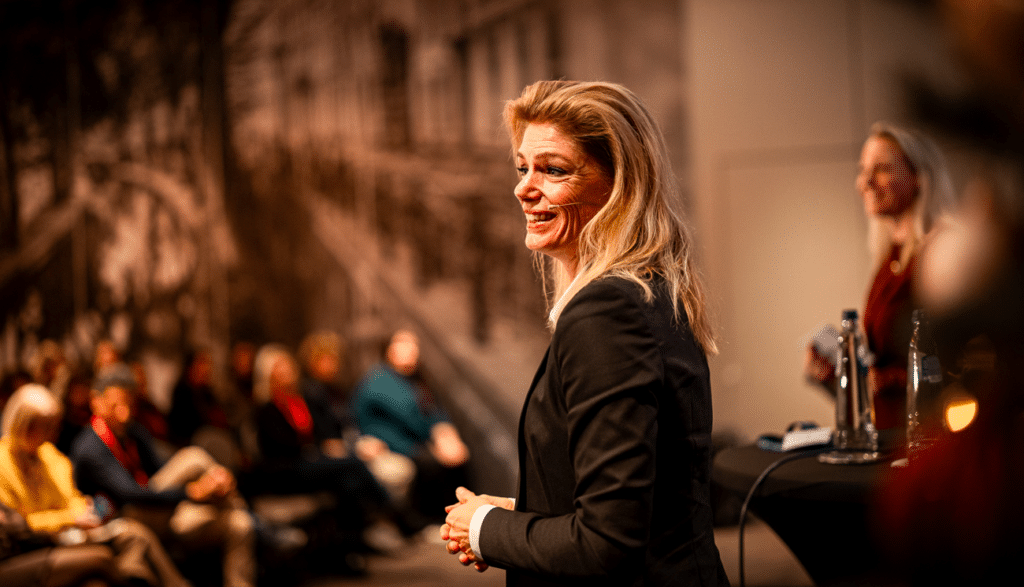
With all the attention given to AI, employees’ mental wellbeing can sometimes be overlooked. Yet mental health-related absence is now rising sharply across society, observes KPMG partner Caroline Tervoort-Visser. It is time to connect these developments, says the 2023 CHRO of the year. At the Arbeidsmarkttrends Events, she will explain what she has in mind. Here is a preview.
> You also spoke at Arbeidsmarkttrends last year. Will it be all about AI again this year?
‘AI is certainly an important lens, and it will remain so in my talk this year. But another year has passed, bringing a year of new insights and experiences. So now I want to bring a broader perspective than AI alone.’
> You are speaking immediately after Mathijs Bouman and Carlijn Kriek. How does your talk connect with theirs?
‘Mathijs will discuss productivity, or rather the lack of it, in the Netherlands and Europe. The Netherlands is lagging behind the rest of Europe, and the question is why. Carlijn Kriek from the municipality of Amsterdam will then address, among other things, internal mobility: how difficult it is to get it off the ground, partly because of all the rules surrounding sickness absence, statutory transition payments and employment law.’
‘Research shows that all those AI investments are yielding only limited returns so far. Why is that?’
‘I don’t intend to tie those two talks together completely, but my perspective touches on both. There is a notion that AI is the solution to our productivity problem. Yet research shows that all those investments are yielding only limited returns so far. Why is that?’
> Yes, why is that?
‘When you look at the impact of AI on organisations, my argument is: the more AI you use, the more deeply human skills you need. Roles are being reshaped. Perhaps you loved spending 95% of your time filling in Excel spreadsheets, but soon you will only be checking whether AI has done it properly for you. You might not enjoy that at all. And perhaps people cannot do it, do not want to do it or are not allowed to do it.’
> Do you see that in practice too?
‘Experience shows that the adoption of new technology is still lagging considerably. People find it frightening, they do not feel capable; there can be several reasons. The human factor is one of the main reasons why it is still so difficult to make AI profitable and scalable. I want to explore that further in my talk.’
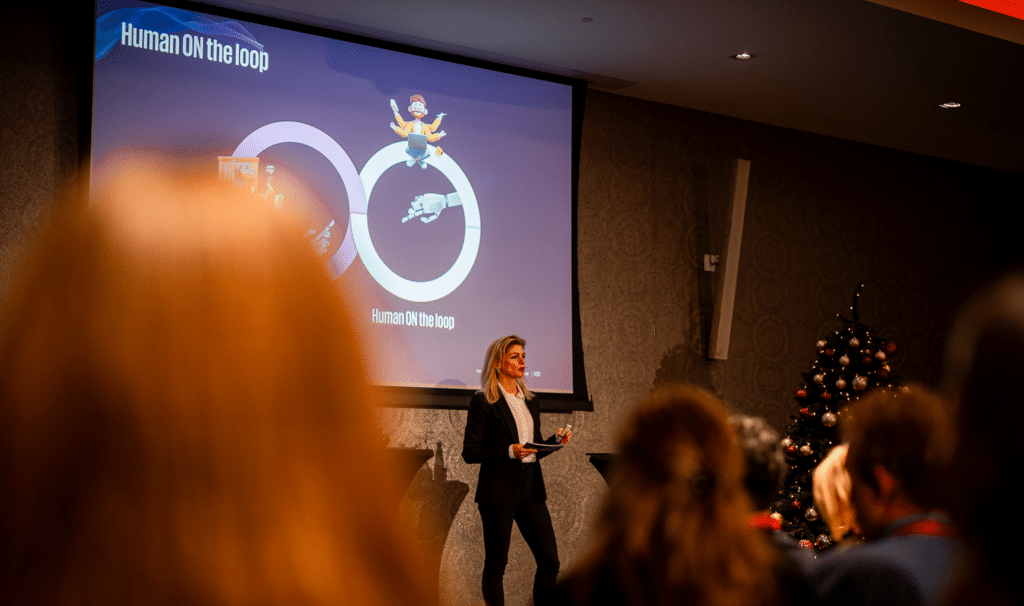
‘The more AI you use, the more human skills you need.’
> You also draw on recent KPMG research. What does it show?
‘We have recently published several studies. One is a regular pulse check of the market: where do we stand with AI? The other offers a much broader perspective, namely that of CEOs worldwide. It provides insights that are highly relevant from a labour market perspective. Will the workforce grow or shrink? And what do CEOs see as the biggest challenge over the next three years? I use that to set the scene.’
> So, what is the biggest challenge?
‘The transformation into a people first, AI-native organisation. That calls for a reappraisal: who do you want to be as an organisation when it is changing so fundamentally? What contribution do you still make to a society that is also going to change enormously? And how do you ensure that your people remain happy and healthy, and continue to have meaningful work?’
> You talked about that last year too, didn’t you?
‘That’s right. I said then that we need to make more room for downtime in our jobs as the use of AI increases. We are really seeing that need materialise now. It is difficult to establish a causal link, because you are not permitted to measure the cause of absence. But it is striking that we are seeing mental health-related absence increase not only in general, but particularly in organisations that have already integrated AI more extensively.’
> What is causing that?
‘Cognitive overload. You take all the breathing space out of the day. What remains are the deeply human skills: critical judgement, creativity, decision-making. These are all highly cognitive tasks. Having to do them in rapid succession is very different from spending half an hour filling in a spreadsheet, sending an email or gazing out of the window for a moment. That’s why I always say: double down on your wellbeing strategy. And that is not about fitness, but about your brain. It needs enough rest.’
> Isn’t that mainly about AI?
‘No, even apart from AI, it is an issue you have to deal with as an HR professional, because people become unable to work for several reasons, and it has a major effect on the labour market. There is a large cohort of people who are not productive and sometimes leave their jobs whilst ill. That is also a burden on society and on the social welfare provisions they draw upon.’
‘You need to make sure your brain gets enough rest too.’
‘We all have a role to play in that. How do you approach it responsibly, and what can you contribute as an organisation? That is an important theme for me.’
> Is there also a recruitment angle to your talk?
‘Certainly. If you want to become a people first, AI-native organisation, you need to re-examine your identity. Why do we exist? That says something about your brand, and therefore about how you position yourself in the labour market. What do you use AI for, and what don’t you use it for? Take customer service. Some organisations that fully automated it are now reversing that decision.’
> Why?
‘There are many complaints about the service provided by all those bots, agents and avatars. Particularly when people share personal stories, they cannot connect or respond to a person’s needs because they have no moral compass. Besides, much AI is simply expensive and unsustainable. So organisations are asking themselves: where do we commit 100% to automation, and where do we make a clear decision not to, because we want to put people first?’
> And that also affects how you deal with candidates and applicants.
‘Exactly, that is part of it too. And when you reassess who you are as an organisation, you also begin to seek out different profiles and skills in the market. You may even find yourself in a completely different talent pool, simply because you have redefined yourself.’
Want to know more?
Caroline Tervoort-Visser, partner in People & Culture Strategy at KPMG Advisory, will speak on 10 December at Arbeidsmarkttrends 2027-2030 at Odido in The Hague. That edition is completely sold out, so a second edition will follow on 28 January 2027 with the same speakers and programme.