
That A.I. is on the rise in recruitment is no news. But new research among more than 1,000 employees and almost 400 employers in the Netherlands, presented today at Indeed’s FutureWorks event in Utrecht, shows a substantial and growing difference in A.I. use. Whilst 57% of surveyed jobseekers now say they use A.I. to improve their chances, only 40% of employers say they use A.I. applications in recruitment. Around half do not use it at all yet, and 10% do not even know whether their organisation uses A.I. in the process.
During interviews, 52% of Gen Z already say they call on A.I. for help. For Gen X, this is only 5%.
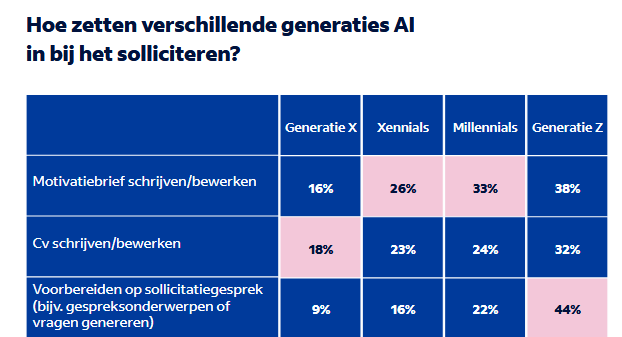
The figures show that jobseekers mainly turn to A.I. for writing cover letters (28%), CVs (24%) and preparing for interviews (23%). Young people are leading the way: only 6% of Gen Z apply without A.I., whilst 60% of Gen X say they still search for work entirely in the traditional way. The gap is also wide in preparation: whilst 44% of Gen Z use A.I. to generate practice questions or interview topics, this is only 9% among Gen X. During interviews, 52% of Gen Z already say they call on A.I. for help. For Gen X, this is only 5%.
Growing mismatch
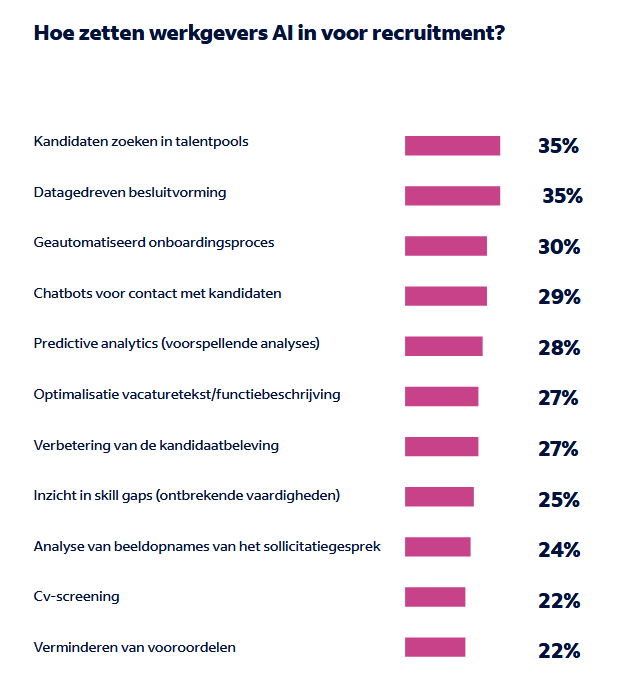
Notably, satisfaction is enormous among employers already using A.I.: 87% say they find it effective, and only 1% see no benefit in it. Yet A.I. is used only to a limited extent, for example for searching for candidates in talent pools (35%) and data-driven decision-making (35%). CV screening is still barely automated (22%). According to Indeed, the research points to a growing mismatch: ‘jobseekers use A.I. to apply faster, better and more purposefully, but employers are missing opportunities by making insufficient use of the available A.I. tooling.’
At today’s FutureWorks event, the job site is therefore presenting two new A.I. tools: Career Scout and Talent Scout. The first is aimed more at jobseekers and offers them a kind of personal A.I. coach, providing insight into suitable roles based on their skills. It not only shows vacancies, but also explains why you are a good match and adapts your CV. Jobseekers can also practise interviews by voice and receive immediate feedback.
Talent Scout is intended to help recruiters quickly identify, match and approach the right candidates.
The second, called Talent Scout, is intended to help recruiters quickly identify, match and approach the right candidates. ‘Describe the ideal candidate and Talent Scout uses A.I. search to uncover hidden talent, essential for responding to labour market shortages. The tool, with ATS integration, explains matches and also handles the initial outreach,’ says Indeed, which is currently testing both tools in the United States. Following a successful introduction there, it will also roll out the tooling in the Netherlands, Indeed promises.
Want to know more?
Read the full study ‘Hiring in 2026’ here:
Hiring in 2026Also read

Indeed
Op Indeed vinden meer mensen een baan dan waar dan ook. Indeed is de nummer 1 vacaturesite (SimilarWeb, totaal aantal bezoeken, juli 2024), niet alleen in ons l…