King Willem-Alexander and Queen Máxima could have come straight from there, according to President Trump. But his ‘secretary of war’ Pete Hegseth, with his biceps and chiselled jawline, is also on its books, according to Trump. And what about the platinum-blonde spokesperson Katie Zacharia, who had to step down after just 5 days because she turned out not to be a lawyer, despite claiming she was? Another classic case of Central Casting, as many American media outlets put it.
The latter, incidentally, was not exactly meant as a compliment, unlike Trump’s remarks about the Dutch royal family. ‘Trump’s central casting approach to government is backfiring spectacularly‘ was the headline MS NOW gave a clip from its 13 October broadcast about the new press secretary’s debut. The recurring theme: a president who appoints inept loyalists rather than qualified officials. But where exactly does the much-used expression Central Casting come from?
A real agency in Hollywood
It is certainly not something Trump made up. Central Casting is a real company, founded on 4 December 1925 by Will Hays, then the figurehead of the united Hollywood studios. It was intended to bring order to the chaotic market for film extras, in which exploitation was rife. For the estimated 30,000 aspiring extras in Hollywood, it quickly became the only gateway to work. Gary Cooper, John Wayne and later Brad Pitt began their careers there.

It is about the packaging, not the contents.
The agency still exists and has some 200,000 extras on its books, from babies to pensioners. The expression out of central casting first appeared in American newspapers in the late 1920s, initially in a literal sense (this extra comes from that agency), and later more figuratively. Someone who is straight out of central casting fits a particular image so perfectly that they seem to have been sent by a casting agency. The police officer who looks just as you would imagine a police officer, the lawyer who looks like a lawyer. It is about the packaging, then, not necessarily the contents.
Appearance as a job requirement
For Trump, the term has become a stock phrase, which he uses as an adjective: ‘Is he central casting or what?‘ General Jim Mattis, Vice President Mike Pence and Supreme Court justices Neil Gorsuch and Brett Kavanaugh all received the label during his first term.
Being able to play the part does not mean you know how to do the job.
In his second term, border official Tom Homan and Federal Reserve candidate Kevin Warsh were among those who followed. When Trump assembled his second cabinet in November 2024, Axios called it a ‘central casting‘ cabinet. According to the outlet, he watched television clips of candidates at Mar-a-Lago to see whether they could play the part convincingly. Former governor Chris Christie summed it up in 2 words: ‘He’s casting.’ As if his entire presidency were a TV show.
Where it goes wrong
Take Kimberly Guilfoyle, a former Fox News presenter and onetime fiancée of Donald Trump Jr. She became ambassador to Greece and resigned on 13 October at the White House’s request. That followed reports that she had allegedly asked a Trump donor for $100,000 to pay her credit card bills. Guilfoyle denies all the allegations. And there are plenty more appointments described – often disparagingly – as ‘central casting‘. Both men and women, for that matter.
But if you recruit on the basis of a screen test, that is exactly what you get: someone who is good at auditioning. Recruiters know the mechanism as the halo effect, first described by psychologist Edward Thorndike in 1920. One striking positive trait, such as presence, looks, persuasiveness or a familiar face, colours the judgement of everything else. Beauty bias and lookism are also directly related.
And in the Netherlands?
There is no literal Dutch translation. The term typecasting is also used in the Netherlands, however, and in politics someone is sometimes described as ‘ministeriabel‘, or suitable for ministerial office. But that refers to expertise rather than appearance: someone whose career or background makes them a credible candidate for a ministerial post.
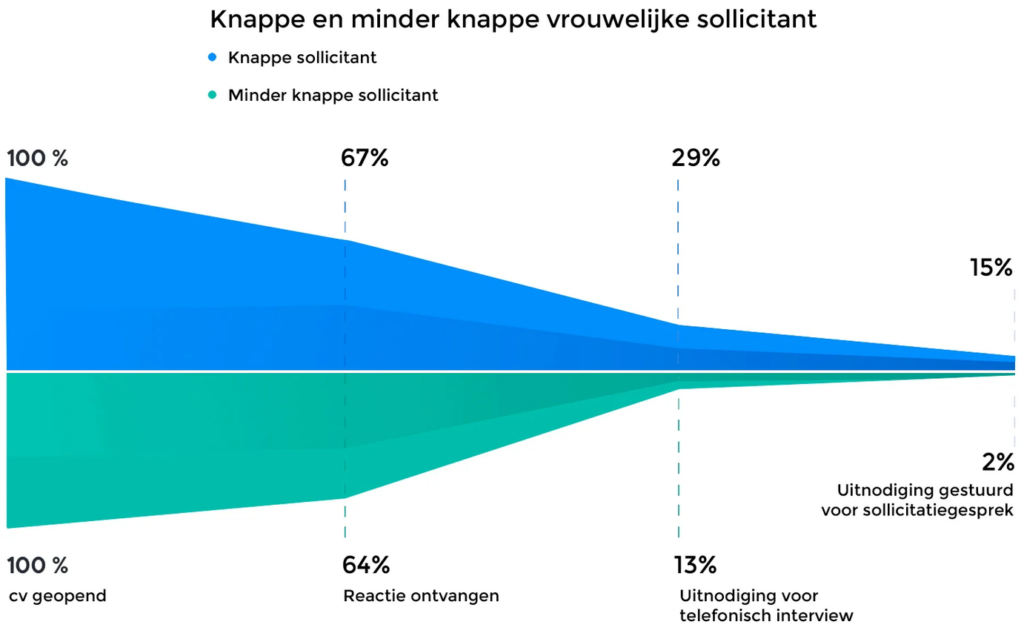
That does not, of course, mean appearance plays no part in recruitment in the Netherlands. Research by the Netherlands Institute for Social Research showed years ago that attractive applicants are 20% more likely to be invited to an interview. In a practical test by CVster, involving nearly 300 applications from fictional candidates, the handsome male applicant received a positive response 73% more often than the less handsome one. The effect was even greater for women.
Economists even have a name for it: the beauty premium or pretty privilege, or conversely, the ugliness penalty. Sociologists sometimes speak of ‘aesthetic capital‘. The term central casting does, of course, refer to something slightly different: stereotyping rather than beauty alone.
Central Casting is a remarkably narrow interpretation of the skills-based hiring Trump claims to champion.
Many commentators cannot ignore the irony, given that Trump was so keen in his Merit Hiring Plan to do away with DEI and restore meritocracy to the labour market. At the very least, we can conclude that Central Casting is a peculiar and narrow interpretation of the skills-based hiring Trump himself claims to champion in that plan.
Read also
All the words of the week. Do you know them all?
- Lump of labour fallacy fallacy (LOLFF)
- The bandwidth contract
- Cohort-based hiring
- AIRD
- The network employer
- NEET
- Motivation purity bias
- Shift shock
- Botsitting
- Hill-climbing
- Time travel
- Brand pedigree bias
- Cybervetting
- New-collar jobs
- Accordion weeks
- Skillfishing
- Forwardfill
- Personality hire
- Lily padding
- Doomjobbing
Related event

Arbeidsmarkttrends 2027-2030
We zijn uitverkocht. Maar goed nieuws! Arbeidsmarkttrends 2027-2030 is volgeboekt. Goed nieuws: op 28 januari 2027 organiseren we een tweede editie, met dezelfde sprekers en hetzelfde programma. Zorg dat je er alsnog bij bent. Bekijk de editie van 28 januari Al jaren geven de beste sprekers en specialisten een arbeidsmarktupdate en een doorkijkje naar de […]
Odido