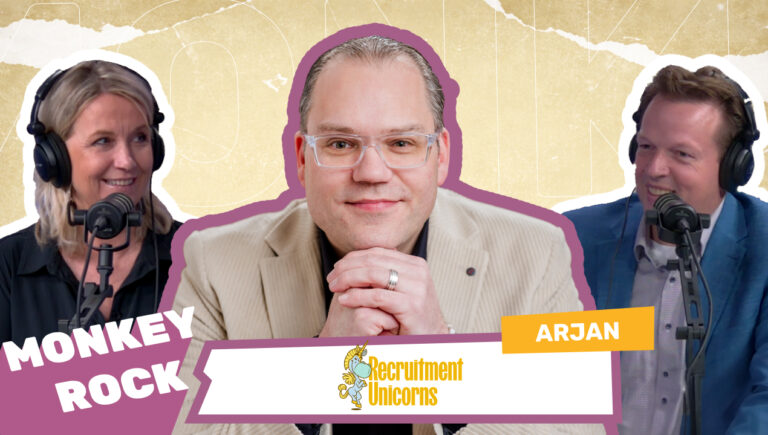
Still, fewer than 20% of all organisations say they officially have an employer branding strategy. But when it comes to all the requests now coming into advertising and media agencies, at least a quarter of them have something to do with employer branding, attendees heard in Amsterdam last week at the first event jointly organised by AdverOnline and IPG Mediabrands, itself known for names such as YUNE, Initiative and UM. ‘You really see enormous growth in budgets for this,’ said Mirande Andreae, client lead at Initiative (right in the photo), during the very first presentation of the day.

Building employer brands is, in short, becoming increasingly important, added AdverOnline director Vanessa Backer (left in the photo). And according to her, it involves the entire journey, from first acquaintance through to possible offboarding. This is where The medium is the message also applies, which was more or less the overall theme of the afternoon. In other words: simply posting vacancies is rarely enough to attract attention these days. Think of the feature film ABN Amro made to find anti-money-laundering specialists, Deloitte’s escape room, or the Defence Ministry’s pilot game. All three are also examples of a degree of preselection.
‘A Gesamtkunstwerk‘
It fits neatly with the story of Ton Rodenburg, strategy director at Rotterdam-based Clubgeist, who gave an impassioned talk about The HeART of Branding. He illustrated it with several examples from his home city, managing to get under the skin of his Amsterdam peers on several occasions. Not so much with his assertion that employer branding is a Gesamtkunstwerk, ‘in which leadership, HR and communications together create that great story well told‘, but rather with amusing slides such as the one below. And this from a man who does not even like football…

Because employer branding is about culture, the heart of a company, Rodenburg believes it belongs at the top of every organisation. ‘Think about how companies such as Coolblue or AFAS do it. They understand how important it is. It really is Chefsache,’ he said.

But even then, according to him, the question is: how do you win employees’ hearts? ‘It starts with: what can you touch? What do you see? When it comes to Rotterdam, that is for example the Erasmus Bridge, which literally represents the space in the city, including the mental space, and the connection between all groups of people, rich and poor. You can also look within your own company for: what is your Erasmus Bridge? What can you touch? What is the one image, the one icon, that tells your story; your brand-worthy image?’
We all knew that Feyenoord kid would grow up some day pic.twitter.com/JoLkrb1qDd
— He Played for Them? (@played_for) February 26, 2015
The second element, ‘and this is where it always gets more exciting’, according to Rodenburg, is the shared value. You cannot touch it, but you can ‘feel’ it, he says. Think of Feyenoord’s ‘young brand ambassador’, Mikey Wilson, who gave the middle finger at a European final as a four-year-old, and later grew into a genuine internet meme. ‘How is it that this little boy is already so enthusiastic about his club? That is that feeling.’ It is what you should also be looking for as an employer in your employer branding, Rodenburg argues. ‘Invest in that energy from within. My conviction is that where brand and culture overlap, that is where people’s energy lies.’
Co-creators
According to Rodenburg, it is ‘a major misunderstanding’ that employer branding is about hiring and recruitment. ‘It is not only about attracting co-creators, but also about inspiring and, above all, developing them. It is about building relationships with all the talent around you. You need to bring everyone along in this every day. Especially the people already working for you.’ For him, development means more than simply having your own Academy or trainee programme, he stresses. ‘Personal development is the most important thing for me in the coming years. But for everyone, not just for the self-proclaimed high potentials.’
Should you even still be focusing on recruiting people who want to stay with your company for 10 years, someone from the audience then asks. After all, nobody stays with an organisation that long any more, do they? But according to Rodenburg, that is a major misconception. ‘Nobody has finished learning after a year,’ he says. It is precisely the people who stay who learn more, he said. Provided that you give them the opportunity to develop themselves and ensure internal mobility. ‘You have to teach people not to walk around the wall, but through it. Because then they learn much more.’
And now… the media
After the break on the sun-drenched terrace, it was the turn of Jessica Groot, strategy director at Initiative, who expanded on how to get Rodenburg’s great story well told in front of the right target group in the right way. According to her, it is not only about selecting the channels with the greatest reach, but also about quality and relevance. In other words, also consider questions such as: what is your competitor doing? What is the umfeld? Is media behaviour lean backward, such as watching television? Or more active and engaged, as with a podcast?’
In labour market communications, it may still be less common to carry out brand tracking research, she said. But according to her, it is becoming increasingly important. ‘After all, you want to know whether your campaign has worked.’ But if you do not conduct such research? ‘Then simply ask your applicants,’ she said. ‘And write down what they say and archive it, so that you can learn from it in future campaigns.’ For its campaign, DJI for example ended up in gyms, where it was able to target its audience of young, sporty men and women, she explains.
She does point out, however: look beyond the figures alone. ‘At DJI, for example, we also chose television adverts. Naturally, you then have a great deal of waste. And the target group, young men, naturally does not watch much linear television either. But those television spots did create authority and urgency. And society as a whole became aware that we were looking for people. Which was also politically important. What is more, it hugely affirmed the choice of the people already working there. So it was about more than just reaching the primary target group.’
Another nice example: Capgemini was once looking for developers. Research among its own employees showed that many of them were big Star Wars fans. That insight then formed the basis for the The Light Side Needs You campaign, a video shown exclusively in cinemas before the film Star Wars The Last Jedi. Afterwards, applications came flooding in almost by themselves.
Emotional connection
Speaking of enjoyable creative examples. Luka Cappetti, content & partnership director at Initiative and the day’s final speaker, was certainly the right person to hear them from. She highlighted the importance of user generated content in employer branding, for instance by referring to a quote from new Unilever CEO Fernando Fernandez, who recently remarked that all stories from large companies are now distrusted, and that the best way to convey your story is therefore to have others, such as influencers, tell it.
@jordiwarners It’s happening!! ?❤️ @Josée B.✈️Floormanager @Schiphol Airport AMS #schiphol #schipholairport #amsterdam ♬ original sound – Jordi Warners And that applies particularly to labour market communications, according to Cappetti. ‘People do not apply for your vacancy, but for what they hear about you as an employer,’ she said. ‘Especially among the large group of passive candidates, it is really important to create that emotional connection.’ The power lies in personal stories, she says. Such as those of the now nationally known floor manager Josée at Schiphol, or John van Grevenbroek from HEMA. Such stories make an employer and company culture ‘tangible’, put a face to employees and at the same time encourage the feeling: ‘I want to work here’, Cappetti said.
@dominosbolsward Would you like to work with us too? Apply at werkenbijdominos.nl!! Hopefully see you soon? #dominos #dominospizza #fyp #tiktoketen #fy ♬ original sound – Domino’s Bolsward Not for recruitment (only)
There are now countless examples to be found on TikTok in particular, especially from retail and hospitality businesses that give a behind-the-scenes glimpse through their employees. But Andy van der Meijde also belongs in the same category, according to her, when he asks DJI employee and senior transport officer Lizette the ‘birthday questions’ we all have about working with prisoners in the car. ‘This video was not developed for recruitment,’ Cappetti said. ‘But it did lead to 381 visits to the vacancy website and 13 applications. So you can see immediate results from it.’
Another example: the Takedown podcast, with which the Police managed to spark the interest of IT specialists in the High Tech Crime Team. Not only a good way to approach the right target group, without much waste, she explained, but also an opportunity to really talk about the substance, which proves important to this target group in their career choices. Again: the medium is already half of the message.
Another example she mentioned also came from the Police: Give a nod to the mod, a campaign that achieved a successful connection with the gaming community, ‘a target group that is difficult to convince with traditional labour market communications’, according to Cappetti.
But she had saved the finest, most moving example until last. It was the NS video featuring Andy, which recently won an award at the Best Social Awards. And once again, a prolonged ‘Aààààààh’ can be heard around the room as we watch Andy’s dream come true.
@nederlandsespoorwegen Andy’s greatest wish: to shadow someone at NS for a day. ?? From making announcements on the train to blowing the whistle at the station. And he does it so well! We are just as proud as he is. ??? #nederlandsespoorwegen #wensdagen #prorail ♬ original sound – NS According to Cappetti, it was a video that not only ‘touches the hearts of travellers and employees’, but also generated a 500% increase in engagement and, through earned media on LinkedIn among other channels, resulted in ‘dozens of applications’ and ‘an enormously positive contribution to NS’s employer image. This reflects on the company’s entire organisation. And note: this was not labour market communication. But it achieved a great deal. It contributes hugely to becoming a love brand.’ And honestly, who would not want that?
Also read


Read this article in full
Become a Werf& member for unlimited access to all articles, research and exclusive insights into the labour market.
No obligations Cancel anytime Secure payment