


A Learning and Employment Record, or LER for short, is a lifelong digital record of what someone has learnt and done. It includes qualifications, certificates, courses, work experience and individual skills, recorded in a standardised, verifiable format. That is the key difference from a traditional CV, which primarily contains what candidates say about themselves. An LER also records who has verified each skill, whether a university, a training provider or an employer. Megan Workmon Larsen of Arizona State University calls it a ‘skills passport‘ that you continue to build throughout your career.
In an LER, candidates manage their own data.
In the US, the term is now commonplace in education and labour market circles. A coalition of 12 American higher education umbrella organisations, united in the LER Accelerator, which launched in 2024 with support from Walmart, drew up 9 principles for its implementation. Ownership explicitly rests with the individual, who manages their own data and decides with whom to share it. A recent report by SmartResume states that the conversation about LERs is shifting from innovation to infrastructure.
The AI-generated CV as a driving force
Why now? The answer lies in the pile of applications on every recruiter’s desk. On the SkillsFWD platform, Larsen describes a recruitment round for 20 part-time student jobs that attracted 2,309 applications. Almost all were the same: the job description had been pasted into ChatGPT or another language model, with a standard CV template and an AI-generated cover letter. She says AI makes CVs uniform and bland, leaving hiring managers barely able to tell candidates apart.

‘An LER does not show what you say you can do, but what has been proven.’
Dave Wengel, CEO of SmartResume, sees this as a threat to the whole movement towards skills-based hiring. ‘If employers cannot trust the skills on a CV, they will not select candidates based on skills either,’ he says. His platform therefore initially presents candidates as a collection of verified skills, without a name or photograph. Larsen, however, is not opposed to using AI in applications as such. Not everything a language model helps to phrase is worthless, she says, but without verification it remains a paper tiger.
From welding videos to ATS
Technically, an LER relies on open standards. With Open Badges 3.0, evidence can be embedded directly in a digital badge, such as a video of someone making a weld. The LER Resume Standard (LER-RS) is intended to ensure that applicant tracking systems can read such a digital CV, including all the underlying data. Where skills cannot be demonstrated directly, third-party assessments remain necessary, according to those interviewed. Candidates can still list anything that cannot be formally certified themselves.
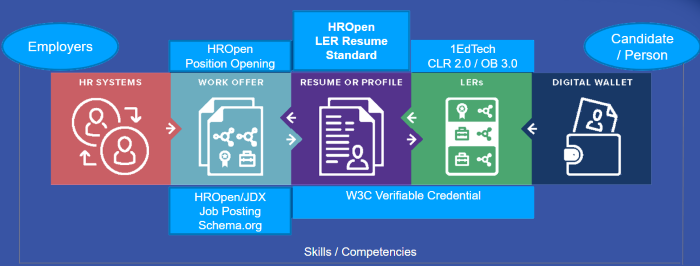
Larsen also warns of a downside. If access to verified credentials depends on what you can afford to pay for them, she says, a system with 2 or even 3 tiers will emerge. The very group that would benefit most from an alternative to formal qualifications risks being left out (again).
The Netherlands: the Integraal Skillspaspoort
In the Netherlands, the same idea is usually called a skills passport. The broadest initiative is the Integraal Skillspaspoort (ISP), which began in 2022 at the initiative of the Amsterdam University of Applied Sciences and HAN. More than 150 labour market organisations now participate, and since April 2026 the passport has been free for all jobseekers and young people. It consists of 3 building blocks.
The SkillsWallet is a personal digital vault in which only recognised organisations may place evidence.
People build a profile on skills platforms. The SkillsWallet is a personal digital vault in which only recognised organisations, such as training providers and providers of prior learning assessment, may place evidence. CompetentNL is the shared skills language, launched in September 2025 and linked to the European ESCO standard. Employers and training providers that want to integrate the system into their own HR or learning platforms pay for it.
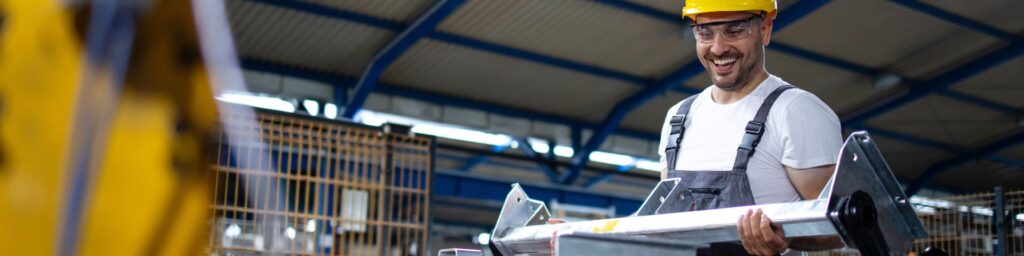
There are also sector-specific initiatives. TNO conducted a pilot using skills passports in the metal and electrical engineering sector, arising from agreements between collective bargaining parties. The construction and engineering sectors have also been using a Digital skills passport through Volandis for some time. In April 2026, the SER published a knowledge document on the path towards a skills-based labour market. On 30 September, 24 trade and professional organisations and trade unions signed a declaration of intent at the SER to work towards that goal together.
‘Promising. But we simply do not know whether a skills passport really works.’
Notably, the Netherlands seems to be using the skills passport mainly to address the mismatch in the labour market and help people move into different jobs, and far less as a weapon against the AI-generated CV. There is also caution about its effectiveness. ‘Promising. That much is true. But we simply do not know whether a skills passport really works,’ TNO researcher Jos Sanders wrote in 2024.
The SkillsCV: skills first, name second
One step short of a passport is the SkillsCV: a CV built not around job roles and qualifications, but around what someone can do. Many Dutch skills platforms allow users to build such a skills CV or skills profile themselves. The best-known provider bearing that name is SkillsCV, a start-up founded in 2020 whose first investors included Intelligence Group and the founders of recruitment agency Westerduin. In 2022, the company raised 2 million euros to launch the app and connect it to government bodies, municipalities, schools and recruiters.
The process is simple. Jobseekers tick their skills or have their experience, qualifications and even hobbies translated into skills. Job vacancies are translated in the same way, after which AI compares the 2. As with SmartResume, the profile is anonymous: personal data is shared only when there is a match. The Zwolle region has been using the app for several years to tackle labour shortages. By the end of 2023, more than 10,000 people there were using the app, with around 250 profiles being added each week.
A SkillsCV shows what someone says they can do; an LER also provides evidence.
The difference from an LER lies in verification. A SkillsCV shows what someone says they can do and removes their name, photograph and qualifications from the initial selection. But ticking the ‘Excel’ box does not prove that someone has that skill. The SkillsCV therefore primarily changes the language of the CV. An LER or a SkillsWallet must also provide the evidence.
Flanders: the government as the source
Flanders has taken a very different route. Following a 2009 decree, it established the Learning and experience credentials database, or LED. It collects diplomas, qualifications, certificates and evidence of experience submitted directly by schools, universities of applied sciences, universities and other training providers. It also contains evidence from prior learning assessment centres, as well as decisions on the equivalence of foreign qualifications.
The City of Ghent uses the LED to check whether applicants have the required qualifications.
Information that people enter themselves on VDAB is included separately as a self-declaration. Citizens can see their data in their digital citizen profile, and public bodies with legal authorisation can request it. The City of Ghent, for example, uses the LED to check whether applicants have the required qualifications.
VDAB also manages Competent, the standard language used to describe occupations in Belgium, along with the knowledge and competencies associated with them. Anyone who creates an account on the site can build a CV with a separate section for competencies. VDAB also uses data from the LED for this purpose. The difference from an LER remains substantial. The LED is a government register of formal qualifications, not a wallet that citizens can take with them to any employer. An LER also collects skills acquired outside education.
Europe: qualifications in the wallet
At European level, the two worlds come together. On 15 September 2026, the European Commission presented the Skills Portability Act, a proposed regulation within the Fair Labour Mobility Package. At its core is the digital issuance of new and recent qualifications in the EU Digital Identity Wallet, which every member state must offer by the end of 2026. Qualifications that are no more than 10 years old will be handled through that wallet.
Every member state must offer the EU Digital Identity Wallet by the end of 2026
Older qualifications will first be verified at source through existing European exchange systems. According to the Commission, only 2 member states currently offer fully digital recognition of qualifications without paperwork.
Just like in America?
For those following the American debate, there is an interesting detail: the digital qualifications must comply with the W3C Verifiable Credentials data model and the European Learning Model. That is the same family of technical standards on which Open Badges 3.0 is built.
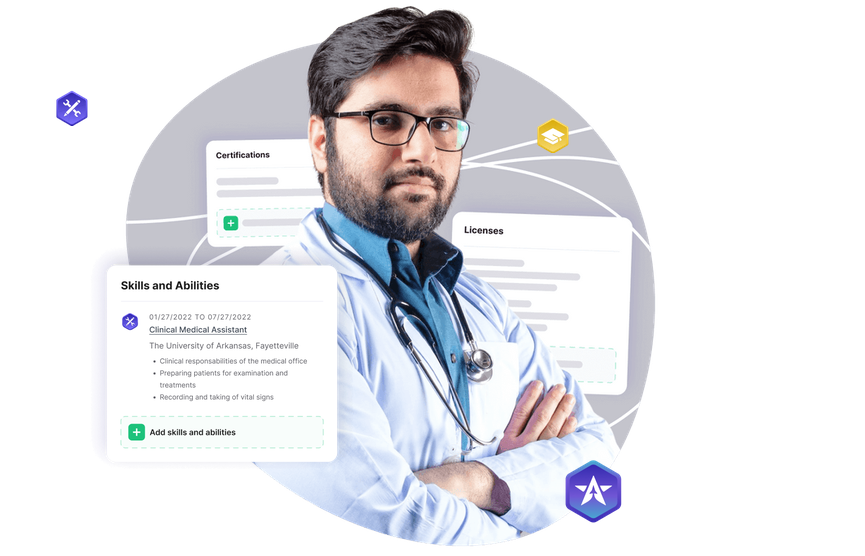
Europe starts with formal qualifications from national qualifications frameworks.
The focus is different, however. Europe starts with formal qualifications from national qualifications frameworks and primarily wants to make it easier to work across borders. The process has not been smooth: the Commission’s internal scrutiny board gave the impact assessment a negative opinion as recently as August. The proposal is now before the European Parliament and the Council. In May, the Netherlands, Belgium and Luxembourg had already sent a joint Benelux non-paper setting out their priorities.
The same idea, many routes
Placed side by side, the starting points are strikingly different. The American LER comes mainly from universities and edtech and focuses on recruitment and selection, with the AI-generated CV as a driving force. The Dutch skills passport is primarily a coalition of knowledge institutions, social partners and platforms seeking to reduce the mismatch, with its own skills language as a foundation.
With the LED, Flanders has had a reliable government source for more than 15 years, but mainly for official qualifications. Europe is now laying the legal and technical tracks, with the digital wallet as the principal vehicle. For recruiters, then, the question is not whether the CV is losing credibility, but which of these routes will ultimately reach their ATS first and lead from there to relevant matches.
Read also
All the words of the week. Do you know them all?
- Central casting
- Lump of labour fallacy fallacy (LOLFF)
- The bandwidth contract
- Cohort-based hiring
- AIRD
- The network employer
- NEET
- Motivation purity bias
- Shift shock
- Botsitting
- Hill-climbing
- Time travel
- Brand pedigree bias
- Cybervetting
- New-collar jobs
- Accordion weeks
- Skillfishing
- Forwardfill
- Personality hire
- Lily padding
- Doomjobbing
Related event
Arbeidsmarkttrends 2027-2030
We zijn uitverkocht. Maar goed nieuws! Arbeidsmarkttrends 2027-2030 is volgeboekt. Goed nieuws: op 28 januari 2027 organiseren we een tweede editie, met dezelfde sprekers en hetzelfde programma. Zorg dat je er alsnog bij bent. Bekijk de editie van 28 januari Al jaren geven de beste sprekers en specialisten een arbeidsmarktupdate en een doorkijkje naar de […]
Odido


