In April 2026, vacancies at the 25 largest European defence companies – as measured by job site Indeed – were around 65% higher than before the war in Ukraine, in 2021. Over the same period, the total number of European vacancies actually fell by around 15%. The defence sector is therefore performing significantly better than the wider European labour market. But strikingly, the Netherlands is a major exception. The share of defence-related vacancies here fluctuated around 2% between January and April 2026 – in line with previous years, when the share varied between approximately 1.7% and 2.5%.
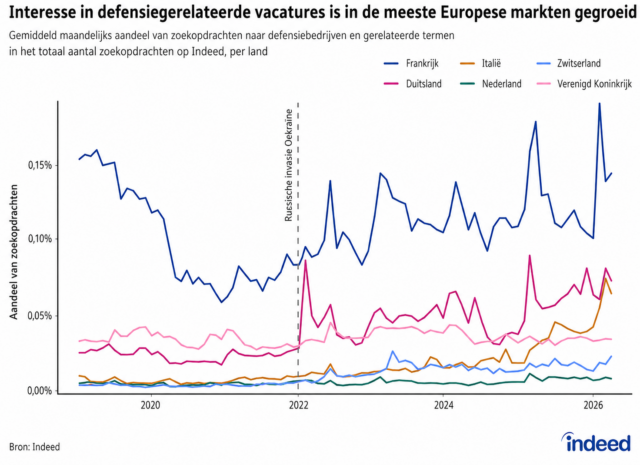
The Netherlands deviates from the European pattern.
There is therefore certainly no sign of structural growth. And not only the number of vacancies at defence companies, but also the behaviour of Dutch jobseekers has shown hardly any structural growth in recent years. The number of defence-related searches did increase after 2019, but following a slight peak in 2023, search volume has recently stabilised at a level that is higher than before 2022, but without any further upward trend. Meanwhile, the interest of other European jobseekers in defence jobs has been structurally higher since 2022. The Netherlands therefore deviates from the pattern.
France dominates
The European defence landscape is dominated by 3 countries, with France standing out. The country accounts for approximately 33% of open vacancies, followed by the United Kingdom (20%) and Germany (19%). The Dutch share is negligible by comparison. Italy is a notable outlier: whereas the country accounted for only around 1% of all European defence vacancies in 2020, this share had risen to more than 12% by 2026.
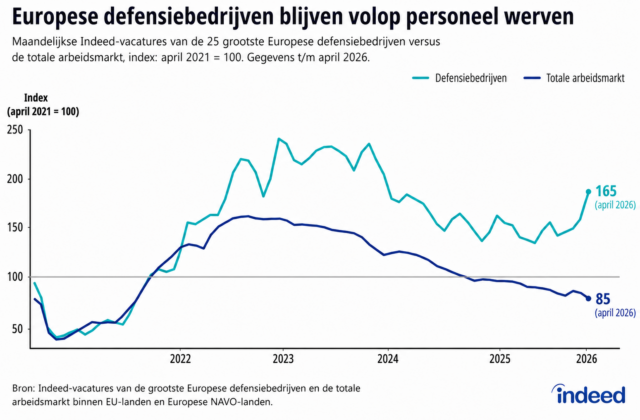
So what exactly are defence companies looking for? Demand is driven by technical talent. Three occupational groups stand out within the European vacancy mix: production and technical roles (15%), software development (15%) and engineering (around 12%). According to Indeed, this reflects the increasingly technical nature of the sector, in which software, hardware and industrial production are becoming ever more closely intertwined.
SIPRI list
Indeed’s analysis is based on vacancies from 25 of the largest European defence companies in the EU, other European NATO member states and Switzerland, taken from the top 100 ranking of SIPRI, including companies such as Airbus, Rheinmetall and Saab. For subsidiaries within larger corporate structures where the share of defence activities in total turnover is below 20% (such as Thyssenkrupp Marine Systems and Airbus Defence and Space), data collection was carried out through keyword-based extraction in order to select only vacancies from the defence divisions of the relevant groups.

Read also
Related event
Arbeidsmarkttrends 2027-2030
We zijn uitverkocht. Maar goed nieuws! Arbeidsmarkttrends 2027-2030 is volgeboekt. Goed nieuws: op 28 januari 2027 organiseren we een tweede editie, met dezelfde sprekers en hetzelfde programma. Zorg dat je er alsnog bij bent. Bekijk de editie van 28 januari Al jaren geven de beste sprekers en specialisten een arbeidsmarktupdate en een doorkijkje naar de […]
Odido
Indeed
Op Indeed vinden meer mensen een baan dan waar dan ook. Indeed is de nummer 1 vacaturesite (SimilarWeb, totaal aantal bezoeken, juli 2024), niet alleen in ons l…