The figures for Indeed and LinkedIn are impressive, there is no denying it. Almost half of the 33 billion dollars in revenue (49.8%) and more than 90% of all profits generated worldwide by job boards end up in the pockets of both powerhouses. In terms of market share and market dominance, Europe is not much different. Whilst around 13,200 job boards are active in Europe, 44% of the European workforce (actively seeking employment) prefer Indeed or LinkedIn. That is the average, with peaks of 72% market share in Italy and 62% in the Netherlands, according to data from Intelligence Group.
It seems unlikely that an outsider will be able to challenge one of the two, let alone both, in the coming years.
It seems unlikely that an outsider will be able to challenge one of the two, let alone both, in the coming years. Unlikely, but not impossible. Although it seems more likely that both LinkedIn and Indeed will further expand their positions in the years ahead. They also see each other as their biggest competitor, which drives innovation. For many experts, the level of innovation from both is still modest, but the other job boards are lagging much further behind. And LinkedIn and Indeed’s lead in this area therefore remains unchallenged.
Data on quality of hire
The most important innovation from both LinkedIn and Indeed is that they are currently collecting a great deal of data on the (quality of) hire, enabling them to improve their matching significantly. A strong service that recruiters are very pleased with, and which further strengthens both parties’ lock-in and market power. Take, for example, developments around disposition data that Indeed is focusing on. What not many people are talking about is that Indeed users are ‘required’ to use the Disposition Data API linked to the ATS. As with LinkedIn, the entire process is thus measured.
Indeed users are ‘required’ to use the Disposition Data API, linked to the ATS.
This involves tracking and sharing the outcomes and stages of the application process and the disposition statuses, such as: ‘hired’, ‘rejected’, ‘invited to interview’, ‘candidate withdrew’, ‘no-show’ and ‘vacancy filled’. With the help of this data, the performance of vacancies can be optimised, matching algorithms can be improved, the ROI of job postings can be demonstrated and, naturally, they can further increase their pricing tiers.
Money back?
It becomes interesting if Indeed also wants the disposition data from vacancies and campaigns that were not posted through Indeed or that are the result of other media activity. Many agencies and companies will resist this because data is power, and it means losing bargaining power in relation to Indeed. But with this data, Indeed can both deliver better matches and further increase lock-in and dependency. At the same time, it also reveals the extent of ‘fake and irrelevant applicants’ delivered through Indeed. Employers could receive money back from Indeed for this.
It becomes interesting if Indeed also wants the disposition data from vacancies and campaigns that were not posted through them.
Indeed is therefore making strong progress, and it cannot be ruled out that video will also play a more important role in the coming years, just as it already does at LinkedIn. Innovations at Indeed also appear to be emerging in the field of skills and skills matching. And what about the other powerhouse, LinkedIn? There, at least, the biggest weakness appears to have been addressed when it comes to matching. LinkedIn’s matching has been the laughing stock of the recruitment industry for more than 10 years, but according to Alex Fourlis, General Manager of Veritone Hire and recently a guest on Chad & Cheese, the company is now making enormous strides in this area (in America).
Possibly partly prompted by the A.I. of OpenAI, to which LinkedIn owner Microsoft has access. Fourlis says, among other things: ‘the cost per qualified applicant for LinkedIn is the best performing in North America. It’s one out of three of applications that convert to a quality application.’ And he adds: ‘with all the investment on A.I. and general A.I. going across Microsoft right now, I won’t be surprised that we see leaps and bounds of improvements on the candidate site. So why not the same kind of like improvements being on the employer side of the matching?’
Resistance too
From a business perspective, the dominance of Indeed and LinkedIn is undoubtedly impressive. As are their clever lock-in strategy and the extent to which agencies and corporates have become dependent on these two parties. But this naturally also provokes considerable resistance. First and foremost from the tens of thousands of competing marketplaces around the world, but also from all the (temporary staffing) agencies and corporates that have to pay (much) more every year for results that are not always greater or better. At the same time, agencies still earn many times more from them than they pay, so these are crocodile tears too.
The dominance of LinkedIn and Indeed naturally also provokes considerable resistance.
But the resistance is understandable on the other hand too. My advice would therefore be to (1) embrace all innovations from these parties immediately rather than resist them; (2) not put all your eggs in one basket; and (3) never enter into contracts for longer than 2 years, and preferably shorter, as you need flexibility in this market. Always use alternative channels alongside Indeed and/or LinkedIn, that is my advice. In the Netherlands, for example, you might think of werkzoeken.nl or The Talentpool Community, but think more broadly too: from Google, Meta and TikTok to referrals and internal mobility.
Other threats
In addition to overconfidence from LinkedIn and Indeed and the resistance this may provoke among recruiters, the two powerhouses face other ‘threats’ too. A few are listed below:
#1. Google ‘penalises’ non-market leader Indeed
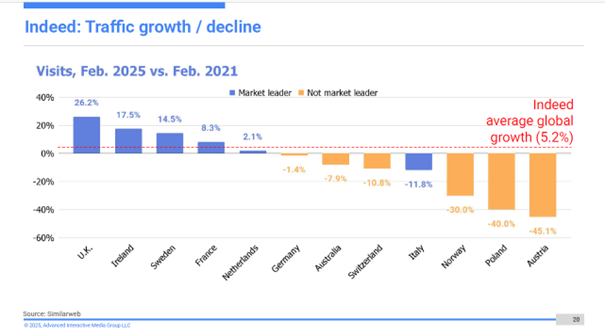
A presentation by Jonathan Turpin at Recbuzz 2025, one of the best labour market and recruitment conferences in the world, shows that Google rewards market leaders with additional traffic. In countries where Indeed is the market leader, its position is growing. In countries where it is not, it is losing ground. As Indeed still has a major dependency on Google, it will become harder for it to grow strongly in countries where it is not yet the undisputed number 1.
#2. A.I. as a dark horse
It will also be interesting to see what effect the rise of OpenAI, Claude, Perplexity, Gemini, DeepSeek and the like will have on jobseekers’ search behaviour. Agents, LLMs and generative A.I. could be the dark horses that shift the hegemony of LinkedIn and Indeed. For now, there is no sign of this, but something like that can happen quickly. It is then interesting to look at the developments of, for example, Rozeegpt.ai from Pakistan.
#3. Niche players and local champions
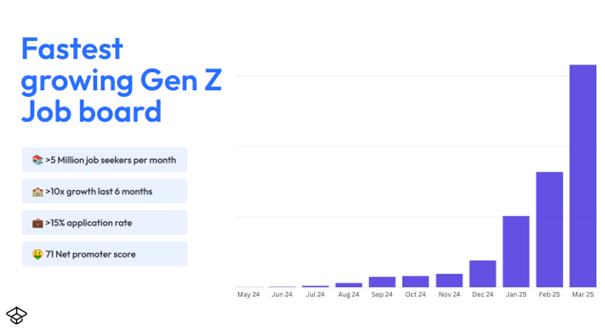
In places where LinkedIn and Indeed are not yet market leaders, it will be difficult to win that position. Local champions and strong niche players (such as StudySmarter) can often hold their own very effectively for quite a long time. It is only through acquisition that Indeed can then become market leader, unless an existing market leader squanders its position and retreats further and further, as we have seen in Norway with finn.no (and in Germany with Xing).
The rise of StudySmarter illustrated
#4. Niche tech stack
Make sure technology suits the target group you want to serve and become an expert in that domain. So be very good at video, mobile, integration with particular ATS or VMS systems, or master the niche of freelancers/self-employed professionals, or be strong in international mobility or knowledge and labour migrants. In this way, you strengthen the niche through superior mastery of the tech stack. The latter gives you an advantage over LinkedIn and Indeed that cannot be caught up in the generic field.
#5. Poor security
Indeed and LinkedIn are breeding grounds for fake, fraud, scamming and insecurity, such as harassment of women and identity theft. LinkedIn is already trying to put a stop to this with verified profiles, but this is only modestly effective at best. For Indeed, it is barely part of its strategy, whilst its CV database is naturally a goldmine for global fraudsters. Focusing on security for employers, workers and jobseekers is one of the most important assets of marketplaces in China and South-East Asia, for example. It could easily become so in Europe too.
#6. The candidate not at the centre
Whoever can deliver the most added value for jobseekers will ultimately win the contest. I would not be surprised if a new generation of ‘marketplaces’ emerges, which turn out to be primarily A.I.-driven agents, with a perfectly integrated tech stack, placing candidates’ wishes at the centre, such as: what people want to earn, where they want to work, how long they want to work, when they are paid and what they would like to do (a kind of skills, but different). And then enabling them to apply easily and safely via video or a standard profile.
As long as they do not lose the candidate’s goodwill, it will be difficult to beat LinkedIn and Indeed.
For now, LinkedIn and Indeed are setting the tone in the market. And they are doing so better than the rest because they continue to innovate and know exactly which recruiter buttons to press. The conclusion is therefore: as long as they do not lose the candidate’s goodwill, it will be difficult to beat them. But… nothing lasts forever. That is why I am also very curious about all the new developments and challengers, such as The Talentpool Community, Rozeegpt.ai and Mercor. Although, if I were Mercor, I would not have chosen an M that looks so much like Monster’s. On the other hand: they are already worth 2 billion. So who am I to have an opinion about that?
Read also

Indeed
Op Indeed vinden meer mensen een baan dan waar dan ook. Indeed is de nummer 1 vacaturesite (SimilarWeb, totaal aantal bezoeken, juli 2024), niet alleen in ons l…