Migrants and people with a migrant background are more likely to be unemployed than people with a Dutch background, as research by Statistics Netherlands (CBS) recently showed. The question, of course, is why? CBS lists a whole range of possible causes , from age to level of education. Strikingly, one explanation that research strongly suggests is not given in the accompanying report: discrimination.
‘Labour market discrimination in the Netherlands is not an isolated incident; it is more of a pattern.’
According to CBS, the unemployment rate among migrants rose from 5.8% in 2024 to 6.9% in the first three quarters of 2026. Among people born in the Netherlands with one or two parents born abroad, unemployment also rose, from 5.3% to 6.0%. To be honest, those figures do not surprise me. As a researcher in the field of discrimination, I am familiar with many studies showing that labour market discrimination in the Netherlands is not an isolated incident: it is more of a pattern.
A subjective experience?
Victims of discrimination are often told that it is ‘just a feeling’ that they are being discriminated against. That it cannot be proved and that there are supposedly no hard facts. But researchers use field tests to demonstrate discrimination. In these field tests, researchers send large numbers of CVs to employers and record their responses. The CVs are all identical except for one thing: the name, the country of birth or the photograph. This enables researchers to establish precisely whether Mark, with the same CV, is more (or less) likely to be invited to an interview than Mohammed.
And what do they find? A different name alone can make a big difference to whether or not you are invited to a job interview. In one of those studies, an applicant with a Dutch-sounding surname was 60% more likely to get through the initial selection than an applicant with an Arabic-sounding surname. And if a CV lists a country of birth that is perceived as Muslim? That person is less likely to be invited to an interview than someone with exactly the same CV listing the Netherlands as their country of birth.
The situation in the Netherlands is not so good
And it does not stop there. People without a migrant background who have a criminal record for a violent offence are even more likely to receive a positive response to their application than people with a migrant background without a criminal record.
And if you think things are probably not so bad in the Netherlands compared with other countries, I have bad news for you. An applicant with a Moroccan background is less likely to be invited to a job interview in the Netherlands than an applicant of Moroccan origin in Spain. And an applicant of Turkish origin is less likely to be invited to an interview in the Netherlands than an applicant of Turkish origin in Germany.
As an applicant of Turkish origin, you have a lower chance in the Netherlands than in Germany.
In addition, research shows that discrimination based on skin colour is just as prevalent in the Netherlands as in the United States. And possibly even more so. We do not know exactly whether labour market discrimination has increased further recently. But in 2023, it was found that this discrimination remained stable in other countries. In the Netherlands, by contrast, there appears to be an increase.
What now?
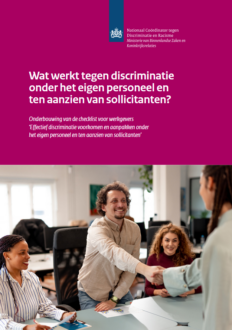
The good news? Something can be done about labour market discrimination. There are various approaches, as described in a ‘gold standard’ for employers. These approaches are supported by scientific evidence. First, there is the method of objective recruitment and selection for the selection stage. This means assessing candidates as fairly and impartially as possible. Rather than being guided by whether you feel a connection with someone, you assess only the competencies, knowledge and skills required for the role.
Who do you picture when you think of ‘a cleaner’? And who when you think of ‘the director’?
This objective method helps prevent you from being influenced by prejudices or stereotypes. Everyone has prejudices. Here is an example. Suppose you think of a ‘director’. You might unconsciously picture a white man. The word ‘cleaner’ will probably bring a very different image to mind.
Biased and Kahneman
This is explained very skilfully in the book Biased by Professor Jennifer Eberhardt. That book really ought to be on every recruiter’s desk. As should the book Thinking fast, thinking slow by Nobel laureate Daniel Kahneman. To save you some reading: Kahneman explains that objective recruitment and selection not only prevents discrimination, but also helps you find the best candidate for the role.
A win-win situation, then. An increasing number of organisations therefore seem to be making, or wanting to make, the move towards objective recruitment and selection. After all, no employer should accept that a surname and place of birth can still have more influence on someone’s chances of getting a job than talent and skills.
About the author

This article was written by Hanneke Felten (senior project leader and discrimination researcher at Movisie).
Read also
Related event

Leergang Strategisch Recruitment | UITVERKOCHT
Ben je klaar om je recruitmentcarrière naar een hoger niveau te tillen? De Leergang Strategisch Recruitment biedt je de perfecte mogelijkheid om je kennis te verdiepen en je professionele groei te versnellen. Als ervaren recruiter of recruitmentmanager ontwikkel je strategische inzichten en vaardigheden die je een sterke en leidende gesprekspartner maakt voor het management. Je […]
Rotterdam