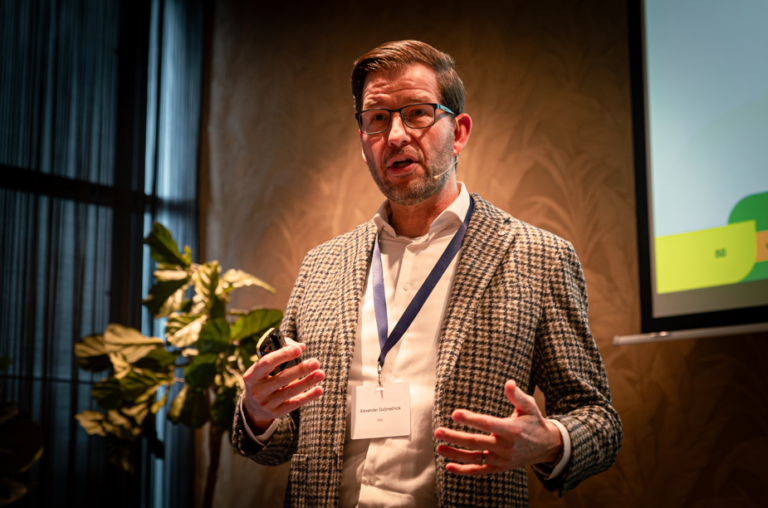
As if to make it clear that they mean business, no fewer than five of them have turned up for the interview appointment. Head of sales Henke van Homoet and business development manager Paco de Heij arrive in Haarlem together with Timetohire CEO Edwin de Jonge, where Stefan Ebbeling and Remko Booghmans are already waiting to welcome them with open arms on behalf of Recruitment Marketeers. The mood is buoyant. Jokes fly across the table, and the fridge is nearly empty. It quickly becomes clear: this is a group of people who genuinely like one another.
‘We simply click.’
And that is precisely the purpose of this interview. Because the whole world may now know: the RPO specialists at Timetohire are going to work closely – and mutually exclusively – with the conversion and communication specialists at Recruitment Marketeers. There is no merger in sight for the time being, but they do visit each other’s clients together frequently and support one another wherever possible. ‘We simply click’, says Ebbeling. ‘It is not a marriage. But feel free to call it more than a casual fling – a quality fling’, he says with a laugh.
Municipality of Zuidplas
It started when Timetohire was working on an assignment for the municipality of Zuidplas and wanted to bring in additional recruitment marketing expertise. ‘That is how the ball started rolling’, De Jonge explains. ‘We had invited a few parties, and with Recruitment Marketeers we immediately felt a connection.’ And now they visit each other regularly. Quite literally every Friday, when several people from Recruitment Marketeers work at the Timetohire office and share knowledge with one another. ‘We really want to invest in each other’s knowledge and expertise, otherwise it will not get off the ground’, says Booghmans.
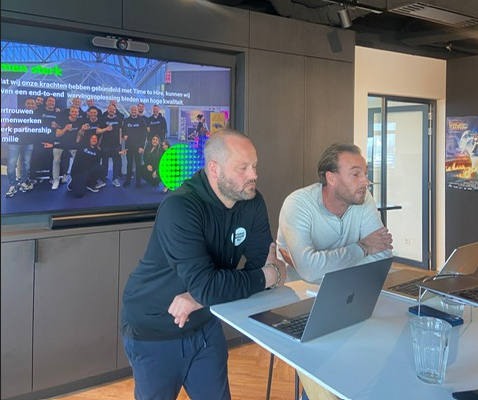
If you approach it properly, the work complements each other well, he believes. ‘Implementing a good recruitment process is just as important as the campaign itself. That determines success. We are well able to reach and enthuse people. But if your process is not good afterwards, a good campaign is of no use to you. That is why I am so pleased with this collaboration. Timetohire keeps very close to the action and understands what is needed for a good process. Together, that can create something wonderful, from which the client can only benefit.’
National Careers Fair
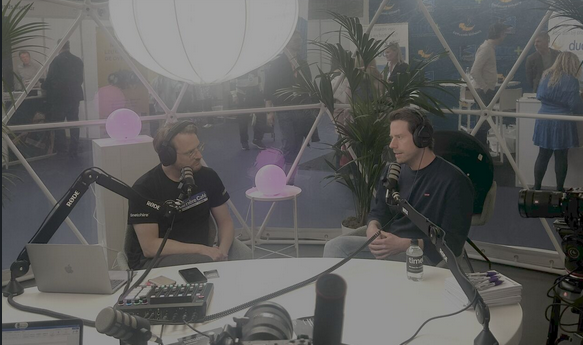
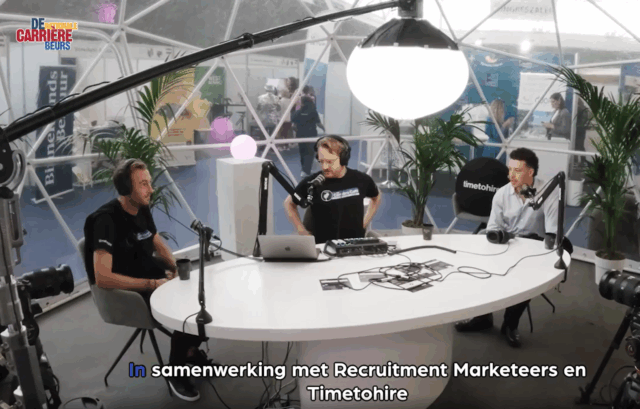
That there is a mutual connection became apparent, for example, last month, when both parties set up a mobile podcast studio together at the National Careers Fair and recorded no fewer than 23 podcasts in two days. ‘A fantastic collaboration’, De Heij recalls. ‘You are working together at a fair, you simply start early and finish late. And then you notice that the energy between you is good. We often only need half a word. I genuinely think those podcasts turned out at least five times better as a result than we had expected beforehand.’
It also helps that both companies cover very different parts of the recruitment world, whilst sharing core values, De Jonge adds. ‘Giving each other trust and delivering good work must come first. We have also worked with groups where the financial model became the leading factor. But in our view, you are approaching it the wrong way then. It is a short-term vision, not a sustainable model.’ Booghmans: ‘And in our view, the success of campaigns lies precisely in building sustainable relationships with the client. In our experience, that always improves the result.’
A great deal of opportunism
In that respect, Booghmans has something else to get off his chest. He currently sees quite a lot of parties appearing that claim to understand recruitment marketing, but deliver little in practice. ‘There is a great deal of opportunism in the market’, he says. ‘Many regular marketing agencies are entering the field now, despite having zero knowledge of recruitment and zero knowledge of data. Yet they suddenly start making claims about the copy and the content, and about which channels can reach the right people at the right time. But an application is still very different from wanting people to put something in their webshop basket.’
‘We want to avoid aggressively selling each other’s products and services across the table.’
But this raises the question: if recruitment is so different from ordinary marketing, why not enter into a full marriage? ‘We do believe that we are best at selling ourselves. We want to avoid aggressively selling each other’s products and services across the table. Communicating that story as well as we do for our own organisation, or as Recruitment Marketeers does for theirs, is almost impossible’, says De Jonge.
Introducing each other
It always starts with the relationship, Booghmans adds. Simply making an introduction for the other party, and following it up properly. ‘So far, that has actually been quite successful.’ As at Strukton, where Timetohire provides in-house recruiters through an RPO arrangement and also introduced Recruitment Marketeers. De Jonge: ‘I also think it is sometimes more powerful when you say: look, this is what we are very good at. But this may not be our expertise. Fortunately, I know a party that is very good at it.’
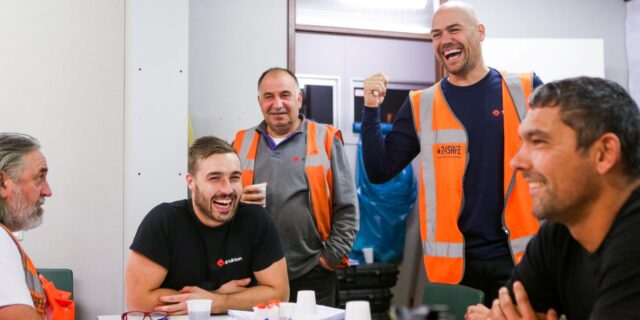
Image: Strukton careers site
‘For us, it is very helpful in turn to work with recruiters who are based at a client’s site’, says Booghmans. ‘You always gather more information that way than through a standard briefing. You get a better understanding of the question behind the question. Why should someone want to work there? Sometimes it is quite difficult when we are brought in somewhere and the client says: I need ten fitters by yesterday, just create a campaign. Of course, we can do that. But it is much nicer when you have more information from the client themselves, and are physically present there too so that you can ask those questions. You pick up much more.’
Talent follows talent
Back to that exclusivity for a moment, says De Heij. ‘You can place your vacancies with five agencies, or with just one. I think you see more ROI when you have one partner. That is how it works for us with Recruitment Marketeers. You gain more speed, understand each other better, and can help each other improve.’ As happens, for example, during the lunch & learn sessions at the Timetohire office, where mutual knowledge sharing is central. De Jonge: ‘It is about the quality you deliver yourself and also expect from your partner. Listening to your client, but also delivering. I strongly believe that talent follows talent, and I think you can see that here too.’
‘I strongly believe that talent follows talent, and I think you can see that here too.’
The continuing scarcity in the labour market works in their favour, they are convinced. ‘The story you tell as an employer is becoming increasingly important’, says De Jonge. ‘And so is continuing to tell that story. No one-offs. If you let go of continuity, it always quickly dries up in practice. Keeping it going is always the hardest part.’ But at the same time, it is hugely important, he says. ‘It forces you to think: which people do you want to attract? And how exactly do you want to do that? You do not want to simply pick people up off the street. You do not want to make your recruitment dependent on getting lucky once. It is too crucial for that.’
More than CTRs
Booghmans agrees. ‘Creating a campaign is not that complicated in itself. But creating a special campaign that precisely meets the need? That really is a profession. Sometimes I think myself: if only we had applied the brakes a little earlier. Efficiency does not always lie in targeting, but often in the content as well. It has to be honest and accurate. After all, it is not only about bringing people in, but also about keeping them. You can already see that at Strukton, where it is not only about, for example, CTRs, but also about: how well does that person really fit the profile? For me, that is also where the major benefit of working with Timetohire lies.’
‘The value often lies beyond just that hire’, says De Jonge. ‘In that respect, recruitment is often still a strange market. We still encounter many hiring managers who say: I need three candidates tomorrow. Just imagine a sales manager saying: I need three clients tomorrow. Everyone knows that is not how it works. Why should it be any different in recruitment? There too, you always need more touchpoints. So it is also up to us to strengthen that understanding in the market. And the fact that we are doing it together now only makes it stronger. Others naturally do not have that distinctive capability.’
The next step
Well then, one final look ahead to – let us say – 2030. Can they see themselves tying the knot together by then? ‘Above all, we want to be the best in recruitment’, says De Jonge, keeping his answer somewhat open. ‘At every company that wants to take recruitment seriously, we should at least be on the shortlist by then.’ But Booghmans is slightly more outspoken. ‘It could well be the next step, I do not rule it out. Perhaps there will be two logos on the door then, perhaps only one. But in any case, there will still be two areas of expertise.’
‘What matters to me is this: together means together. It does not mean alone, with someone else.’
Just give it some time, he says. ‘A bit of ping-pong, literally and figuratively’, referring to the table tennis table behind him. ‘At the moment, we are mainly focused on: how can we do the best possible job together for a client? We do not need to become an elephant either. It is about making an impact. But what matters to me is this: together means together. It does not mean alone, with someone else. That forms the basis for everything. Because what we can achieve together here cannot simply be replicated by any random RPO or marketing agency.’
Read also