She herself also started there ‘of course’ in one of the shops. And yes, that was during the weeks around Black Friday too. ‘Like so many employees here at head office’, says Sanaa van der Klooster, who has been Talent Acquisition Partner for the 54 Dutch branches of MediaMarkt for about a year. And now it is up to her to ensure that none of those branches is short of staff during these most important weeks of the year for the originally German media company. What does that involve?
> Let’s start broadly. What is your biggest recruitment challenge?
‘Our roles are quite attractive, particularly to younger people. They combine well with school or other jobs: you can work at weekends, in the evenings, very flexibly on a part-time basis. An ideal side job, then. The challenge, of course, is that school always takes priority. Planning ahead can therefore be difficult at times, I hear from the shops. If there is an exam week in between, or someone has to work on a school project, that naturally always comes first.’
> Are you different from other retailers in that respect?
‘I think it is a challenge for all retailers, in fact for all companies targeting a young demographic. We have a huge number of shops, 54, all of which recruit most of their young staff for sales and checkout service roles.’

‘Young people and more experienced people are interested in different departments.’
‘Of course, the products are great too, so you quickly appeal to a young demographic that finds them interesting. More experienced people, for instance, often find the white goods department, with washing machines, more interesting. In those departments, you see that the team is made up differently. I also think customers may be looking for more experience and reliability there, although there are also very good salespeople in the white goods department who are young.’
> How do you translate that into practice? Do you prefer to recruit older people for white goods?
‘We deliberately work with flexible contracts and fixed hours. So it simply depends on a candidate’s preference and what fits their life. That creates a great dynamic in the shop: you have the faces that are always there and the faces that step in from time to time. The most important thing, I hear from the shops, is that there is a connection with a candidate. Whether someone is very good at selling TVs, smartphones or washing machines is secondary. The key thing is that there is a connection and that someone is genuinely willing to learn.’
> What is the balance between what you do centrally and what the shops do?
‘Previously, the entire recruitment element was handled in the shops. That naturally takes an incredible amount of time for the shop manager: posting vacancies, monitoring them, closing them again, carrying out a screening among all the CVs that come in. We have recently taken that part, especially the administrative side, completely off the shops’ hands.’
‘A shop now tells us, for example: I want to open three vacancies for this department. We then make an initial selection from the CVs. Every shop naturally has slightly different needs, but we look at what matches the role. Some shops, especially outside the major cities, consider it very important that someone speaks fluent Dutch.’
‘Some shops consider it very important that someone speaks fluent Dutch.’
‘We look at that, then pass the CVs on to the shops. Often, the shop manager takes it from there; at our company, that role is called the CCO, the Chief Customer Officer. There are also shops where someone from the management team takes it on. And in very large shops, the CVs are further divided among the team leads. Based on the CV, the shop tries in any case to call everyone briefly to get a first impression.’
> But a CV from an 18-year-old does not tell you very much, of course.
‘No, that is true. We came up against that very often with this younger group. Sometimes we did not even receive a CV, but a photo of something. Or there was no CV at all. That is why MediaMarkt has also had an AI tool for several months now. Naturally, we are keeping up with AI, especially with that young demographic.’
> Did you develop it yourselves?
‘It was partly purchased and partly developed in-house by our colleagues at the parent company in Germany. For now, we use it for our sales roles, because those are the roles all branches are looking for most. A candidate can choose to have a conversation with the tool. It asks things such as: where have you worked before, what did you learn there, what do you enjoy? But also the hard requirements: how many hours are you available, and on which days? That quickly provides more information than a CV usually shows.’

‘We in the Netherlands were the first to test the AI tool.’
‘A shop can then see very quickly: okay, this person is available on Saturday and Wednesday, which is exactly what we need. We are now developing it extensively, and we in the Netherlands were the first to test this tool.’
> Can you already say anything about how it is being received?
‘Candidates respond very positively, particularly the younger demographic. They find it very interesting and are already somewhat used to it: everyone asks ChatGPT things these days. For that demographic, it is completely normal. Reactions among older demographics are a little mixed. You still hear people say: I’ll just take the regular route. They often already have a CV. And that option is naturally still available too; you can still apply via the regular route.’
> And what about the shop managers?
‘It took some getting used to for them. Naturally, they are all very accustomed to CVs. Based on the conversation with the candidate, this tool also creates a CV: this candidate has so many years of experience at that organisation. It also looks at skills. This candidate is probably good at human interaction because they learned that in this role. In addition, the AI tool transcribes the entire conversation, so you can read it back. There is also a short summary with the highlights from the conversation: this is what the candidate is really excellent at, and this is what they are suited to.’
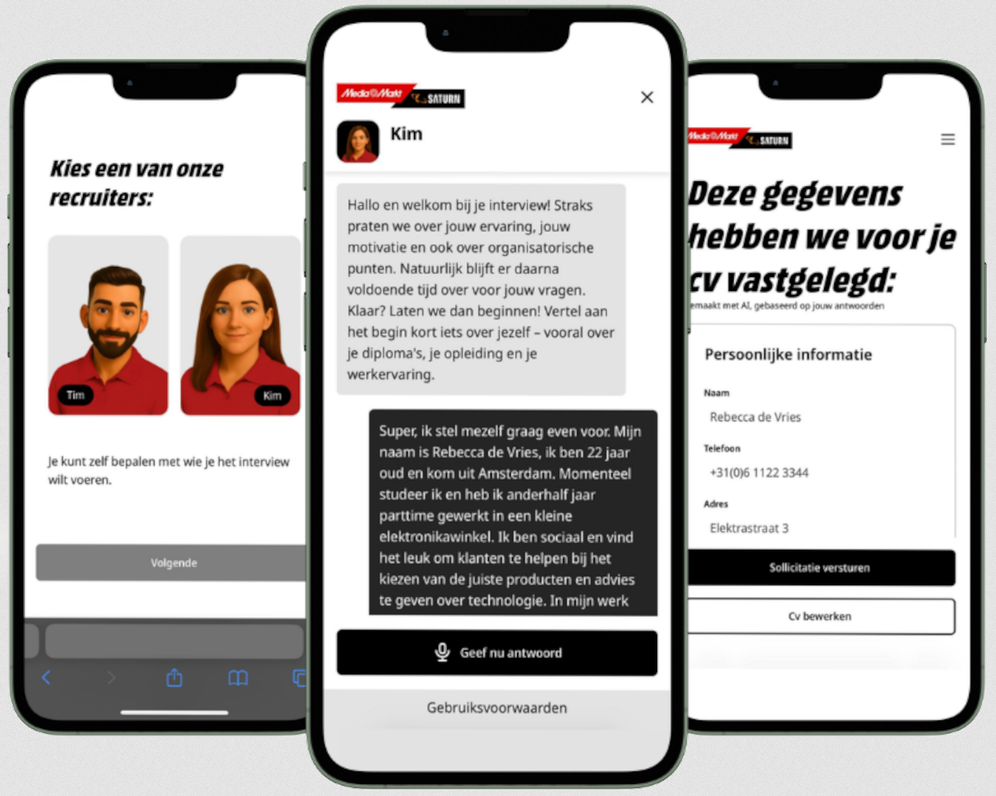
‘Normally, you open a CV and quickly see: this person appeals to us, this person is not a fit for this role. At first, it took some getting used to because there is an additional document with extra information. But I notice that many shops respond very positively to it. It can occasionally be a little difficult; the CV is compiled from the information a candidate provides. If someone is naturally brief and shares less information, you also get a short and limited CV.’
‘If someone is naturally brief and shares less information, you also get a short and limited CV.’
‘But after the conversation, the candidate still has room to view and amend their CV. If you have forgotten how long or since when you have worked somewhere, you can add that yourself later. That is done manually: candidates see the CV before submitting it and can make changes by typing.’
> You just mentioned the willingness to learn. What do you offer to support that?
‘We regularly hold progress discussions with employees: where do you see yourself in a year’s time, and what interests you? A large group are students, and we often map out: if you are taking that course, you could eventually go in this direction with us. For example, towards our head office. A great many people at head office came from the shop floor, including me. Then you have a MediaMarkt heart, as we call it.’
‘Someone who has worked here for some time knows which levers to pull.’
‘At the very least, you know how it works. That is also a real preference in the shops. When they are looking for people for more senior roles, such as management roles and team leads, it simply works best when someone from the current team is suitable. It is a large organisation, you receive a great deal of information at the beginning and it really takes some time to find the right people. Someone who has worked there for some time knows which levers to pull. That is why we really focus on supporting people in their careers. And that is why eagerness to learn is so important: then we also see long-term potential in someone.’
> What really distinguishes MediaMarkt in your view, apart from the product range?
‘I think MediaMarkt is an organisation where anything is possible. You do have to roll up your sleeves yourself, but there are so many opportunities, almost unlimited opportunities. If you come up with a really good idea yourself, whether at head office or in a shop, there are always people willing to listen to your plan and think it through with you. Everyone is also genuinely keen to help one another, and everyone is very driven.’
There is such a drive behind this company; you can feel it everywhere.
‘At the moment, everyone at every level of the organisation is focused on Black Friday, because as an organisation we want to achieve the best results together. People who are in the shops from early morning until late evening, people supporting the shops from head office. There is such a drive behind this company; you can feel it everywhere. Especially around Black Friday, which is always the moment when we go full steam ahead with recruitment.’
> How do you approach that?
‘We do not want to rely too heavily on recruitment agencies. That is why our plan from the outset was: we are going to recruit people ourselves, on MediaMarkt contracts. That way, they have the full MediaMarkt experience from start to finish. They really feel it, have the conversation in the shop and make the choice to come and work here there. You want to give people the best possible impression straight away. Working at MediaMarkt is one thing; starting around Black Friday is something else altogether.’
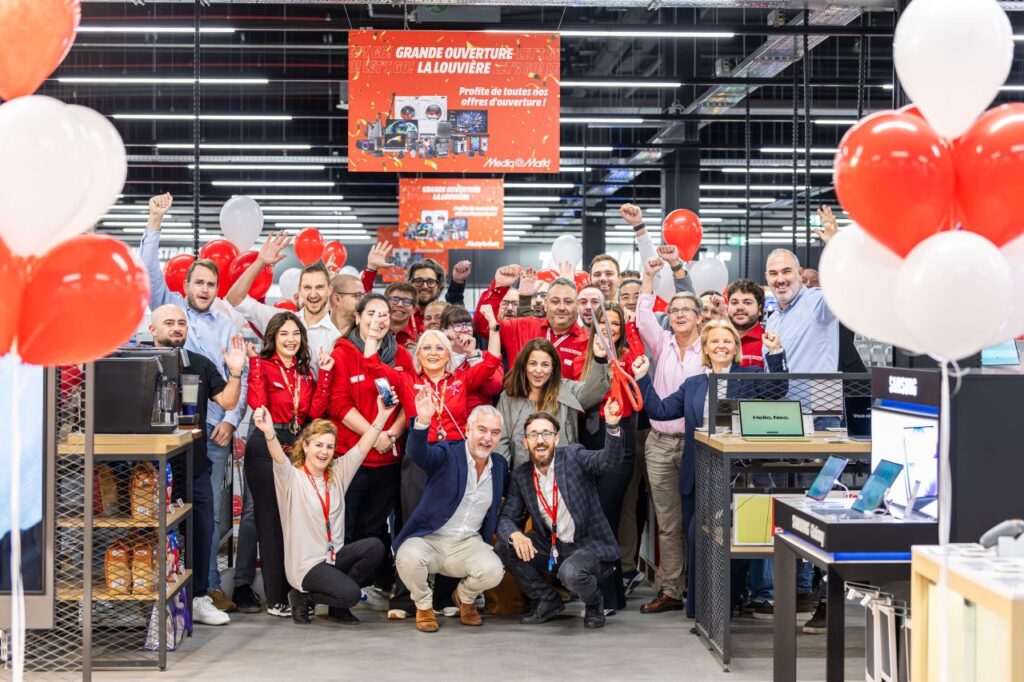
‘That is why, for the first time this year, we also worked with recruitment days, where we could hold many interviews in one day. Working around Black Friday is hectic; in a very short time, you become a very close-knit team. We really wanted to convey that at the hiring event too. It is extremely busy and hectic, but in one day you learn what you would normally learn in a month, and you get to know everyone well straight away.’
‘During Black Friday, you learn in one day what you would normally learn in a month…’
‘During that event, we also wanted to give an immediate impression of the different departments. You can still choose: does telecoms seem interesting to you as an area to sell in, or are you perhaps more service-oriented and would prefer to work in the checkout service department? It was the first time we tried it, and it actually had a very positive outcome.’
> It is obviously not your first Black Friday. How did you do it before?
‘I have to say very honestly that this was my first Black Friday recruitment campaign; I started in this role just after Black Friday last year. Previously, budgets across all channels were increased during this period to bring in as many applicants as possible. But that takes a great deal of time for a shop, and for us too, of course. So this hiring event was really an experiment, where we invited everyone who applied and seemed reasonably suitable based on an initial assessment.’
> The candidate can get a feel for the atmosphere too. But they also meet other candidates.
‘We certainly thought about that at the beginning too: what would it be like with so many people together? But some of the responses we received from candidates afterwards were really along the lines of: I actually found it nice, because I did not have to stand there on my own. When I had to wait for a moment, I had a conversation with the person next to me. Where are you from, why did you apply here? After all, you apply here because you can easily start conversations with people and are generally sociable. You could really see that in the group; people were having conversations.’
> And you can also see who does not do that.
‘That is right. But I really do not want to say straight away that someone is not suitable for a job with us. In that respect, it is not a selection test or anything. You could also say: you applied for a sales role, but perhaps you would prefer working in the warehouse. Or perhaps you are very handy and would like to work at the Smartbar, applying screen protectors and helping people with their phones.’
> Where do you advertise your vacancies?
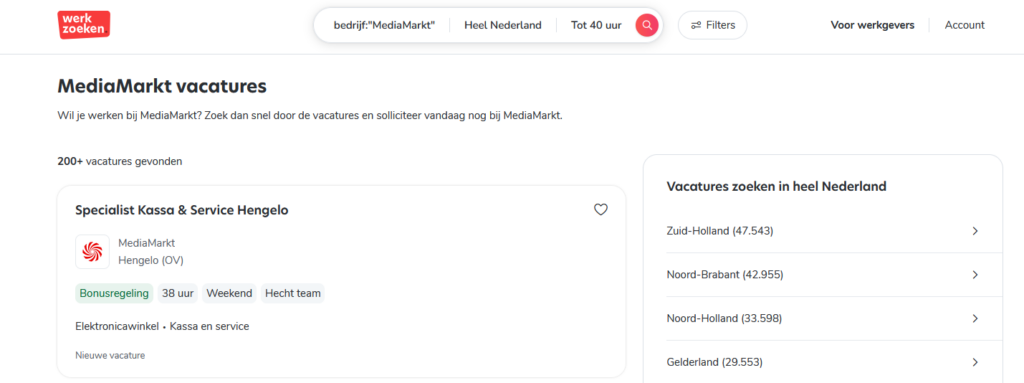
‘Around the shops, and via well-known job boards. We have just completed a pilot with Werkzoeken.nl to first see whether suitable candidates would come through. In particular, the ease of communicating with them, and the many options available to employers to specify what sort of candidates they are looking for and how the platform supports them, were really reasons for us at that time to say: let’s give this a try. With certainly positive results.’
> You are large, but also strongly local, I imagine. Is that right?
‘Yes, for example, we cannot simply move staff from one branch to another. In large cities with several shops, such as Rotterdam or Amsterdam, you do see that happening. In principle, that does not have to go through us either. The shop managers have a great deal of contact with one another; it is almost like a community. I think they speak to each other more often than they speak to us. But that is good too, because we are really a supporting function.’
‘I think the shop managers speak to each other more often than they speak to us.’
‘When we see that a shop is really in need of staff, we do step in and ask other shops: can you deploy someone who would be willing to help out in that shop for a few days? Sometimes that has a major effect. But for a shop that is the only one in a city, it can sometimes be more difficult. They are often young people, and not all of them have a car. It also needs to be easily accessible by public transport, and that varies somewhat by branch. We do encounter that from time to time.’
> What else do you do to support the hiring managers?
‘We do as much as possible to support them and really try to speak with them regularly. For example, if a shop says: candidates are coming in, but they are consistently not the candidates I am looking for. Then we look at the vacancy texts together: what are you actually looking for, can we amend the text? Or someone says: I am looking for a lot of people, but I simply do not know when to make time for all those candidates. Then I come over for a day and we schedule everyone in.’
‘Together with one colleague, I make up the recruitment department here.’
‘They may also want insight into certain data or into the labour market. It really varies greatly, but we always try to provide the best support possible. I do this work at head office with one colleague. Together, we are the recruitment department. We also have HR business partners, of course. They are a very important link between us and the shops: they pick up signals from the shop and involve us when necessary.’