Female self-employed professionals, too, had an average lower income than men for a long time. This was partly because women are relatively more active in occupations and sectors with lower hourly rates, but even after this adjustment, a difference remained that could be explained solely by gender. In recent years, particularly since 2020, female self-employed professionals have made significant progress. In fact, the average hourly rate for women is now higher than that for men, according to the latest edition of the Talent Monitor, the quarterly report by Intelligence Group and HeadFirst Group on the labour market for self-employed professionals.
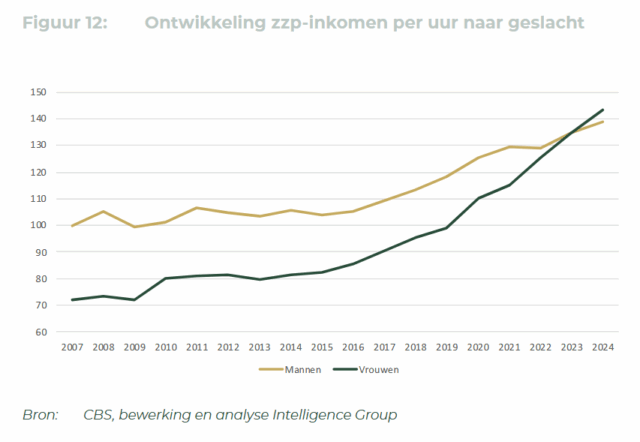
Since 2007, women’s income has grown by an average of 4.1% per year, compared with an average of just 2.0% for men over those years. According to the researchers, this catch-up is probably driven by a combination of factors:
- Changed composition of the self-employed population: more women have recently entered higher-paid specialist and senior roles.
- Selection effect: women who choose self-employment are relatively more often at the ‘top’ of the market (more experience, niche roles), whilst the male self-employed population is broader, including more middle and lower-rate segments. This brings down the male average.
- Shortage sectors: relatively many male self-employed professionals are active in sectors such as ICT, where rates are currently falling. By contrast, relatively many women are active in sectors with persistent shortages, such as healthcare.
- Equality: there is greater rate transparency and attention to equal pay, meaning that the previously ‘unexplained’ gap to the disadvantage of women has largely disappeared.
Read this article in full
Become a Werf& member for unlimited access to all articles, research and exclusive insights into the labour market.
No obligations Cancel anytime Secure payment


Vertage
Vertage is de nieuwe naam van HeadFirst Group in Nederland en het wereldwijde merk achter Striive, HeadFirst, Sterksen, StarApple en ProUnity. Vertage zet zich…