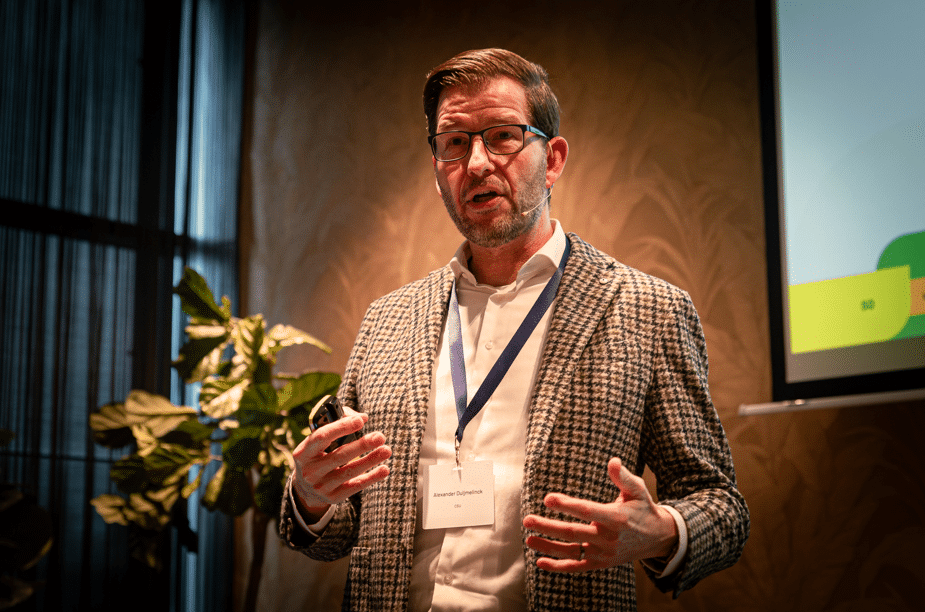
He has worked in recruitment since 2001, first in the temporary employment sector and then at CSU, where he was responsible for recruitment and onboarding in recent years. Until the end of March. That was when he experienced for the first time what it was like to lose his job in a reorganisation. ‘I’ve been through many reorganisations, but this was the first time I was affected myself.’
‘I’ve been through many reorganisations, but this was the first time I was affected myself…’
For a few months, Alexander Duijmelinck was one of the many people over 50 looking for work. As a recruiter, he had always had strong views about rejecting candidates. Now he experienced first-hand what it was like to be rejected. He has since started work as a recruitment manager at AB Werkt, but he will carry his experiences of the past few months with him. And he has a clear message for his fellow professionals.
You have to be a manager to become one
The first thing he noticed was that we write extensively about skills, but in practice organisations still look for an exact match on a CV. ‘Ideally, we look for someone who has already done exactly the same thing for several years and now wants to come and do it for you. At the same time, we often find it difficult to connect relevant experience from other sectors or fields to a vacancy. Yet the whole idea behind a skills-based labour market is that you look beyond sector-specific or job-specific experience.’
‘Ideally, we look for someone who has done exactly the same thing for years and now wants to come and do it for you…’
He noticed it almost everywhere. In healthcare, he needed healthcare experience; at a call centre, call centre experience; at a local council, experience at another council. ‘I even asked: isn’t it about being able to motivate and retain staff, and ensuring they can have productive conversations with your customers? Understanding peak periods in a call centre and acting on them really isn’t that difficult or unique. But no, you had to have experience in the sector. In other words, you have to have been a manager before you can become one.’
Sometimes, the reality also clashed head-on with what had been promised beforehand. At one local council, he was rejected after a third interview, even though the organisation had said it was looking for someone who could bring about change and help build for the long term. He came second. ‘The person who was hired was highly experienced and came from another council. That made it clear to me once again how big the gap can be between what organisations say they are looking for and whom they ultimately choose.’
The cover letter as a love letter
Duijmelinck has held the same view for years: ‘A cover letter is essentially a love letter. You’re more or less asking someone: sell yourself to me, declare your love for me. A bit like all those dating shows on TV.’ So a candidate sits down on a Sunday afternoon to write that letter and starts imagining what it would be like to work there. ‘But what do they get back? Often a standard email: we’ve received a lot of applications, based on the criteria we won’t be taking yours any further, do take a look at our other vacancies.’
‘You’re essentially asking a candidate: sell yourself to me, declare your love for me.’
‘They ask me to write a love letter, but they don’t take the time to explain why they’re rejecting me,’ he says. ‘You’re often told that there are so many applications that there isn’t time for personal feedback. Sometimes all they say is: we’re proceeding with other candidates. With no explanation as to why.

At the same time, you are sometimes invited to apply for other vacancies within the organisation. He finds that contrast difficult. ‘If you ask for a cover letter, you must give a meaningful reason for rejecting someone. You should refer to something in the letter, the CV or their work experience. That way, you at least give them the same personal attention you previously asked of them.’
‘Explain the reason’
He illustrates how frustrating this can be with a rejection for an employee experience manager role at a major supermarket chain. ‘It was a role I thought my experience would be well suited to.’ The reason for his rejection was that his motivation was not convincing enough. Otherwise, it said much the same as always: there was no time to respond individually.
‘Candidates want to understand why a particular decision has been made.’
‘The rejection itself wasn’t even the problem for me,’ he says. ‘Every organisation is entitled to make its own decision. What I missed was an insight into how that decision was reached. What exactly were they looking for, and why wasn’t my profile a good enough match? Candidates don’t always have to agree with a rejection, but they do want to understand why the decision was made.’

There is another way
It is not rejection in itself that bothers him. It is the way it is done. There were, for example, rejections he did appreciate. The best came from an experienced recruiter who took plenty of time to explain her decision. ‘She wrote a detailed response: Alexander, you have a fantastic CV, but this is what we’re looking for in the role and I can’t see it in your application. This is important to us, and so is that. And that’s why we’re not taking your application any further.’
It is not rejection in itself that bothers him. It is the way it is done.
Another came from a manager at a local council. ‘He said: I really enjoyed our conversation and I think you can do the job. But I wonder whether, given your background, this role would be challenging enough for you.’ That manager then helped him get an interview with another department. That, he says, shows there is another way.
A sideways move is not a lack of ambition
He also noticed that anyone who does not necessarily want to move up has a hard time. ‘If you want to make a sideways move, or perhaps take a small step back, it’s interpreted as a lack of motivation. No ambition.’ Yet more and more people later in life say they have built a career and now want to use their experience in a different way, without necessarily wanting to become a manager again. ‘That’s received very poorly in the job market, even though those people are valuable.’
What can recruiters do with this? According to Duijmelinck, it starts with the relationship with the hiring manager. ‘You often hear recruiters say they find rejecting candidates difficult. But rejecting candidates isn’t difficult. Things go wrong when you don’t set expectations for your hiring manager.’ If you forward 5 CVs and get 3 back marked ‘reject’, ask why. ‘The arrangements you make with your hiring manager determine the quality of the feedback you receive. And the better the feedback, the easier it becomes to reject someone.’
‘The better the feedback from the hiring manager, the easier it is to reject someone.’
He gives an example. ‘If you can say: we had 3 candidates, 2 have a lot of experience in what we’re looking for and you don’t yet, you already have a very plausible explanation.’ And what if none of the candidates is suitable? Then offer a suggestion about how the person could develop towards such a role. For him, it is not about being nice, but about being clear. ‘A sentence like: your CV doesn’t bring out as clearly what I heard in the interview. That gives a candidate the feeling that their application has been taken very seriously.’
Rejection starts with the initial briefing
Should cover letters be removed from the process altogether, then? He does not think that is the solution. At CSU, he did not ask for a letter for cleaning roles, and every applicant was called within 24 hours. At AB Werkt, he now also contacts every applicant within 24 hours. ‘That conversation often makes it clear whether it’s a good fit or not.’ But if you do ask for a letter, he believes a rejection should always include a meaningful explanation. ‘If you want someone to convince you why they’re right for you, convince them why they’re not.’
‘If you want someone to convince you, convince them why they’re not right for the role.’
Are recruiters able to do that? ‘I think so. If you can prepare a shortlist for your hiring manager you can also give the candidate something in return: we’ve chosen people with this profile because experience in this area is important to us.’ And then explain why. ‘Why do you need a degree from a university of applied sciences? Why do you need to have worked at a local council?’ That naturally brings you back to the initial briefing. ‘A hiring manager is always looking for the perfect candidate. But as a recruiter, you have to be prepared to set boundaries. What’s realistic, and why do you want certain requirements in the job advert?’
Experience it for yourself
‘I’ve sometimes said that 80% of recruiters should experience losing their job, without unemployment benefit, to see how they are treated as candidates. So that they also feel the uncertainty that can come with it, whether financial or arising from the need to have a role and make a contribution through a job again.’ Emails that arrive late or not at all, deadlines that are changed at a moment’s notice, hours invested with nothing ever coming back, not even reimbursement for travel expenses.
He knows recruiters often say this is part of the process, as are impersonal rejections: after all, you cannot reply to everyone personally. ‘That may be partly true,’ says Duijmelinck. ‘But marketing works hard on your corporate identity. You want people to come and work for you because of what your organisation stands for. This greatly undermines that. It may be part of the process because of a lack of time, but it absolutely should not be if you are striving for quality.’
‘This may be part of the process because of a lack of time, but it absolutely should not be if you are striving for quality.’
After all, recruitment is not just about whom you bring in, but also about whom you do not. ‘Rejecting candidates may not be the most enjoyable part of the job,’ he concludes. ‘But if you have the reasoning and can communicate it well, it can be immensely rewarding. You know you’re giving someone something they can genuinely use in their next application.’
Read also
Related event

Arbeidsmarkttrends 2027-2030
We zijn uitverkocht. Maar goed nieuws! Arbeidsmarkttrends 2027-2030 is volgeboekt. Goed nieuws: op 28 januari 2027 organiseren we een tweede editie, met dezelfde sprekers en hetzelfde programma. Zorg dat je er alsnog bij bent. Bekijk de editie van 28 januari Al jaren geven de beste sprekers en specialisten een arbeidsmarktupdate en een doorkijkje naar de […]
Odido