Are more and more people becoming stuck in their ways in the labour market? People who supposedly cannot be persuaded to leave their permanent jobs? The reality is very different. According to Intelligence Group, in the first quarter of this year, 46.1% of people who found a new job were given a permanent contract straight away. The average over the past 10 years is 38.8%. And the Labour force survey by Statistics Netherlands (CBS) shows that the number of employees on permanent contracts grew from 5.23 million in 2021 to 5.66 million now.
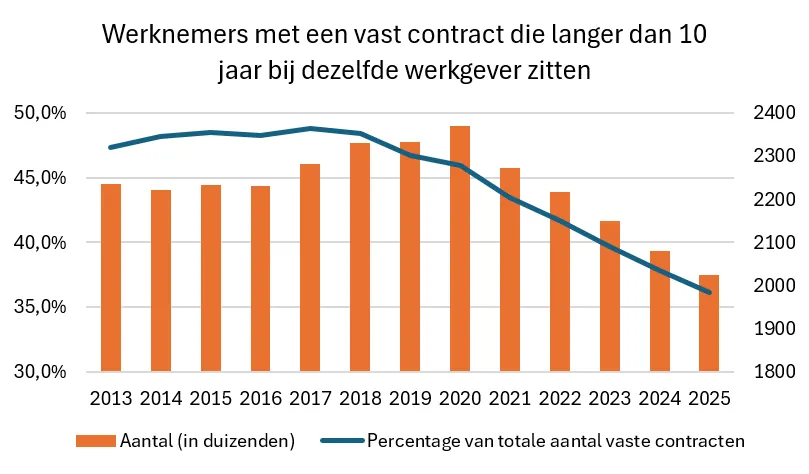
The proportion of permanent employees with at least 10 years’ service fell from 47% in 2018 to 37%.
But what sits behind this growth in the number of permanent jobs? In 2021, employees on permanent contracts had worked for their current employer for an average of 11.3 years; by 2025, that had fallen to 10.5 years. The proportion of permanent employees with at least 10 years’ service fell from 44% to 37% over that period. The proportion of people with 5 to 10 years’ service, by contrast, rose from 18% to 23%. In this respect, the permanent job therefore seems to be in retreat rather than on the rise.
2 explanations
A closer look quickly reveals 2 explanations for the growth in permanent contracts. The first, of course, is the tight labour market. As early as 2022, CBS observed that contracts offering flexible workers greater security were being issued more frequently as a result. According to the statisticians, the tight market gave workers more bargaining power and could give employers ‘a reason to retain people’.
The number of permanent contracts also rose in the tight labour market of the 1990s, despite the stronger move towards flexibility at the time.
That is nothing new. During the labour shortage of the late 1990s, for example, CBS observed that the number of permanent contracts was rising ‘faster than ever’, despite the strong move towards greater labour market flexibility at the time. The same happened on a considerable scale during the tight labour market in the years before the coronavirus crisis.

The second explanation is the Balanced Labour Market Act (Wab), which came into force on 1 January 2020. Since then, employers have paid a lower unemployment insurance contribution for a permanent contract than for a flexible one. This made hiring permanent staff relatively cheaper.
Length of service falls
But has this increase in permanent jobs also led to less mobility in the labour market, as one might expect? It appears not. Economists Tijmen de Vos and Josha Box look at a longer period on Rode Cijfers and, based on the CBS table, find that the average length of service of permanent employees has fallen by around 2 years (!) over the past 10 years.
‘Dutch workers are not stuck in their jobs at all.’
For all workers combined, including flexible workers and the self-employed, the decline is smaller. Their average length of service fell from 8.6 years in 2021 to 8.3 years in 2025. In other words, it seems to be mainly employees on permanent contracts who are spending less time in their jobs; this is much less true of other workers. ‘Dutch workers are not stuck in their jobs at all’, the 2 authors conclude.
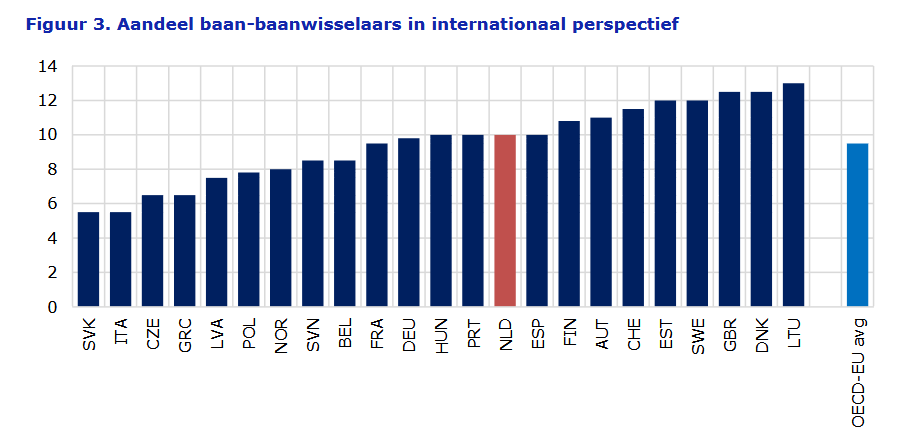
What is more, Dutch employees on permanent contracts change jobs just as often as employees on both permanent and flexible contracts in the rest of Europe, according to Eurostat figures. According to these data, Dutch workers, along with the Danes, change jobs more frequently than anyone else in the EU.
More newcomers among permanent staff
So why is the number of permanent contracts rising, but not the average tenure? The figures point primarily to a change in the composition of the group. People who previously started out as flexible workers now get permanent contracts sooner. They then count as permanent employees with a short length of service. Flexible workers have spent an average of 1.9 years in their current jobs. The more of them move into permanent roles, the lower the average for the permanent group becomes.
The composition of the group on permanent contracts appears to be changing.
In addition, the employed workforce grew from 9.25 million in 2021 to 9.83 million in 2025. According to Rode Cijfers, that growth was concentrated among young people, older people and migrants. Newcomers to the labour market start, by definition, with 0 years of service. The crisis years may also play a part. Permanent employees who have now been in service for over 10 years joined at a time when hiring was lower. The group with 5 to 10 years’ service, who joined during the tight labour market after 2015, grew from 0.94 million to 1.28 million over the same period.
No wave of job-hoppers
And what does that mean for labour market mobility? The Dutch central bank, De Nederlandsche Bank (DNB), analysed CBS microdata from 2011 to 2025 inclusive. On average, around 17% of employees change employer each year, with no clear upward or downward trend. Mobility did, however, fall noticeably after 2022, despite the tight labour market. DNB cites labour hoarding as a possible explanation: employers retain staff even when there is temporarily less work.
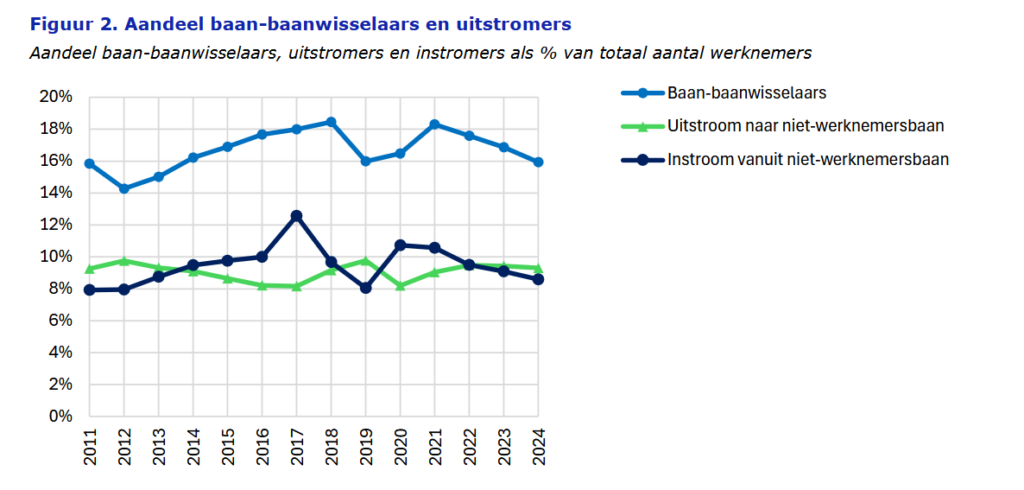
Intelligence Group observes broadly the same trend. In the first quarter of 2026, 18.1% of workers found a new or different job, the lowest level in over 4 years. Internal mobility, at 9.8%, is also at its lowest point in 13 years. And employees who resign from their jobs are less likely to do so for a new job. According to CBS, that proportion fell from 42% to 38% between 2022 and 2025.
Is the tide turning?
Whether jobseekers will continue to obtain permanent contracts so easily in the coming period is another question. As labour shortages ease, flexible work is growing again. In the first quarter of 2026, there were according to CBS 2.7 million flexible workers, 63,000 more than a year earlier. The number of permanent employees also grew, by 60,000, but less rapidly than in previous quarters. And in the third quarter, the number of permanent employees rose by just 10,000, whilst unemployment climbed to 407,000 people.
In that sense, permanent jobs becoming less permanent seems to be mainly a matter of the economic cycle (and demographics!), rather than regulation. Nor is it necessarily something employers need to fear. If employers become less inclined to offer permanent contracts as labour shortages ease, this could eventually push up the length of service of permanent employees again. But that would not be because they are becoming more loyal; rather, it would be because the group on permanent contracts is growing more slowly through the addition of newcomers, who are by definition already the most mobile.
Read also
Related event

Arbeidsmarkttrends 2027-2030
We zijn uitverkocht. Maar goed nieuws! Arbeidsmarkttrends 2027-2030 is volgeboekt. Goed nieuws: op 28 januari 2027 organiseren we een tweede editie, met dezelfde sprekers en hetzelfde programma. Zorg dat je er alsnog bij bent. Bekijk de editie van 28 januari Al jaren geven de beste sprekers en specialisten een arbeidsmarktupdate en een doorkijkje naar de […]
Odido