Discrimination on the grounds of educational level is experienced even more frequently in Dutch workplaces than discrimination based on nationality, skin colour or religion, according to research by Intelligence Group among more than 8,000 employees, following recent SCP research into perceived group disadvantage. More than 3% – around 1 in 30 – felt they had been discriminated against in the past year because of their education or educational level. This puts education in fourth place among the 17 grounds for discrimination examined.
People educated at (v)mbo level feel discriminated against one and a half times as often as those educated at hbo and wo level.
Among those educated at vmbo and mbo level, the figure is 3.7%, compared with 2.4% of those educated at hbo and wo level: one and a half times as often. For people educated at vmbo and mbo level combined, educational level is, after age, even the most frequently cited reason for perceived discrimination at work. Among all employees, educational level (3.1%) is mentioned more often than nationality (2.5%), skin colour (2.1%) and religion (1.7%).
‘The divide runs deep’
‘We talk a great deal about our appreciation for skilled workers, but in the workplace some of them feel discriminated against precisely because of their educational level,’ says Geert-Jan Waasdorp, founder and director of Intelligence Group. ‘The SCP research shows that the divide between educational groups runs deep. Our figures make visible that this inequality is also experienced in day-to-day working relationships. It comes second. Let that sink in for a moment: second place. That does not seem to me to be something employers and politicians can ignore.’
‘Our figures make visible that inequality is also experienced in day-to-day working relationships.’
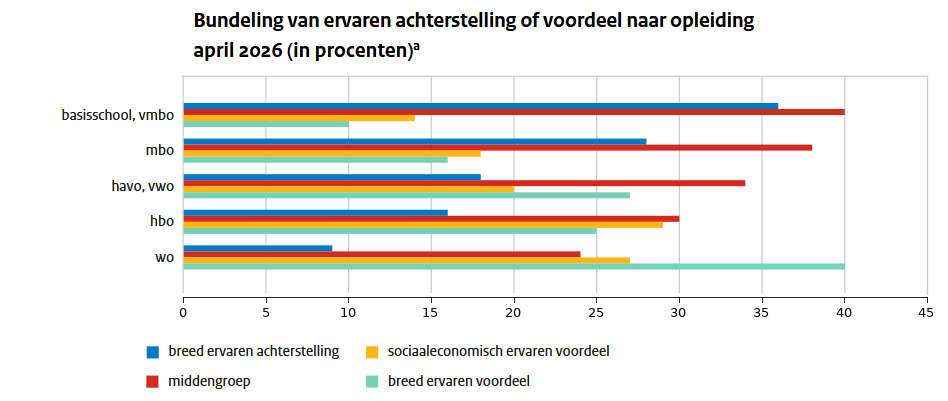
In research by the Netherlands Institute for Social Research, 46% of those educated at wo level see their own group as having an advantage when finding work, compared with 16% of those educated at vmbo level. The SCP mainly examined perceptions of groups; Intelligence Group asks employees on what grounds they personally felt discriminated against at work. The outcomes are therefore not directly comparable, but they complement each other and clearly point in the same direction.
Experienced, but not explicitly included in the law
Article 1 of the Constitution and international treaties provide general protection against discrimination. However, educational level is not an explicitly protected ground in equal treatment legislation. In September 2025, the then Schoof government also chose not to introduce separate legislation for this. The Netherlands Institute for Human Rights had previously advised additional protection for goods and services, but not for job selection: after all, a diploma may be a justified requirement in that context.
‘Someone who did not finish school can remain at a disadvantage for ever…’
‘Of course an employer should be allowed to ask for relevant qualifications,’ Waasdorp responds. ‘But that is different from denying people with the right skills and performance opportunities for advancement because they do not have the right piece of paper at the right level. Someone may have obtained an hbo diploma 30 years ago and reap the benefits for the rest of their life without demonstrable performance, whereas someone who did not finish school remains at a disadvantage for ever, even if their performance is there.’
How much value does education have?
According to him, the question is therefore not whether we should ban diploma requirements, ‘but whether, after 5 or 10 years of work experience, we should still attach much value to them in the occupations where this is possible.’ He therefore calls on employers to include educational level in employee research and diversity policy, and where possible to assess people on skills rather than diplomas.
Read also
Related event

Arbeidsmarkttrends 2027-2030
We zijn uitverkocht. Maar goed nieuws! Arbeidsmarkttrends 2027-2030 is volgeboekt. Goed nieuws: op 28 januari 2027 organiseren we een tweede editie, met dezelfde sprekers en hetzelfde programma. Zorg dat je er alsnog bij bent. Bekijk de editie van 28 januari Al jaren geven de beste sprekers en specialisten een arbeidsmarktupdate en een doorkijkje naar de […]
Odido