
Could the skills-based labour market finally be on its way? Based on new research by Indeed, you might almost think so. The world’s largest job site surveyed 5,650 jobseekers and 3,651 employers with senior management responsibility, and concluded that no fewer than 88% of Dutch employers now consider critical and problem-solving thinking more important than a degree (51%) or years of work experience (54%). The ability to learn quickly is also regarded as essential by 86%.
As many as 91% even regard the ability to collaborate effectively as ‘essential’.
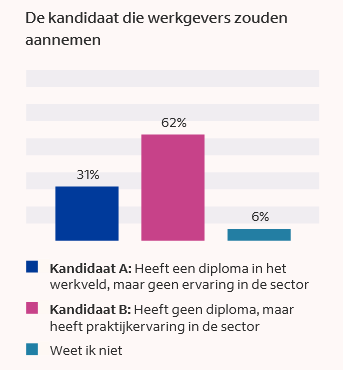
And this skills-based approach is not just about technical skills; soft skills are also rapidly gaining ground. Dutch employers have a strong preference for employees who can collaborate well, adapt quickly and think in a problem-solving way. No fewer than 91% even regard the ability to collaborate effectively as ‘essential’. If employers have to choose between a candidate with a degree but without experience, or a candidate without a degree but with practical experience, 62% choose the latter.
Having to choose
‘The labour market requires more than just professional knowledge – people need to be versatile and able to develop themselves,’ the researchers conclude. ‘Degrees are all well and good, but without the right skills a company cannot do much with them,’ says Stan Snijders, managing director of Indeed Benelux. ‘Employers are finding that traditional selection criteria allow them to attract relatively fewer candidates. By focusing on skills, they attract a broader and more diverse talent pool and find employees who are a better fit for the company culture.’
‘Only 15% are already actually adapting job descriptions to changing expectations.’
However, there is still much ground to be gained in this area, he says. ‘Only 15%, for example, are already actually adapting job descriptions.’ More than 500 jobseekers and over 250 employers in the Netherlands took part in the research. The jobseekers surveyed are, incidentally, slightly more likely than employers to believe that skills should be decisive in selection procedures.
More difficult or easier?
Another striking finding in the research is that 55% of Dutch employers believe recruitment and selection are becoming increasingly difficult, whilst only 10% believe they have become easier over the past 3 years. Looking at the jobseekers in the research, the Netherlands stands out as a positive outlier: whilst in countries such as the UK and the US more jobseekers say the recruitment process has become more difficult, only 20% here say it has become harder, compared with 41% who have found it easier over the past 3 years.

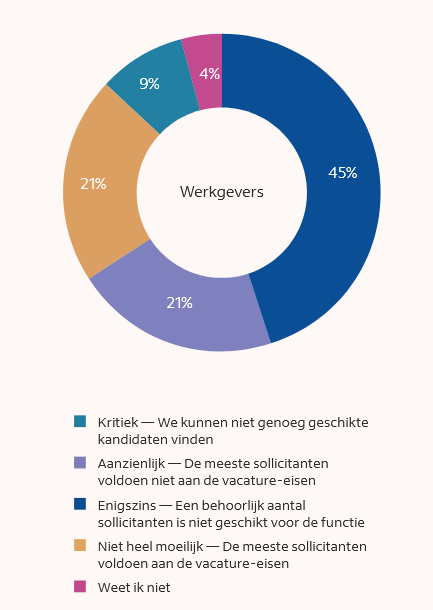
How difficult is it to find quality in recruitment? Fewer than a quarter of the employers surveyed describe it as ‘not very difficult’ or do not know. However, most respondents say they have ‘some’ to even ‘considerable’ difficulty achieving quality, and almost 10% even call it ‘critical’.
Persuasion needed
According to the research, much of this misery can be prevented by placing greater emphasis on skills in the selection process. However, some work is still needed to spread the word. In the Netherlands, only 57% of employers say they are familiar with the term skills-based recruitment, less than the 61% of all respondents in the 6 countries surveyed.
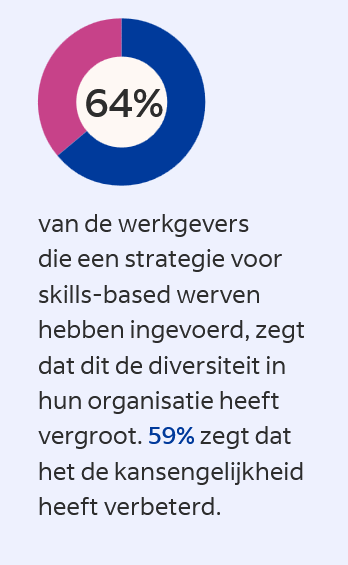
However, employers who say they already use a strategy for skills-based hiring appear surprisingly positive about it. From a list of possible benefits from which they could select 3, 28% of employers reported ‘more innovation and greater resilience’ in the company, and an equal proportion pointed to more transferable skills and more suitable candidates. In addition, 24% mentioned improved work performance, 23% a higher ROI from recruitment campaigns due to lower costs, 22% said they attract employees who are more interested in further training, 20% mentioned greater workforce diversity, and 19% better retention.
But how?
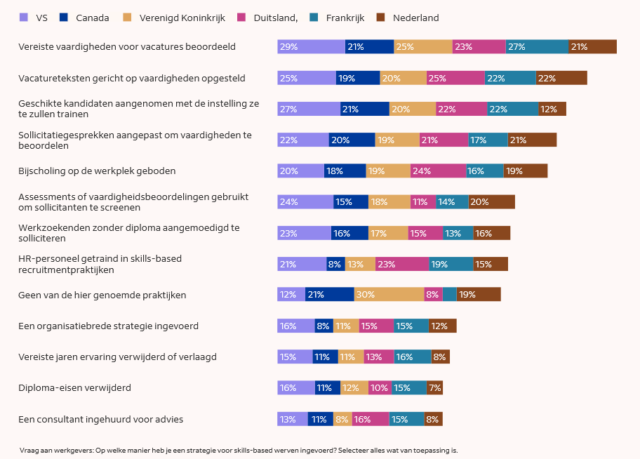
But how exactly do those employers select based on skills and critical thinking rather than degrees and CVs? For example, by adapting their job adverts and writing more around skills (22%), followed by taking another critical look at the skills required for vacancies (21%) and considering how to structure interviews differently (21%). A much smaller proportion of Dutch employers, for example, encourage jobseekers without a degree to apply too (16%) or hire candidates with the intention of training them (12%).
It is also concerning that the Netherlands differs considerably from the other countries surveyed when it comes to implementing technology to support this process. For example, in the US, the percentage of employers who say they now use more tools than 3 years ago (49%) is higher than the percentage of employers who say they use the same number or fewer tools (46%), whereas the Netherlands is lagging behind in this respect. Only 29% of respondents say they have increased their use of recruitment technology, and 55% report ‘no change’.
Strikingly, the Netherlands appears to be lagging behind in the adoption of new recruitment technology.
And yet, according to the researchers, technology could help, for example, to convey soft skills on a CV or assess them properly. ‘Generative AI is particularly good at text analysis and can analyse both job adverts and CVs to determine which skills are required for a role. It can then recognise a relevant connection, even if the applicant does not use the exact words from the job advert. Better screening of unstructured data makes employers less dependent on less relevant requirements such as degrees,’ the report states.
Read everything?
Download the full research on skills-based recruitment here:
Indeed researchFind out more?
Want to know more about skills-based recruitment? On 19 June, we are organising an inspiring event about it at Werf&, with plenty of practical examples. Read all about it here:
Read also

Indeed
Op Indeed vinden meer mensen een baan dan waar dan ook. Indeed is de nummer 1 vacaturesite (SimilarWeb, totaal aantal bezoeken, juli 2024), niet alleen in ons l…