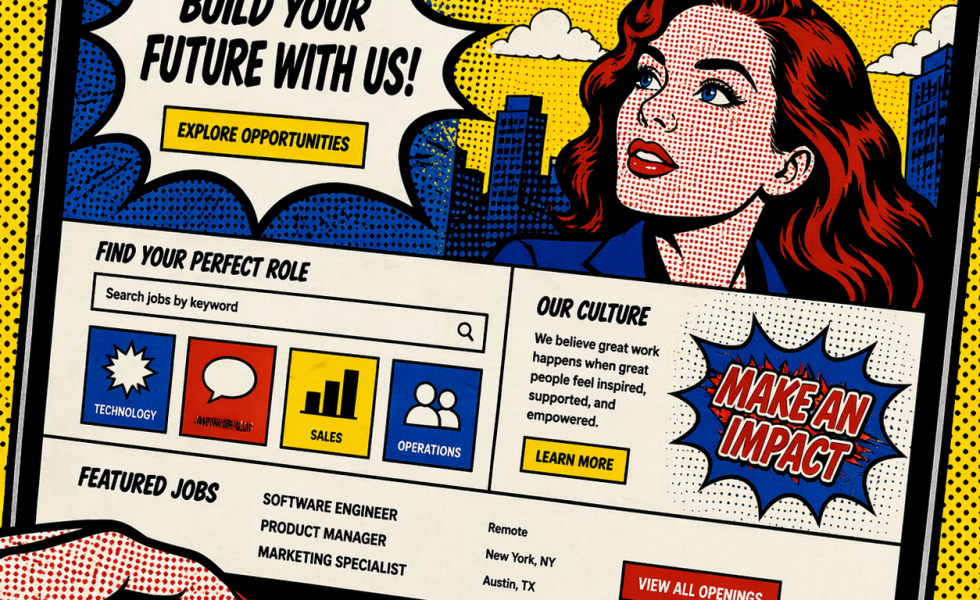
Ever since the internet has existed, job boards have always played a central role in bringing together supply and demand in the labour market. Whether it was Monster in the early days, or Indeed, LinkedIn, and Dutch players such as Werkzoeken today: it has always been about building reach among target groups, and then presenting vacancies as attractively as possible. But the rise of A.I. is increasingly turning that model upside down, notes analyst Matt Charney. And according to him, the (possibly surprising) winner of the future will be organisations’ own careers sites.
‘Candidates no longer start searching within a job board, but within an LLM.’
The traditional model of job sites and job boards ‘has historically worked reasonably well’, he writes. But according to him, that golden age is coming to an end. And it is (yes, once again) A.I. that is causing it. As a result, the online click is becoming less important in the candidate journey. ‘Instead of starting with a search engine, candidates now begin their career exploration directly within LLM-driven answer systems, such as ChatGPT or Claude,’ he says. This makes search terms and intermediaries less important, whilst what you have to say on your own site matters increasingly more.
No reach for sale
Buying reach, as was common with traditional search engines? It is nowhere near as easy in LLMs. And that means a great deal, says Charney. ‘For a job board operator, this shift represents an existential crisis.’ But what does it mean for (corporate) recruiters, according to him? At the very least, that they will need to pay much more attention to their own careers sites. ‘Because these are still too often overlooked and undervalued when it comes to conversion and infrastructure, at least compared with external job sites and just-in-time sourcing.’
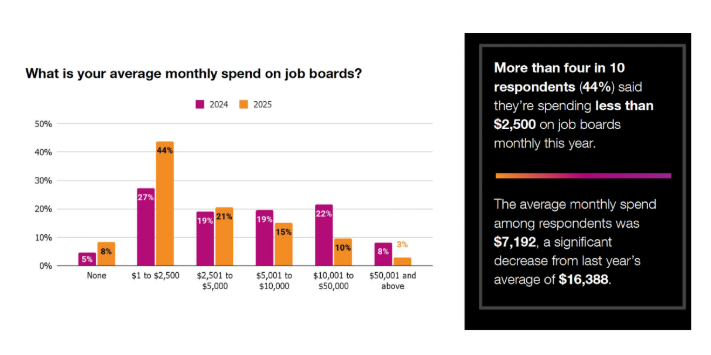
After all, your careers site is the only place that you as an organisation control, he argues. ‘But across all industries, markets and roles, the conversion rates of job-site visitors into completed applications are consistently in the low single digits – in most cases only somewhere between 2 and 5%. That means that, even in the best case, 95% of job-site visitors (the vast majority of whom are paid traffic) drop off before they even begin applying. That is a missed opportunity that no employer can afford, a critical flaw in the recruitment process,’ says Charney.
You can no longer buy your way out of it
Until now, organisations have always been able to ‘buy their way out’ of this ‘flaw’ by purchasing reach on external sites, so that they still received enough applications. But in the age of LLMs, that will no longer be so easy, he argues. Nor will it be necessary. However, companies will need to understand more about what motivates their candidates, he says. ‘Employers often invest too much in acquiring visitors, whilst investing too little in – or even completely overlooking – the experience that determines whether those visitors are actually useful. This imbalance is of course not new, but A.I. makes it much harder to ignore.’
The search volume generated by A.I. rose by no less than 527% in one year.
According to sources such as Adobe Analytics, Similarweb and Search Engine Land, search volume generated by A.I. rose by no less than 527% in 2025 compared with the previous year. If that continues, A.I. will generate more referral traffic than traditional search engines as early as 2028. And the intent of those visitors is high, studies show. ‘The click-through rates can rise to as much as 88%, or around 99.7% higher than promoted content on LinkedIn. Users arriving via A.I. also tend to be more likely to convert, simply because they have already done the exploratory work.’

Filtering out the noise
Employers now appear largely to be ‘stuck in a vicious cycle of overpaying for low-intent or irrelevant traffic’, according to Charney. ‘This is due to an unhealthy reliance on traditional job boards and search behaviour, and because most recruitment processes depend on volume to compensate for inherent inefficiencies. But 90 to 95% of most employers’ recruitment processes simply consist of noise. Once A.I. starts filtering out that noise, organisations will get a much clearer picture of how well their recruitment efforts are actually performing.’
‘Traditional search engines wrongly assume that users already know what they are looking for.’
According to him, that clarity will help demonstrate that the budget spent on sites such as Indeed, LinkedIn or traditional programmatic job boards could in principle be better spent on organisations’ own careers sites. But it reveals something else too, says Charney: ‘Traditional search engines assume that users already know what they need to search for. But when it comes to careers, it is quite clear that almost nobody really knows. Most people therefore keep searching for jobs rather than discovering career opportunities. This is a huge missed opportunity for both employers and the candidates they want to hire.’
Skills underestimated
OECD research and various recent studies have consistently shown that employees often underestimate or overlook their transferable skills, whilst having limited insight into related career opportunities or potential employers, says Charney. But A.I. in particular can shed light on this, according to him. ‘This not only changes the way career opportunities are discovered, but also creates an entirely new pool of potential but passive candidates, who might otherwise never have encountered job platforms or your careers website.’
‘For some reason, recruiters and job boards have largely ignored this so far.’
This could represent ‘a huge breakthrough’ for talent acquisition, he says. ‘But for some reason, recruiters and job boards have largely ignored this so far. After all, it is easier to post a vacancy and hope for the best than to challenge the status quo.’ Nevertheless, he recommends facing this truth. ‘The recruitment results will be more than worth it. The longer organisations wait to reconsider the dynamics of recruitment marketing, the lower the return on investment will become.’
No warehouse
Charney draws on the old saying: ‘Candidates are consumers, and like all consumers, they have a choice.’ So, to become an attractive employer for qualified candidates effectively, it is important to realise, according to him, that finding a job follows the same discovery process as any other major online purchase – ‘albeit with much higher stakes than virtually any other e-commerce category’. And that means your careers site should not be ‘a warehouse full of outdated signage and ageing infrastructure’, but rather a shop that potential buyers are happy to enter.
‘Candidates expect targeted recommendations because they also use Netflix.’
‘Candidates increasingly expect personalisation because they use Amazon. They expect targeted recommendations because they use Netflix. They expect speed, simplicity and relevance because every digital experience in their lives – except searching for a job – is frictionless, painless and virtually instant. This is probably the reason why 95% of careers-site visitors immediately decide not to make a purchase. The growing gap between candidate expectations and the recruitment reality on many careers sites is where candidate conversions fail.’
An opportunity, also for job boards
But, as he also makes clear, it is of course also an opportunity. ‘Marketplaces that manage the workflow and job inventory, maintain deep employer relationships and make use of proven application infrastructure will remain relevant – and a viable recruitment source.’ Job boards therefore certainly still have a right to exist in the age of A.I., but more at the top of the funnel, he says. ‘Platforms that control the workflow or the user experience retain their influence and (usually) their value.’
‘The bad news is that not even A.I. will solve this problem for you.’
At the same time, it is therefore also high time to invest more in organisations’ own careers sites. ‘The bad news is that not even A.I. will solve this problem for you.’ It could even worsen the problems, according to Charney, who will also give a webinar on the subject next week. ‘Because if the search for talent takes place outside the narrow silo of job sites, and candidates do not arrive through clicks but with clear, targeted intent, you can no longer hide the difference between inadequate processes and successful experiences behind vanity metrics such as total traffic or number of applicants.’
Read also
Want to know more?
More practical stories about A.I. and recruitment? Or would you like to learn how to experiment with it meaningfully yourself? You can do it all on 26 May during the AI & Talent event. You can read all about it here:




Read this article in full
Become a Werf& member for unlimited access to all articles, research and exclusive insights into the labour market.
No obligations Cancel anytime Secure payment
Related event
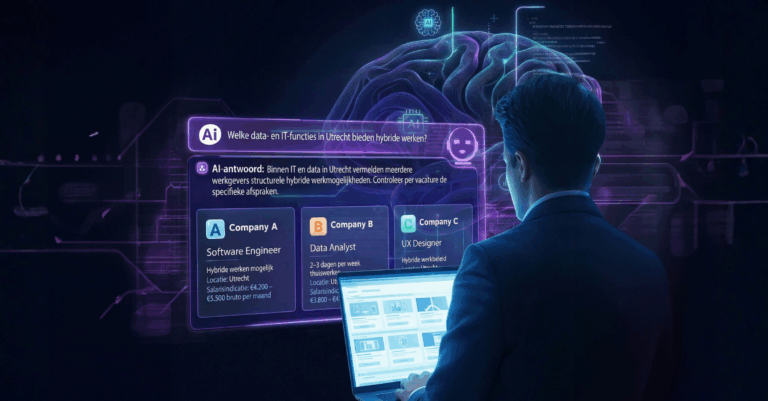
Seminar GEO: maak je klaar voor de AI-baanzoeker
AI-zoekmachines zoals ChatGPT en Perplexity veranderen hoe kandidaten werkgevers vinden en vergelijken. In plaats van lijstjes met links krijgen mensen directe antwoorden en advies. Dat schuift verkeer weg bij klassieke SEO en jobboards, en richting AI-gedreven zoekgedrag.In dit seminar leer je hoe je jouw werkenbij-site, vacatureteksten en employer content zo inricht dat AI-modellen je organisatie […]
Rotterdam