We have already given plenty of attention to books published this year such as The secret of the most attractive employers by Arjan Elbers & Nicol Tadema, Brutally honest recruitment by Aaltje Vincent and Reinventing interviews by Wim Thielemans. But of course, plenty more worth reading for recruiters has appeared in recent months. The following 10 books would make excellent additions to your wish list in the coming weeks.
#1. Thank you for your interest. We’ll be in touch
One of the most important books published this year is undoubtedly Thank you for your interest, we’ll be in touch, by Margreet Boeren. Its early nomination for Recruitment book of the year 2026 is further evidence of that. ‘This book brings together the voices of jobseekers, recruiters, hiring managers, HR directors and policy experts from Belgium and the Netherlands, revealing a pattern that is much bigger than any single story,’ says the author.
‘Being acknowledged does not mean you get the job. It means being taken seriously as a human being.’

In the book, Boeren introduces what she calls the ‘threshold model’, which she says revolves around 3 questions: am I acknowledged? Am I seen? Am I heard? ‘Being acknowledged does not mean you get the job. It means being taken seriously as a human being, even when the answer is no.’ According to the author, the book is not an indictment of any one profession, but ‘a mirror for everyone who shapes selection criteria, processes, systems or development policy.’
#2. Combined jobs
What if the solution to a tight labour market and staff shortages in the public sector lies not just in recruiting more people, but above all in organising work differently? That is the question Emile van Nassau, coordinator of Werken in Gelderland, explores in his book Combined jobs. The traditional career with 1 role at 1 employer is becoming less and less of a given, he argues. But how should these new careers take shape? And how can recruiters respond to them wisely?
‘The traditional career with 1 role at 1 employer is becoming less and less of a given.’

The book is full of practical examples, from Arnhem City Council’s municipal staff pool to defence reservists, as well as personal stories, such as that of an HR professional who combines their job with work in music. ‘It shows how combined jobs help not only to address long-term labour shortages, but also to foster career development, flexibility and new forms of collaboration suited to our times,’ says the author, who hopes above all to inspire recruiters.
#3. The ideal labour market
An ideal labour market in which everyone can take part? According to Arthur Hilberdink, it is not an illusion or an unrealistic dream. ‘It can be an everyday reality. Drawing on my experience as head of Facility Support at the University of Groningen, I invite you to discover the stories of people who found new opportunities because someone recognised their talent. This book is grounded in practice and shows how trust, humanity and good leadership can change lives.’
This book shows how trust, humanity and good leadership can change lives.’

The subtitle How it can be done in Groningen is a neat reference to the motto of the current cabinet, which is going through such difficult times. The author, winner of the Rick Brink Award 2025, introduces his so-called KansWerk model, designed to help people currently on the sidelines find lasting employment, including those with a disability affecting their ability to work, those receiving WIA or Wajong benefits, and others facing barriers to employment.
‘I have learnt that the problem usually does not lie with people,’ he says. ‘The problem often lies in the way organisations are set up. When employers are willing to look at talent differently, possibilities that previously seemed invisible can emerge.’
#4. Just act normal
More on an inclusive labour market can be found in Just act normal, which has been in shops since late September. ‘With this book, they want to challenge readers to question their own idea of “normal”. After all, it is simply the sum of what someone is used to through their upbringing, culture and surroundings, and what is normal for one person is not necessarily normal for another,’ say authors Danielle Jiskoot and Sacha Martina.
‘This book is not a bible for diversity and inclusion. That is precisely what we do not want.’

‘The book is not a bible for diversity and inclusion,’ says Jiskoot. ‘That is precisely what we do not want. The subject is so vast that it can leave people feeling a little paralysed. But almost all major social changes started small. With this book, we want to encourage those small changes. Choose not to make that one remark, or do ask that one question.’
Despite what the title might suggest, Just act normal is not an accusatory or angry book. ‘We recognise the importance of the activist voice, but we choose a different approach ourselves,’ Jiskoot explains. ‘We want to bring different people together. We do that at House of Inclusion too. It does not help if we take a firm public stance or come down hard on someone when they make a mistake. We still make mistakes too. And we work on diversity and inclusion every day, no less.’
#5. Inclusion doesn’t work
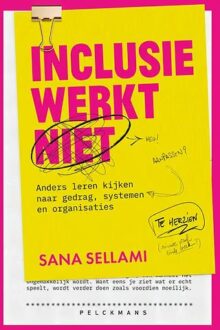
Can we conclude from this that inclusion does not work? That is certainly the provocative title of sociologist Sana Sellami’s latest book. ‘You’ve tried. Training, charters, working groups. And yet little changes in the workplace,’ she writes. ‘And that feeling is justified. But the problem is not a lack of effort. We focus on what is visible and miss what really drives behaviour and decisions.’
We focus on what is visible and miss what really drives behaviour.’
According to Sellami, this book reveals why inclusion initiatives stall. ‘The answer lies not in intentions, but in behaviour, in systems and in what we do and do not do every day. This book is not a step-by-step guide, but a book that reveals why well-intentioned actions so often change nothing. And why that only becomes clear when you learn to look differently.’
#6. Work is actually quite enjoyable

A fine title for the new book by Roeland van Laer, who previously wrote The end of HRM and The talent jungle, among others, and is known as chair of the Recruiter Code. In his latest work he shows how jobs and tasks are changing, how careers are getting longer, and how every employee is consequently expected to keep learning and adapting for longer. ‘But keeping up is not enough,’ says Van Laer. ‘How do you make sure you do work that suits you, stay healthy and motivated, and continue to enjoy what you do?’
How do you make sure you do work that suits you and continue to enjoy what you do?’
This newly published book seeks to answer that question, with relatable situations, personal experiences, sharp insights and practical questions. ‘You cannot determine how the world of work changes,’ says the author. ‘But you can determine how you continue to grow within it. And perhaps along the way you will discover that work really is quite enjoyable.’
#7. Collective intelligence
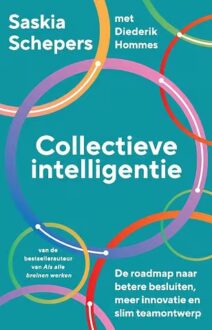
With books such as When all brains work and When all brains learn – which together sold more than 30,000 copies – Saskia Schepers put neurodiversity on the map in Dutch organisations. She showed how brains that work differently call for a different approach: understanding rather than fixing. Her new book Collective intelligence has recently been published, presenting itself as a practical guide for teams, covering everything from team design to decision-making.
‘The challenge is not a shortage of intelligence, but a failure to make full use of it.’
The book, which she wrote with interim executive Diederik Hommes, combines scientific insights with engaging practical examples and promises a concrete roadmap for better decisions, more innovation and higher performance. ‘The challenge in this complex world is not a shortage of intelligence, but a failure to make full use of it.’
#8. Why Fikele does (not) stay
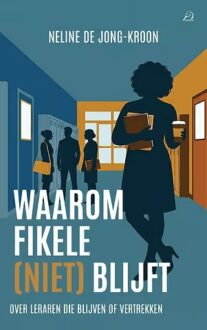
One sector where shortages also persist is, of course, education. In this book, English teacher Neline De Jong-Kroon explains what she believes is behind them: being a teacher involves much more than teaching alone. The author, whose doctoral research examined why teachers leave the profession, now adds relatable stories and characters to that academic research. But there is another distinctive feature: it contains a choose-your-own-adventure element, in which readers must choose between chapter A and B at various points.
‘A book that does not just make you read, but also makes you think.’
‘A book that does not just make you read, but also makes you think,’ says one review. A conclusion from the doctoral research also recurs throughout: teachers who initially had doubts say they decided to stay in education because of better leadership, better collaboration, greater recognition and more appealing work. A teacher considering leaving today may therefore decide to stay tomorrow if conditions improve, says De Jong-Kroon, who sees this as an important opportunity for schools.
#9. Employer branding: from promise to experience
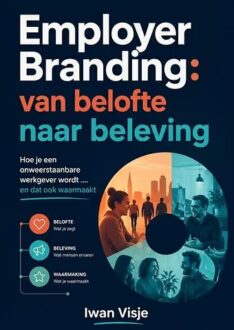
Returning a little more directly to the recruiter’s field, we come to business specialist Iwan Visje, who recently wrote Employer branding: from promise to experience. ‘Every organisation has a story. About who they are, what they stand for and why people want to work there. In a world where everything is visible, what matters is no longer what you say, but what people experience. This book gets to the heart of that,’ says the author.
‘In a world where everything is visible, what matters is no longer what you say, but what people experience.’
The promotion of this rather slim book could be stronger, not to mention the dreadful AI cover, but in our view people who advocate ‘looking beyond campaigns, slogans and attractive promises’ always deserve attention. So here it is.
#10. From filler content to killer content
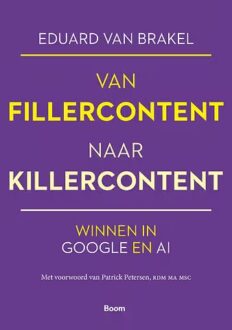
Speaking of AI: it is striking how many traditional books feel the need to cover this subject this year, producing a rather interesting collision between the old and new worlds. Plenty has of course already been written about it in recruitment, but GEO (generative engine optimisation) deserves a special mention. And Eduard van Brakel happens to have written a rather readable little book on the subject.
‘Machines are becoming more modern, but the need for good, genuine stories is timeless.’
In that book, the editor and content specialist introduces what he calls the ‘human rule’: ‘No more tricks to please machines, but valuable, authentic content to inspire people.’ Now that AI is getting better and better at producing average content, he argues, human experience, expertise, trustworthiness and original stories are becoming increasingly valuable. And that is a rule worth remembering in employer branding in particular.
As Van Brakel himself puts it: ‘Machines are becoming more modern, but the need for good, genuine stories, or valuable content, is timeless.’ And hopefully these 10 books prove that once again.