


Just a little more on that famous French economist (Thomas Piketty). Last time, I wrote that he is just as bad at forecasting as all economists and therefore certainly just as bad as John Maynard Keynes when it comes to how many hours we will work in the future. But both men are world-famous for a reason. And in that report, in which he made his forecasts, Thomas Piketty did indeed write some very sensible things about what ‘would be good for the economy’. Or, more precisely: what would be good for economic and climate justice. In an article for the Financial Times, he reiterated this:
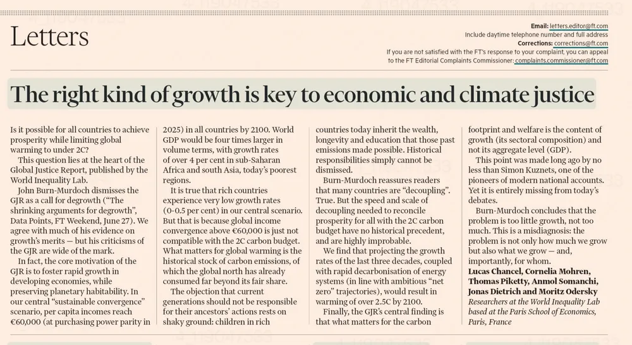
Piketty’s argument (and that of others) concerns the ‘right kind of’ growth in the economy. In other words, some economic activities may well grow, whilst others would preferably not. The question is now which criteria should be used to choose growth or contraction in economic activities. For Piketty, in conversation with Ilja Leonard Pfeijffer, the answer is clear. Economic growth must meet two conditions: growth must remain within planetary boundaries and lead to a fairer distribution of that growth, both within and between countries.
Labour shortages
The promise of the Global Justice Report is also that this choice for targeted and shared growth is good for democracy. This choice, for targeted and shared growth, could (should?) also be the guiding principle in solving labour shortage issues in the Dutch labour market. Which sectors may grow would then depend on whether growth in those sectors remains within climate boundaries and whether growth is ‘inclusive’ and primarily benefits people who need growth in their income.
Last year, for example, the Dutch government decided that Defence spending must rise substantially (to meet the new NATO target of 5% of GDP). One consequence is that there will be an even more acute shortage of (suitable) Defence personnel. That shortage is so large and acute that it can probably only be resolved by ‘drawing away’ staff from other sectors of the economy. Sectors where shortages are already substantial.
A matter of choice
Because this is recognised by our government, a so-called Interdepartmental Policy Review is being prepared, examining for a number of shortage sectors (defence/security, engineering, healthcare and education) how acute and ‘solvable’ the problem is in an overall tight labour market. And therefore also: which sector should be given priority in addressing labour shortages.
Is it sensible to solve Defence’s problem if this leads to shortages elsewhere?
For those interested in policy, this is an exciting exercise, because it requires choices to be made or, at the very least, the consequences of those choices to be made clear. It should be obvious that a solution to Defence’s shortage problem, if it leads to greater shortages in healthcare, is not a good solution. In the same way, if all ICT professionals move into the AI tech sector, this will come at the expense of the availability of those skills in defence and security, education and healthcare.
Planetary boundaries
But there is a way to set priorities when addressing labour shortages. Following Piketty’s reasoning: priority should go to sectors that can grow without exceeding planetary boundaries. This may say something about the tech sectors that want to grow through energy- and water-hungry data centres, unless they can plausibly demonstrate that this growth benefits people who do not currently benefit from it, for example by creating jobs for people who are still some distance from the labour market. Readers may decide for themselves how likely the latter is.
For Defence specifically, the choice has effectively already been made.
For Defence specifically, the choice has effectively already been made. High social priority has been given to security and combat readiness, to resilience. But the question of whether this causes economic growth within planetary boundaries has not been asked. Nor has the question of whether growth in Defence actually contributes to a better distribution of overall prosperity.
Broad prosperity
If those questions are again not asked when addressing Defence’s staffing issue, this may come at the expense of broad prosperity in our country, if only because we might have been better able to deploy the available workforce for a resilient economy that remains within planetary boundaries and allows more people than at present to share in its benefits. And that is, if we are to believe Piketty and co., perhaps also immediately a solution to the crisis facing our democratic system.
About the author
 Ronald Dekker is an independent labour market expert and a ‘practical thinker’ at RoDeO Labour market intelligence. Image above: Stichting Guruz.
Read also
Related event

Leergang Strategisch Recruitment | UITVERKOCHT
Ben je klaar om je recruitmentcarrière naar een hoger niveau te tillen? De Leergang Strategisch Recruitment biedt je de perfecte mogelijkheid om je kennis te verdiepen en je professionele groei te versnellen. Als ervaren recruiter of recruitmentmanager ontwikkel je strategische inzichten en vaardigheden die je een sterke en leidende gesprekspartner maakt voor het management. Je […]
Rotterdam