You might not expect it at first glance. The Netherlands has a reputation for all wages being fixed in collective labour agreements, for endless wrangling over every tenth of a percentage point, and for salaries being immovable and inalienable rights once they have been agreed. But viewed differently, the Netherlands turns out to be, remarkably, the most volatile country in the world when it comes to remuneration. At least, that is what Indeed recently found by looking at the salaries stated in job adverts (across 8 countries) for particular roles, and how they change over time (up or down).
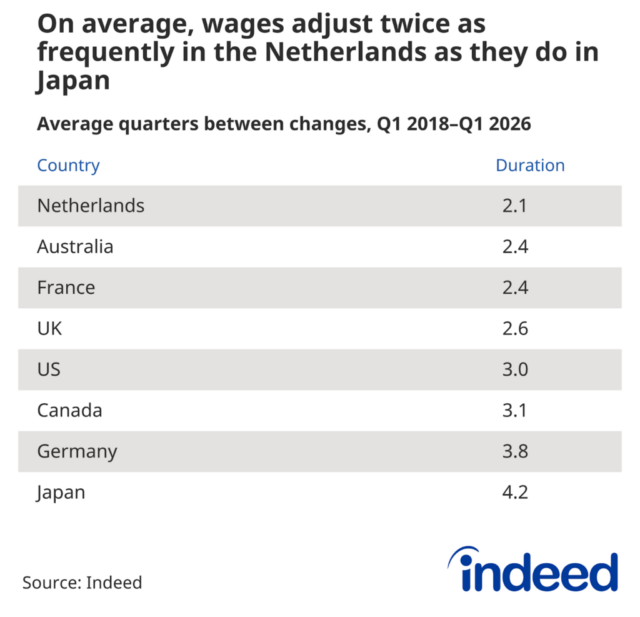
Note that this concerns roles and vacancies, not individuals. But according to Indeed, it does show that salaries respond to economic changes more quickly in the Netherlands than anywhere else, compared with other European and North American countries (and Japan, which comes bottom in this overview). According to the researchers, this creates opportunities for jobseekers: ‘In a market where wages are constantly moving, timing is crucial. Those who actively compare or switch benefit the most.’ And for employers, they say, it means that ‘salary setting is no longer an annual exercise, but an ongoing competitive tool in the battle for talent.’
Recovered since coronavirus
The analysis shows not only that wages in the Netherlands can rise and fall relatively quickly over time, but also that they have generally recovered quite well since the inflation peak that became visible in early 2021, more or less after the coronavirus pandemic. According to Indeed, the real purchasing power of the average Dutch person is now at 99.7% of that point, whilst countries such as Spain (96.2%) and especially Italy (89.9%) still show a clear dip. In Japan and Canada too, (advertised) real salaries still lag behind those of early 2021, whilst in the US and the UK they have already fully recovered as well (and sometimes even exceeded that level).
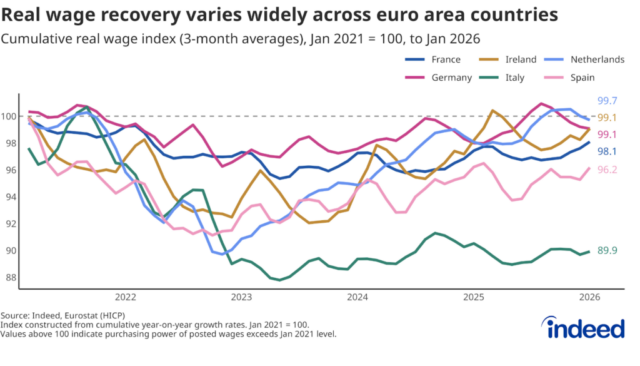
According to the researchers, the speed at which and the extent to which wages are adjusted determines a large part of that recovery. ‘Our analysis of wages in job adverts across 8 major economies over the past 8 years shows that advertised wages change more frequently in some countries than in others, ranging from around twice a year in the Netherlands to less than once a year in Japan. Because wages are generally adjusted periodically and in discrete steps, it can take some time before they respond to shocks.’ But in the Netherlands this happens relatively quickly, they say, making the labour market relatively flexible.
Wage growth is slowing
According to the most recent data from the Indeed Wage Tracker, growth in advertised wages has eased considerably recently, which also aligns with recent data on Dutch wage developments. Looking at the three-month average, year-on-year growth in advertised wages in the eurozone fell from 3.1% in January 2025 to 2.3% in January 2026, although the researchers note that ‘wage growth in several countries still remains well above inflation.’ This is particularly the case in the Netherlands, they say, with 2.0 percentage points more wage growth (4.2%) than inflation (2.2%).
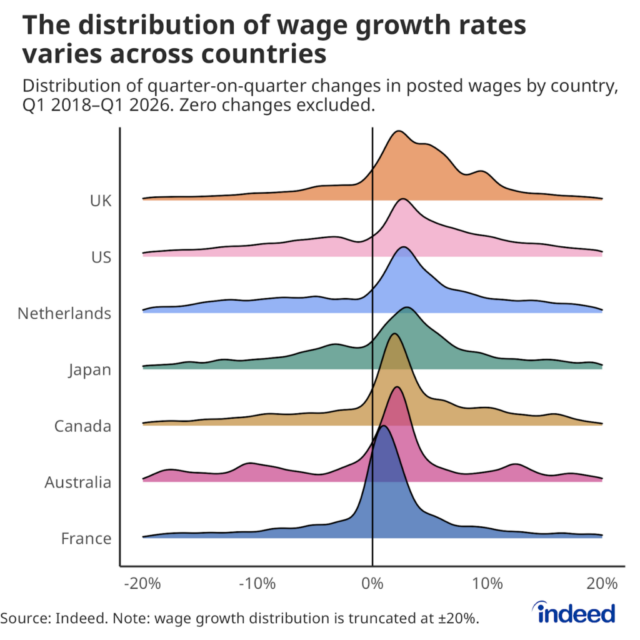
Local inflation rates are, incidentally, barely related to the local frequency of wage changes in the different countries, the researchers observe. ‘Instead, structural characteristics of the labour market – including the strength of trade unions, legislation protecting employees and wage-setting institutions – appear to play a greater role.’ The composition of the occupational group is also likely to play a role. ‘Lower-paid roles, for example, are often more standardised, with pay frequently closely linked to the minimum wage.’
Is it labour market tightness?
Are wage developments also directly related to labour market tightness? In other words: do staff shortages create upward pressure on the salaries offered? That appears not to be too significant (or disappointing, if you prefer), according to the researchers. ‘The slow real wage recovery in southern Europe, for example, does not appear to be caused by weak demand for labour. On the contrary, as previous research shows, vacancies in Italy and Spain remain well above their pre-pandemic level, indicating robust demand for workers.’ But this has therefore not translated into rapid real wage growth.
‘In flexible markets such as the Netherlands, wages can also fall when conditions cool.’
And that, according to Indeed, is in turn related to such factors as ‘delays in renewing collective labour agreements in Italy and a larger labour supply due to immigration in Spain’. In that respect, the Netherlands is in a good position, they argue. ‘In more flexible markets such as the Netherlands, wages can also fall when conditions cool, but rise again when demand for workers increases. In more rigid markets, the delay risks resulting in workers experiencing no real wage growth for longer periods.’
Also read
Related event

Strategisch Recruitment in de praktijk
De tweedaagse voor de strategische praktijk onderbouwt met de laatste innovaties, data, en modellen In de hedendaagse wereld van schaarste, tekorten en ‘de war for talent’ binnen talent acquisition is een strategische kijk en aanpak van recruitment essentieel. Deze tweedaagse training ‘Strategisch Recruitment in de praktijk’ biedt je de handvatten om recruitment naar een modern […]
Rotterdam
Indeed
Op Indeed vinden meer mensen een baan dan waar dan ook. Indeed is de nummer 1 vacaturesite (SimilarWeb, totaal aantal bezoeken, juli 2024), niet alleen in ons l…