Every recruiter today will probably recognise it. After years of barely receiving any applicants, the situation now appears to have changed completely. Post a vacancy online these days and your inbox is often flooded with responses in no time, sometimes dozens or hundreds a day. The only problem is that these applications are far from always serious, and often come from, for example, automated bots that help candidates apply for virtually anything and everything for a few euros a week.
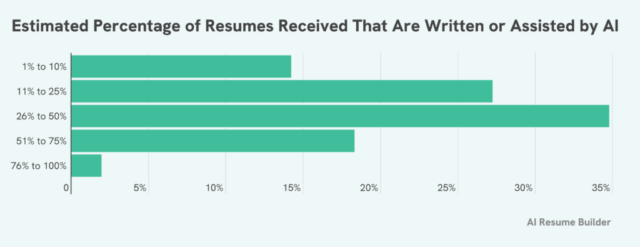
The problem has now become so great that employers are urgently looking for solutions. In a recent survey by AIResumeBuilder, no fewer than 1 in 5 companies said they were considering a system that would make applicants pay to be allowed to apply in future, with almost 90% of them stating that they were at least ‘somewhat likely’ to introduce it.
As early as the 1990s
And that is not such a strange idea at all, says recruitment guru Dr John Sullivan. ‘Suppose you charge a small fee, often called a “processing fee”, for every application a candidate submits to your company.’ You could always reimburse that fee later if the candidate actually comes in for an interview. But at least the inflow would be considerably lower from the outset, he says. ‘And do not think this is an entirely new idea. Back in the 1990s, there were already airlines using this model both to reduce the flow of applications and to generate revenue.’
Do not think this is an entirely new idea…
And it still happens today, he says. ‘For example, at many police and fire departments, which use the proceeds to cover the costs of the selection stage.’ In America, the practice is illegal only in California, although it often raises moral questions. ‘Unfortunately, the approach has also gained a bad name these days because it is one of the main sources of application fraud.’ In other words: how can you ever make candidates pay for an application when they are not sure that the vacancy actually exists, and the money may therefore end up in the wrong hands?
Containing the flow
Nevertheless, according to Sullivan, having to pay for an application could certainly help improve the quality of applications, reduce the number of spam CVs and deter non-serious candidates who submit CVs ‘just to explore the market’. You would be left with serious candidates only, Sullivan is convinced. Although, of course, the question is whether you would have any candidates left at all…
‘By making people pay, you would be left with serious candidates only’, Sullivan is convinced.
That is why the American recruitment guru also suggests other ways of curbing the flow of pointless applications. For example, he is considering setting a limit on the number of applications a candidate can submit each month. ‘This restriction would undermine much of the value of spamming AI agents. But to be effective, you would need to reinforce this restriction on applications with a penalty. For example, by automatically deleting all submitted CVs from a candidate who has breached your restriction.’
Captcha
Another solution is according to Sullivan to pay more attention to referrals, or to reduce the number of vacancies with features such as LinkedIn’s Easy Apply and Indeed’s Quick Apply, by advertising on other job sites. Introducing a captcha on your site can of course also help fend off AI applications (although you are then training other AI models, but that aside). Anything is better, he argues, than trying to filter out AI applications, with the risk of also removing genuine applications. ‘In my experience, this approach of recognising AI-generated content does not work and is also extremely time-consuming.’
But would paying to be allowed to apply really be the holy grail? Rachel Serwetz, career adviser at AIResumeBuilder, certainly has her doubts. ‘I do not believe it is the right solution in the current economy, especially with so many unemployed people. Instead, I think companies would be better off requiring a video application, an assessment or even a small project or case study‘, she says. These approaches also slow down the flow of applications and improve candidate quality without charging people to apply or creating the impression that you are profiting from jobseekers.’
The reverse idea
Amusingly, a few years ago the reverse idea emerged: should you not actually pay applicants when they take the time to indicate that they want to work for you, rather than the other way round: that they should pay you? In Canada, one company paid candidates as much as 75 dollars. It is probably something to do with the spirit of the times that the discussion is now resurfacing in reverse.
There are already quite a lot of companies building a business model around helping applicants apply for jobs.
But someone like Geert-Jan Waasdorp, director of Dutch labour market research firm Intelligence Group, says he does not believe in it at all. ‘Making people pay to apply is the perfect recipe for exploiting people. Think of employers posting fake vacancies and thereby swindling candidates out of money.’ At the same time, he says, a company such as BOLD, which bought the remains of Monster(board), is trying to build a business model around guiding people for a fee and offering paid tools to apply for jobs. More paid job boards are also appearing again. And the difference from paying to apply is not that great, of course…
Blockchain
According to Waasdorp, however, Sullivan has overlooked one solution: identity verification systems such as SkillsCV or Victoria-ID, where you show – for example via blockchain – that your application comes from a human being. ‘I certainly believe we are moving towards validated profiles’, he says. However, this too can be seen as a barrier to applying. And organisations simply do not want to make that barrier too high (yet), for fear of missing out on the right and suitable candidates as a result.
How do you know you are not missing the ideal candidate the moment you close the vacancy?
The debate also touches on another age-old discussion: how many applications do you actually need? At Digitaal-Werven, Anne Jaakke (Rituals) recently said that they close a vacancy as soon as they have three good candidates who have made it through the first selection stage. ‘Do you know how nice that is?’, she asked rhetorically. But who is to say the fourth candidate is not better? How long do you want to keep vacancies open in the hope that the ideal candidate will still come forward spontaneously? It is a debate on which few figures are available, and one that has only become more pressing due to the rapid rise of AI.
Find out more?
On 28 October, the conference AI & Talent: The future of HR and recruitment will take place, bringing together HR and recruitment professionals to further explore the power and application of AI. Featuring Jarno Duursma and Caroline Tervoort-Visser, among others. Read all about it here:

Read this article in full
Become a Werf& member for unlimited access to all articles, research and exclusive insights into the labour market.
No obligations Cancel anytime Secure payment