With Undutchables, a recruitment agency for international talent looking to work in the Netherlands, Marjan Stoit has been working on the internationalisation of the labour market for 25 years. Something which, in her view, may be more necessary than ever given the tightness of the labour market. But it is also a phenomenon she sees coming under considerable pressure, with all the consequences that entails for our economy.
‘We cannot afford to introduce restrictions whilst neighbouring countries are doing precisely the opposite.’
‘With the arrival of the Schoof cabinet and the continuing shortage in the housing market, the branding of the Netherlands as an attractive international business location is at risk,’ she says. ‘We cannot afford to introduce restrictions whilst neighbouring countries are instead focusing on instruments to recruit candidates more easily for hard-to-fill roles.’
Are migrants still welcome?
Stoit is one of the many speakers at the Internationalisation of the Dutch labour market conference, which will be held in The Hague next week and where all the advantages and disadvantages of labour migration – at every level – will be discussed. In her view, it is at least a subject we should handle with care. ‘The Netherlands has traditionally been a country that attracts internationals from all over the world and has always done business internationally, and it seems that we are now less open to this.’
‘We need highly educated, creative and innovative talent that is not always available within the Netherlands.’
Not wise, she says. ‘We are a small country with a well-developed knowledge economy that thrives on international trade relations. For this, you need highly educated, creative and innovative talent that is not always available within the Netherlands. With the new political wind that is blowing, the much-needed arrangements for foreign talent wishing to work in the Netherlands are being called into question. You can see that the negative climate surrounding migration is also affecting migrants who already work here. They are beginning to wonder whether they are still welcome here.’
Open, tolerant, inclusive and liberal?
And the labour market can hardly do without that, she says. Over the 25 years that Stoit has been placing foreign talent at Undutchables, she has seen that the Netherlands long held a preferred position among international talent. ‘For years, the Netherlands successfully positioned itself as an attractive location for both foreign companies and Dutch companies that are partly dependent on foreign talent. Candidates abroad generally know us as an open, tolerant, inclusive and liberal country. In addition, there have traditionally been attractive arrangements for knowledge workers and expats (such as the 30% ruling).’
‘Is restricting labour migration the right instrument to solve the housing shortage?’
But whilst other countries are introducing arrangements to tackle pressing labour market shortages through labour migration, the discussion here is ‘about expats driving up house prices and foreign students supposedly making higher education less accessible to Dutch students’, she says. Certainly, the Netherlands has a housing shortage, and she recognises that. ‘But is restricting labour migration the right instrument to solve this, whilst a record number of vacancies remain open? And international students represent attractive potential for Dutch companies.’
The importance of labour migration
Stoit stresses several times that she does not want to take the politician’s seat. But she also wants to make clear that policy on labour migration has major direct consequences for Dutch businesses. ‘It is not without reason that ASML has knocked on the cabinet’s door and threatened to leave the Netherlands if it can no longer grow here. Even if you succeed in training more people for shortage occupations, it will still take years before you notice the effect. Companies cannot wait for that.’
‘As far as I am concerned, it is desirable to expand, rather than restrict, the number of arrangements for specific target groups.’
If we want to keep our economy healthy, we must therefore be extremely careful about discouraging labour migration, she says firmly. ‘As far as I am concerned, it is desirable to expand, rather than restrict, the number of arrangements for specific target groups. In addition, of course, work must continue to address bottlenecks here, such as aligning education with the labour market and housing.’ Ultimately, she says she is optimistic about this. ‘Migration is a complex issue that provokes many sentiments, but overall, labour migration has contributed positively to our prosperity for many years.’
Learn more?
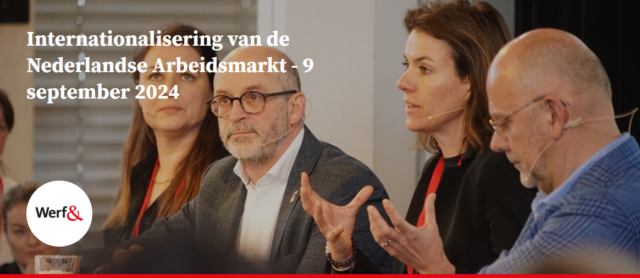
On 9 September 2024, the second edition of the Internationalisation of the Dutch labour market conference will take place in The Hague. During this conference, participants will be inspired by the facts, context, practice, best practices, dilemmas, challenges, issues and solutions. No sacred cows, but facts and practice. Problems and solutions. So register quickly now:
This story was written by Marc Tinnemans (blikvoortekst).