Hardly any maternity care left. Some 5 million outpatient clinic visits that cannot go ahead. Around 15.4 million fewer GP consultations. Approximately 35,000 nursing home places lacking. And a shortage of no fewer than 74 million hours of childcare. In total, around 15% (!) of all care that cannot be provided. Larissa Lodewijk and Inge Bouman-Vuik both explain it calmly, without panic in their voices. But their contribution, as the day’s first speakers, is no understatement. It is immediately a wake-up call for everyone in the packed hall at the Van der Valk hotel in Utrecht: this really matters, quite literally a matter of life and death.
‘The question is whether we should want 1 in 4 people to work in healthcare.’
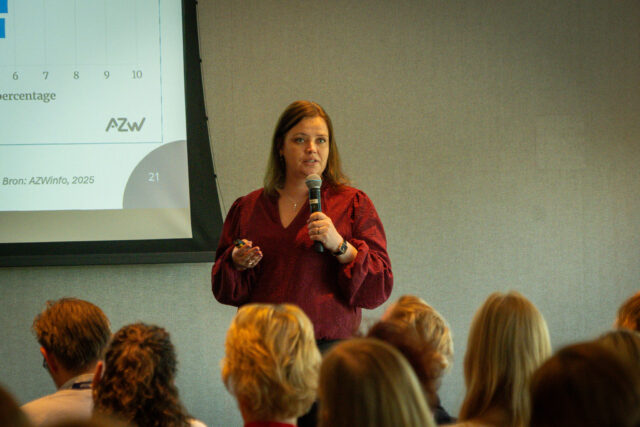
‘These are the projections for 2034 if we continue as we are,’ says Bouman-Vuik (photo), who at RegioPlus tracks all labour market data for the Netherlands’ by far largest employer (in total). ‘We represent 1,500 organisations and around 1.5 million employees, plus another 192,000 self-employed professionals,’ her colleague Lodewijk had explained shortly beforehand. That already concerns around 1 in 6 workers. But if demand for healthcare continues to develop as currently projected, that share will rise to 1 in 4. ‘And the question is whether that is something we should want together,’ Bouman-Vuik says dryly.
Read this article in full
Become a Werf& member for unlimited access to all articles, research and exclusive insights into the labour market.
No obligations Cancel anytime Secure payment