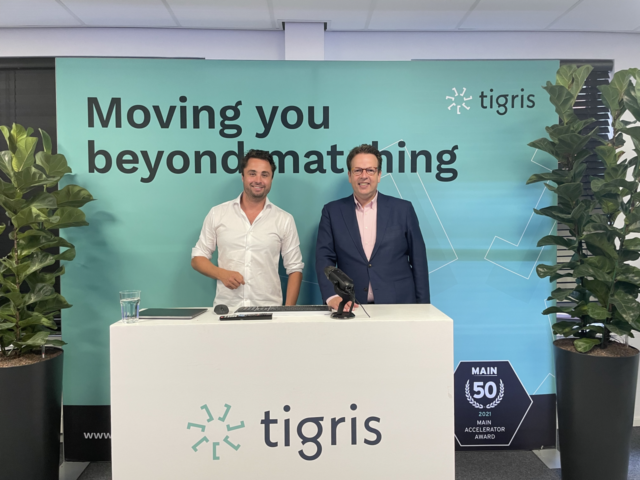
The last mile: anyone who works in logistics knows the phenomenon only too well. The final part of the delivery process is, after all, the most difficult and the most expensive. You can no longer send a parcel with thousands of other orders to a large depot – it has to go to a single address; it has a unique final destination. This is the point at which genuine transport experts distinguish themselves from the rest, and therefore earn their money. And if Maikel Neelen (Tigris) and Geert-Jan Waasdorp (Intelligence Group) are to be believed, the same will soon apply to recruitment experts.
[private roles=”werf_subscriber_unpaid”]
This development has everything to do with the rise of artificial intelligence, a rise that has progressed faster over the past six months than we could ever have imagined. The last mile will therefore also emerge very quickly in the world of recruitment, Neelen and Waasdorp predicted last week in their webinar Digital trends and developments in the temporary employment sector. That is remarkable, especially when you consider that other new eras in this world only emerged after knocking on the door for several years. But what does the last mile actually mean in a recruitment context? And why is it being prioritised thanks to A.I.?
Automation boosts productivity
To understand what will change in the world of recruitment and selection in the short term, we must first know the current state of affairs. During their webinar, Waasdorp and Neelen did not mince their words: there is much to be enthusiastic about, but the fact is that recruiters’ productivity has been declining for years. This is not (solely) down to the profession itself – labour market shortages and a lack of investment in new technology are also to blame for this (although the average recruiter can also increase their productivity exponentially through training and education).
‘The fact is that recruiters’ productivity has been declining for years.’
At the end of the day, ever more recruiters are delivering ever fewer candidates – that is the harsh reality. Does the sector want to boost that productivity again? In other words: do you want to ensure that fewer recruiters find more candidates? Then, Waasdorp and Neelen believe, a large part of the recruitment process must be left to automation.
And that is possible, as they also know. After all: in the ChatGPT era, writing job adverts and personally approaching candidates can be done by a chatbot. An LLM (Large Language Model) can also compare candidate profiles with job descriptions and rank suitable applicants on that basis. We have not even mentioned its ability to request additional candidate information, benchmark salaries and draw up contracts. What remains is – you guessed it: the last talent mile.
Last talent mile to stand out
In this last talent mile you have secured a candidate: you know exactly who they are and what they can do – your automated processes have ensured that. The only thing that now needs to happen – something that sounds very simple, but is very difficult – has everything to do with a personal touch. A recruiter of flesh and blood must ensure that the candidate settles in pleasantly with their new employer. Every candidate will need something different for this, a task that is tailor-made for a skilled recruiter – and not for a robot.
A recruiter of flesh and blood must ensure that the candidate settles in pleasantly with their new employer.
Suddenly it becomes clear why Waasdorp and Neelen see the future in the last talent mile and why they believe agencies that do not get on board are doomed to fail. According to the gentlemen, agencies that do get on board must ask themselves a number of questions. For example: which unique qualities can I deploy in the last mile ? And: is the talent I place sustainable? In other words: can an A.I. not take over that last mile from me in my niche? Do they find the right answers to these questions? And do they learn to make automation work for them, including by becoming experts in prompting and leveraging the right platforms? Then they will know how to distinguish themselves in the last mile and fulfil their ambitions.
[/private]
Want to know more?
Listen to the full webinar again here. Or register now for the HR & A.I. Congress on 7 September, or the seminar ChatGPT and recruitment, the future of talent acquisition on 31 August.

Read this article in full
Become a Werf& member for unlimited access to all articles, research and exclusive insights into the labour market.
No obligations Cancel anytime Secure payment

Tigris.Works
Hoe Tigris jou écht verder gaat helpen. Wij denken aan jou. Jouw ambities, jouw dromen. Met ons netwerk door heel Nederland, connecten we je met de juiste recru…