Whilst unemployment is rising, more and more American employers also have vacancies they cannot fill. According to a new survey by Express Employment Professionals and Harris Poll, 44% of American hiring managers say their company currently has vacancies that remain unfilled. That is a substantial increase from 36% in autumn 2025 and the highest level since autumn 2023. The US labour market is therefore becoming tighter again, whilst companies simultaneously say they do want to hire – but there are also queues of people waiting.
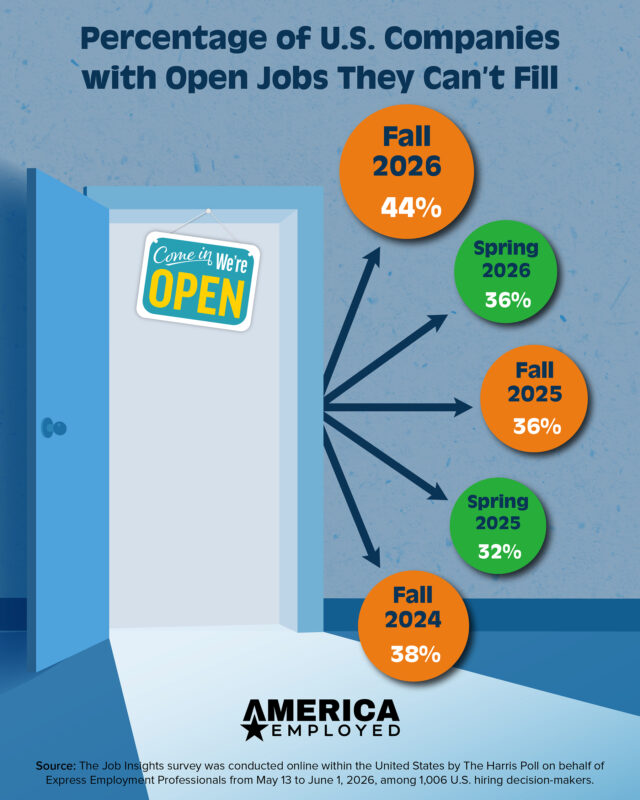
The duration of the recruitment process is also increasing, the survey shows. More than 2 in 5 hiring managers (43%) say that the time required to hire a candidate has increased recently, and more than 1 in 4 (26%) say they need at least 4 weeks for CV screening, interviews and the final decision. At the same time, employers close an average of 21% of their vacancies without hiring a candidate, and more than 1 in 4 employers (27%) say that a quarter or more of their vacancies remain completely unfilled.
More than 1 in 4 employers say that a quarter or more of their vacancies are forced to remain unfilled.
Remarkably, although the process is taking longer on the one hand, companies are actually conducting fewer interviews with candidates before making an offer. Candidates now go through an average of 4 interviews before receiving an offer, compared with 5 when the same question was asked in spring 2023.
Candidates do not feel heard
Employers are therefore not exactly holding back in their vacancy and expansion plans, according to the recent survey. Remarkably, because candidates now appear to be experiencing a very different reality. Jobseekers surveyed for another survey (by the same parties) say that applying for jobs is becoming increasingly difficult. They also feel that the process is becoming less and less human. Nearly 1 in 3 (31%) cite navigating an automated recruitment process, rather than feeling heard by people, as a concrete challenge in their search.
‘1 in 5 is convinced that A.I. is taking jobs and thereby limiting their chances of securing a new position.’
The same proportion (31%) believe that companies pretend to be recruiting, but in reality only collect CVs without serious intent. A mismatch in job level also plays a part: more than 1 in 4 candidates (28%) say overqualification makes their search more difficult, compared with 22% who experience underqualification as a barrier. Another 1 in 5 (21%) is convinced that A.I. is taking jobs and thereby limiting their chances of securing a new position. ‘Recruitment has only become more complex’, concludes Express Employment International CEO Bob Funk Jr..
Dutch employers recognise this
It is an image that many Dutch employers will undoubtedly recognise. In the Netherlands too, the qualitative mismatch remains a major problem, despite a somewhat cooling labour market. Research by UWV earlier this year among 3,550 employers shows that an average of 45% of vacancies created in the past 12 months were difficult to fill. That is down from 53% in 2023 and 2024, but particularly in construction (71%) and industry (53%), the share of hard-to-fill vacancies remains extremely high.
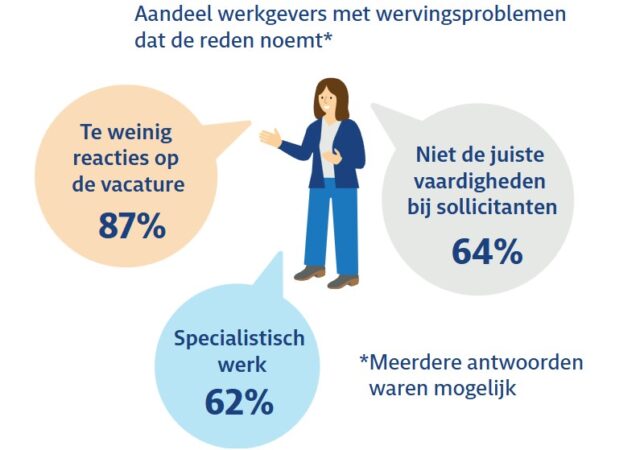
Employers mainly cited qualitative bottlenecks as the cause: for 64%, applicants lack the right skills; for 59%, specialist knowledge; and for 55%, work experience. For 36% of employers with hard-to-fill vacancies, candidates’ salary expectations play a role. However, the biggest problem remains simply too few responses to vacancies: 87% of employers cite a shortage of applicants as a reason for their recruitment difficulties. With, at the heart of the whole story, a mismatch between value and expectation.
A.I. appears to widen the gap
In the field of technology too, we see in the Netherlands the same tension that emerges from the American survey. The Workmonitor 2026 by Randstad, based on research among more than 27,000 employees and 1,225 employers in 35 countries, shows that employers are, for example, moving ahead decisively with A.I. implementation, whilst more than 1 in 5 employees (21%) believe their tasks are completely immune to A.I. Nearly half (47%) also say they fear that A.I. will primarily benefit the company rather than themselves.
According to Randstad, there is ‘an increasingly fine-grained mismatch’ at play.
Randstad explicitly calls this a risk to what it describes as the Great Workforce Adaptation: without training and clear communication, the gap between employer and employee, and therefore also between vacancy and candidate, threatens to grow rather than shrink. There is ‘an increasingly fine-grained mismatch’, according to Bart van Krimpen, Lead Market Intelligence at Randstad Netherlands, earlier this year. ‘One sector faces structural scarcity, whilst pressure is easing elsewhere.’ And also: ‘Employers experience shortages on the one hand, whilst on the other hand part of the available potential is not being utilised.’
What this means for recruiters
The figures from the US and the Netherlands essentially tell the same story from 2 perspectives: statistically speaking, the labour market may be easing somewhat, but the mismatch between supply and demand is not disappearing. In fact, it appears to be shifting from pure scarcity to a more qualitative and process-related problem. Recruitment seems to be finding the answer less and less easily. Employers who leave vacancies open for longer, add more automated steps and at the same time offer less personal contact may risk losing precisely the candidates they need most.
Nearly 9 in 10 employers admitted to having rejected qualified candidates because they did not exactly meet the job requirements.
This is also evident from the so-called hidden workers research by Harvard Business School and Accenture, which raises questions about the idea that there are simply too few suitable candidates. Of the employers surveyed for this, 88% admitted at the time that qualified, experienced candidates are rejected because they do not exactly meet the specified job requirements. Often, these are not genuine shortcomings, but overly rigid criteria in job descriptions and screening systems that automatically exclude candidates with slightly different work experience, education or wording on their CV.
It takes longer
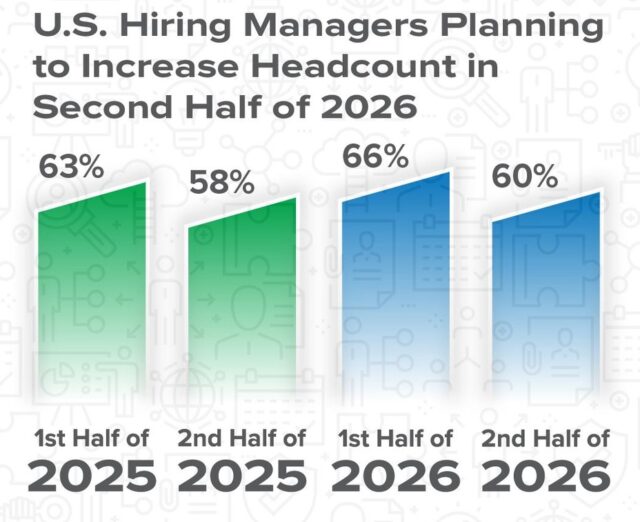
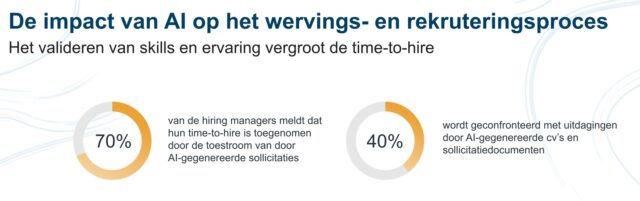
Recent research by Robert Half among 250 Dutch hiring managers also appears to point in that direction. It shows that more than 1 in 3 employers say they plan to expand their permanent teams in the near future, but at the same time 70% indicate that checking A.I.-generated application materials lengthens the recruitment process. ‘This means they need to adapt their selection processes and place greater emphasis on structured interviews, practical skills assessments and experience verification in order to identify the right candidate’, according to Nitin Parbhudayal, Senior Director at Robert Half.
For 45% of all employers surveyed, the process takes at least 1 week longer than before.
Some 27% say they struggle to distinguish between A.I.-generated and original CVs. And 26% also say they spend more time verifying candidate information as a result. These additional checks also extend the total duration of the recruitment process. For 45% of all employers surveyed, the process now takes at least 1 week longer. This includes 10% who have experienced a delay of more than 1 week since A.I. entered the traditional recruitment process.
A different perspective: it is the process
All in all, this casts the UWV figures above in a somewhat different light. Employers cite missing skills, specialist knowledge and work experience as the main bottleneck, but the HBS research suggests that some of those ‘missing’ skills do in fact exist, only they are filtered out by an overly tightly designed process before a recruiter ever gets to see the candidate. The mismatch may therefore be less of a labour market problem than a design problem: how tightly, narrowly and automatically the recruitment process itself is designed.
The mismatch may be less of a labour market problem than a design problem.
The recently announced Talent strategy from the government already explicitly mentions the ‘mismatch’ between requested and available skills. But there appears to be more going on: the American survey suggests that jobseekers and employers simply seem to be finding one another increasingly difficult to reach, and that the current – rigid – process is more of an obstacle than something that facilitates quick and effective matching. In short: the supply appears to be there, as does the demand. It is now up to recruitment to find a new way to bring those two sides together efficiently and more effectively…
Also read
Read this article in full
Become a Werf& member for unlimited access to all articles, research and exclusive insights into the labour market.
No obligations Cancel anytime Secure payment
Related event

Arbeidsmarkttrends 2027-2030
We zijn uitverkocht. Maar goed nieuws!Arbeidsmarkttrends 2027-2030 is volgeboekt. Goed nieuws: op 28 januari 2027 organiseren we een tweede editie, met dezelfde sprekers en hetzelfde programma. Zorg dat je er alsnog bij bent.Bekijk de editie van 28 januariAl jaren geven de beste sprekers en specialisten een arbeidsmarktupdate en een doorkijkje naar de arbeidsmarkt van de […]
Odido