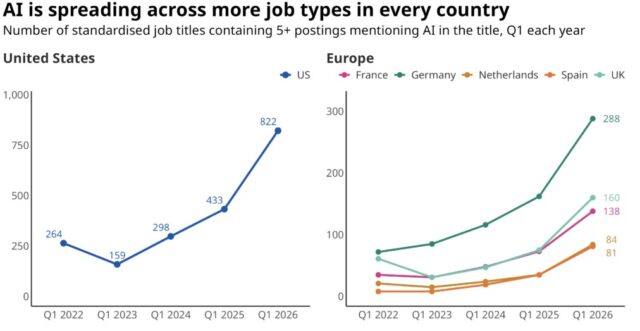
For its new study, Indeed Hiring Lab analysed millions of job adverts in the US and five major European countries. How many standardised job titles included the term A.I.? A title was only considered ‘AI-touched’ once at least five job adverts in a quarter used that term, so that isolated outliers were not counted. In the US, the number rose from 264 in 2022 to 822 in early 2026, or 8.3% of all job titles. Europe is following the same pattern on a smaller scale. Germany leads with 288 A.I.-tinged job titles (4.2%), followed by the UK (160; 2.7%), France (138; 3.3%), the Netherlands (84; 2.2%) and Spain (81; 2.3%).
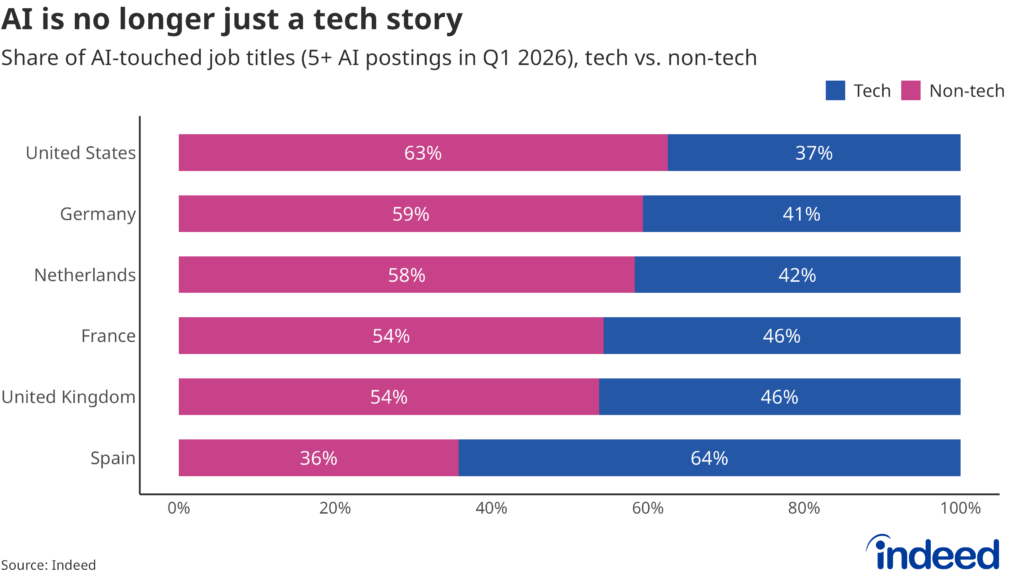
The most striking aspect of this study, however, is not the figures per se, but where the titles are appearing. In five of the six countries studied, more than half of all A.I. job titles now come from an occupation that can be regarded as non-tech. The US leads the way with 63%, Germany follows with 59%, and the Netherlands is close behind with 58%. Only Spain differs: there, 64% of A.I. titles remain linked to a typical tech role. In short, what began as a story about engineers and data scientists now appears to have grown into a phenomenon increasingly affecting the entire labour market.
The Netherlands: marketing and advertising
With 84 A.I.-tinged job titles and a share of 2.2% of the total number of vacancies, the Netherlands may not be leading Europe in this respect, but the direction is crystal clear. This picture is also confirmed, for example, by LinkedIn‘s annual Jobs on the Rise ranking: for the second year running, AI Engineer ranks number one among the fastest-growing roles in the Netherlands. Roles such as Machine Learning Engineer and AI Product Manager are also two popular roles at many Dutch companies, followed by AI Ethicist and Prompt Engineer as emerging roles.
‘A.I. creates new job titles, but rarely new professions.’
Ingrid Schipper, managing partner at recruitment and selection agency SchaalX, did put these developments into perspective. ‘A.I. creates new job titles, but rarely new professions.’ She said so in trade publication Adformatie, in an article about job titles such as AI Growth Architect and Narrative Architect that are currently appearing frequently in vacancies for Dutch marketing and communications teams. Indeed had also cited the example of marketing and advertising specialists using AI tools as an explanation for the 58% of non-tech job titles it found in the Netherlands containing the term A.I.
Familiar professions, new label
Indeed also emphasises that this is certainly not just about new A.I. specialisms. Many roles that have existed for decades are now simply being given the A.I. label because using A.I. tools is now part of the role. In the US, for example, vacancies are appearing for an ‘AI Autonomous Truck Test Driver’, a physiotherapist with ‘A.I. documentation’, and an estate agent with an ‘AI Lead System’. In Germany, an HR manager is seeking someone who can deploy ‘A.I. in HR’ to work more efficiently, whilst in France companies are recruiting salespeople for A.I. products.
This pattern is also recognised by recruitment agency Morgan Black, which, based on the Dutch market, writes that employers are increasingly looking at what a candidate can build and implement with A.I., rather than at a specific A.I. qualification. In other words, traditional roles are naturally absorbing A.I. skills as an obvious addition, rather than as a separate field.
3 types of new roles
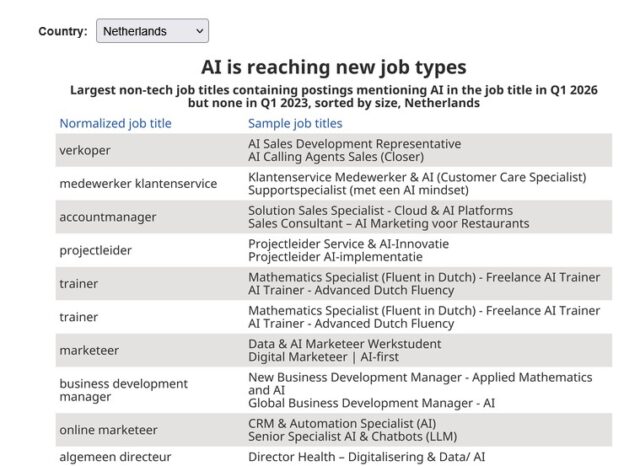
Indeed distinguishes three clusters that recur in all countries studied. The first cluster revolves around A.I. consultancy and implementation: account managers, operations managers and business development specialists who help organisations transition to AI-driven working. The second cluster concerns training and content: language specialists, voice actors and subject experts who provide or assess training data for A.I. models, alongside marketers and designers who use A.I. to create content. The third cluster is instruction: coaches, trainers and teachers who teach colleagues, clients or students how to use A.I. tools (see image above).
For jobseekers and recruiters, the main lesson is probably that A.I. knowledge is no longer an exclusive domain of tech roles. A lorry driver, physiotherapist or HR manager looking for work today may just as easily encounter vacancies expecting some degree of A.I. capability. This does not automatically mean in-depth technical knowledge: more often, it is about having the confidence and ability to use A.I.-supported software, or to contribute ideas about its implementation within a team.
Read also

Indeed
Op Indeed vinden meer mensen een baan dan waar dan ook. Indeed is de nummer 1 vacaturesite (SimilarWeb, totaal aantal bezoeken, juli 2024), niet alleen in ons l…