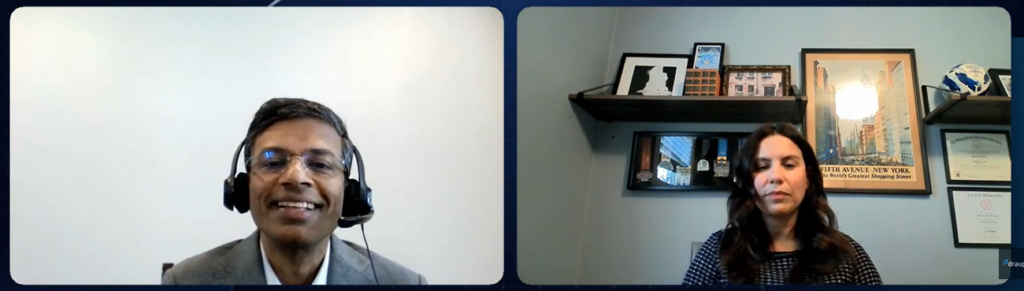
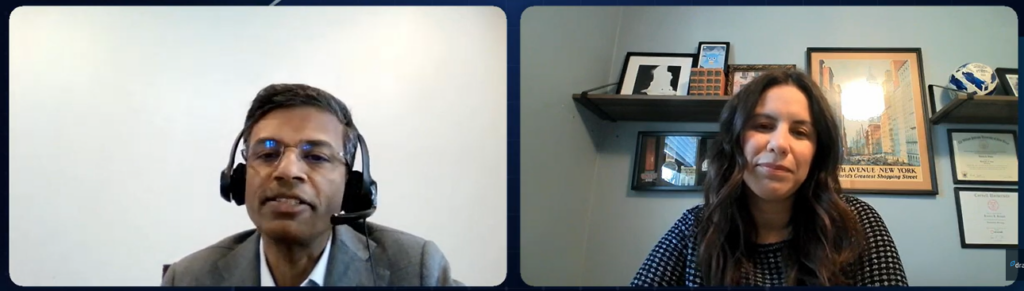
The future of recruitment? It is not about becoming ever faster in your process. It is about being ready before the demand even arises. In the words of Cruijff: ‘Football is simple: you are on time or you are late. If you are late, you have to leave earlier.’ And of course, the same applies to recruitment, said Vijay Swaminathan, co-founder and CEO of Draup, in a recent podcast by Brian Heger, where he appeared alongside Jessica Joseph, director strategic talent sourcing at Aramark.
‘If you wait until a vacancy arises, you are already too late.’
The founder of the Talent Intelligence company, who will soon once again be one of the speakers at the Global Talent Strategy & Intelligence Conference in Amsterdam, spoke mainly about vacancies in frontline roles. According to him, these rarely go according to plan. People leave suddenly, a location is suddenly operating with half its usual staffing, and demand changes faster than a recruitment campaign can keep up. According to Swaminathan, the core problem is that recruitment traditionally only takes action once a role is already open. At that point, it is actually already too late, he says. ‘You need to make sure you are ready by then.’
Less firefighting
Joseph recognizes this from practice at Aramark, a huge hospitality company with around 270,000 employees worldwide, most of whom work in frontline roles. Her team uses Talent Intelligence to read market signals and identify pressure in the labor market early, before recruitment figures themselves start moving, she explains. Think of signals such as a tighter local labor market, changing commuting patterns, or a new client suddenly requiring (many) additional staff.
‘Today’s market demands looking ahead.’
Those who pick up these signals in time can fill pipelines before the shortage actually materializes, rather than having to repair things afterwards, Joseph explains. At Aramark, this shift has led to less ‘firefighting’ and more candidates already being ready when an account is won or an employee is promoted, she says.
Why people beat machines
Swaminathan illustrates the importance of frontline work with a personal experience. When one of his flights was recently cancelled, he saw that 90% of stranded travelers did not turn to the app or call the hotline, but headed straight for the staff member at the counter. Even though digital alternatives were available. In a crisis, people naturally trust people, he argues, whether they are nurses, truck drivers, or foodservice employees. Only when that one employee clearly can no longer cope do people turn to a digital alternative after all.
‘In a crisis, people naturally trust people.’
At the same time, that same frontline employee now expects a modern, digital working environment in their daily work, having become accustomed to advanced devices in their private life. An outdated checkout system or the absence of a digital self-service kiosk in a pharmacy can quickly feel like a shortcoming. According to Swaminathan, digital (A.I.) investments in frontline roles are therefore no longer a luxury, but a prerequisite for retaining talent. Those who fail to make them will see scarce staff leave for an employer with more modern systems.
Hyperlocal customization
A third observation Swaminathan makes in the podcast is that frontline work is extremely local, sometimes down to the level of a municipality or even a neighborhood. While an office worker can easily commute 40 miles to the city center, every kilometer matters for frontline staff. Available public transport, bus routes, and the socioeconomic makeup of the neighborhood all help determine whether or not a vacancy can be filled. That makes hyperlocal signals at least as important as national labor market figures.
‘A bad hire is always more expensive than a vacancy for the right person.’
In addition to speed, cost control also plays a major role, especially in the hospitality and foodservice sectors in which Aramark operates. Joseph emphasizes that a bad hire generally proves more expensive than leaving a role vacant temporarily. By calculating the costs of turnover in concrete terms, her team can convince the business to invest in preparation rather than quick emergency measures.
Swaminathan takes the comparison further with the example of Starbucks, which believed it had found a technically brilliant solution to queues with the introduction of mobile ordering, but at the same time turned out to lose part of the brand experience for many customers: the chat at the counter. His lesson from this is that frontline technology must first empower people before you start automating. Automating too early can improve the numbers on paper while actually undermining the customer relationship.
Frontline as a career path
Another idea Swaminathan explicitly wants to challenge is that frontline work is by definition cheap, replaceable labor. He refers to truck drivers who became millionaires and store managers who grew into top earners, examples that he believes are barely known among people making career choices. If organizations told that story better, he expects more people to consciously choose frontline work, especially now that office roles are coming under pressure from A.I.
‘Those who recruit frontline staff today are also bringing in the company’s future leaders.’
Joseph adds that Aramark has a high percentage of employees progressing from hourly roles into what she calls salaried roles, and that those who recruit frontline staff today are effectively also bringing in the company’s future leaders. She also emphasizes the importance of personal contact at every stage of sourcing: technology helps create scale, but candidates repeatedly cite the conversation with the team as the decisive factor.
From time-to-hire to pipeline health
With the shift towards proactive recruitment, the way recruitment success can be measured also changes, Joseph says. Time-to-fill is, according to her, a backward-looking metric: it mainly tells you what has happened, not what is to come. Her team therefore increasingly focuses on pipeline health, conversion quality (how many candidates actually progress to interviews and offers), and time-to-productivity: how quickly a new employee actually adds value. ‘How many candidates convert into interviews and offers matters more than the volume of candidates.’
‘How many candidates convert into interviews and offers matters more than volume.’
When asked where strategic sourcing is heading, Swaminathan says he sees a gradual but unmistakable shift from role-based to more capability based recruitment. Business leaders know less and less precisely which roles the future will require, but they can identify the capabilities an organization needs to build. The corresponding roles then follow from those capabilities, rather than the other way around.

As an example, he mentions a fictional need for sensors that automatically collect feedback about food in a company restaurant. Once an organization wants to realize that capability, one or more new roles naturally emerge from it, rather than starting from an existing job profile. Swaminathan says he is genuinely excited about the moment when capability-based hiring truly becomes mainstream within strategic sourcing.
Start small, then scale up
Both podcast guests conclude with practical advice for teams that want to embrace this ‘proactive recruitment’ with Talent Intelligence. Joseph advises first having a thorough conversation with the business and identifying shared priorities, especially in organizations with multiple, diverse business units. Those who can find the 80% of shared interests and start with 1 or 2 critical roles will build visible proof before rolling out the approach across the organization.
‘Every profession is slowly becoming a little bit frontline.’
Swaminathan agrees with that advice but adds one of his own pet topics: mobility. Organizations need to actively show their frontline employees that a career starting on the shop floor can grow into a leadership role. According to him, the term frontline increasingly means less ‘physically standing at the counter’ and more ‘working close to the customer’, a reality that now also applies to software engineers. ‘Every profession is slowly becoming a little bit frontline,’ as he puts it.
Want to know more?
Draup CEO Vijay Swaminathan is one of the many speakers at the Global Talent Strategy & Intelligence Conference, taking place between 28 and 30 September 2026 at the H’ART Museum in Amsterdam. Find all the information here, including how to order tickets:

Read also
Related event

Arbeidsmarkttrends 2027-2030
We zijn uitverkocht. Maar goed nieuws! Arbeidsmarkttrends 2027-2030 is volgeboekt. Goed nieuws: op 28 januari 2027 organiseren we een tweede editie, met dezelfde sprekers en hetzelfde programma. Zorg dat je er alsnog bij bent. Bekijk de editie van 28 januari Al jaren geven de beste sprekers en specialisten een arbeidsmarktupdate en een doorkijkje naar de […]
Odido