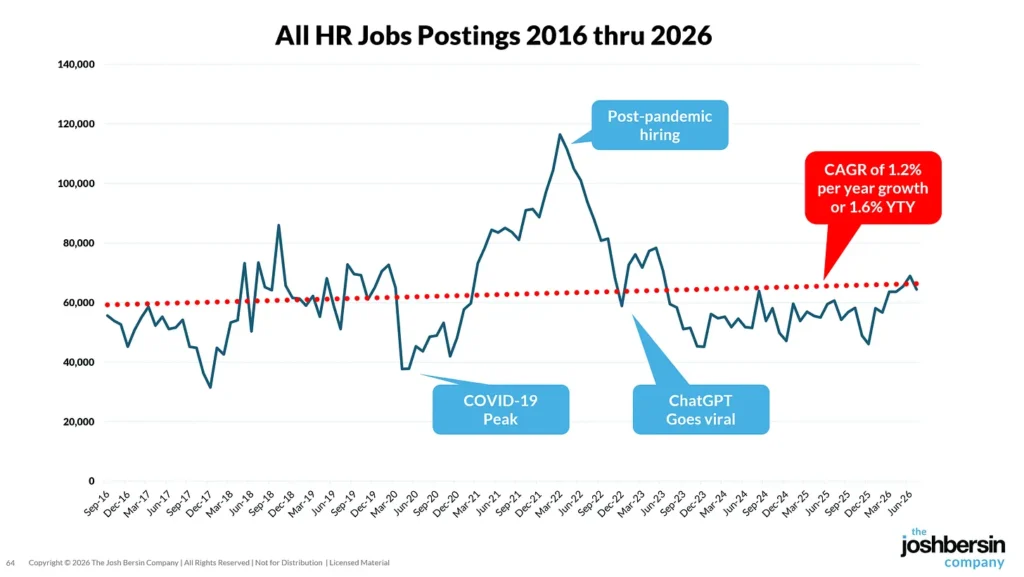
Anyone inclined to be gloomy about the HR profession because of the rise of AI need not turn to Josh Bersin. According to the HR guru, there is no reason for negativity at all; ‘the profession is actually booming ‘, he told his audience in Paris last month. And that includes recruiters. In the past 24 months alone, growth was around 6%, meaning that, according to Bersin, the HR profession has been growing faster than total employment for years.
The same pattern can be seen in the Netherlands, according to new quantitative research by Intelligence Group into HR professionals and recruiters. In 2022, for example, the Netherlands had just over 127,000 HR and recruitment professionals. There are now more than 18% more, bringing the total to around 150,000. The number of HR professionals grew by more than 20%, and the number of recruiters by almost 9% to a total of more than 23,000.
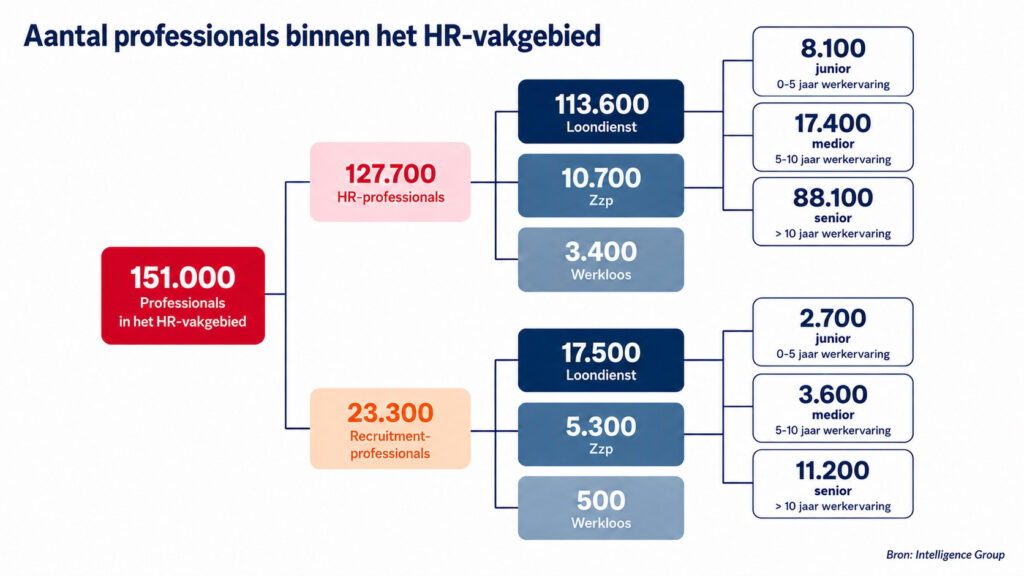
By comparison, total employment in the Netherlands rose by just under 4% over the same period. HR professionals therefore account for an increasingly large share of the total workforce. ‘And that is not really surprising when you list all the staffing challenges employers are grappling with’, says Bob Roders, marketing manager at HR agency Compagnon. HR professionals make up by far the largest group, at 85% of the total. Their unemployment rate fell to 2.7%, well below the national average of 4%.
‘Young talent needed’
The number of senior employees rose by more than 16% in recent years, and the number of juniors by 9%. Senior professionals now account for 78% of HR professionals, and juniors for just over 7%. Roders understands the emphasis on experience, but adds a note of caution. ‘It is important for employers and HR departments to bring in enough young talent too’, he says. ‘That way, you will still have good mid-level and senior professionals in a few years’ time. And you bring in new knowledge, ideas and inspiration. That seems important to me these days too.’
The proportion of self-employed recruiters grew to more than 23%, placing the profession in the top 20.
The number of self-employed HR professionals is also striking. It has grown by as much as 45% in recent years, increasing their share from 7.0% to 8.6%, although that is still below the national average of around 10%. Roders did, however, see the proportion of self-employed workers decline somewhat after enforcement of the Dutch DBA Act began in early 2025. Among recruiters, the proportion who are self-employed is much higher: around 23.2%. This puts the profession in the top 20 for self-employment. The number of self-employed recruiters also grew by 32.5% over the past 4 years.
Unemployed recruiters extremely scarce
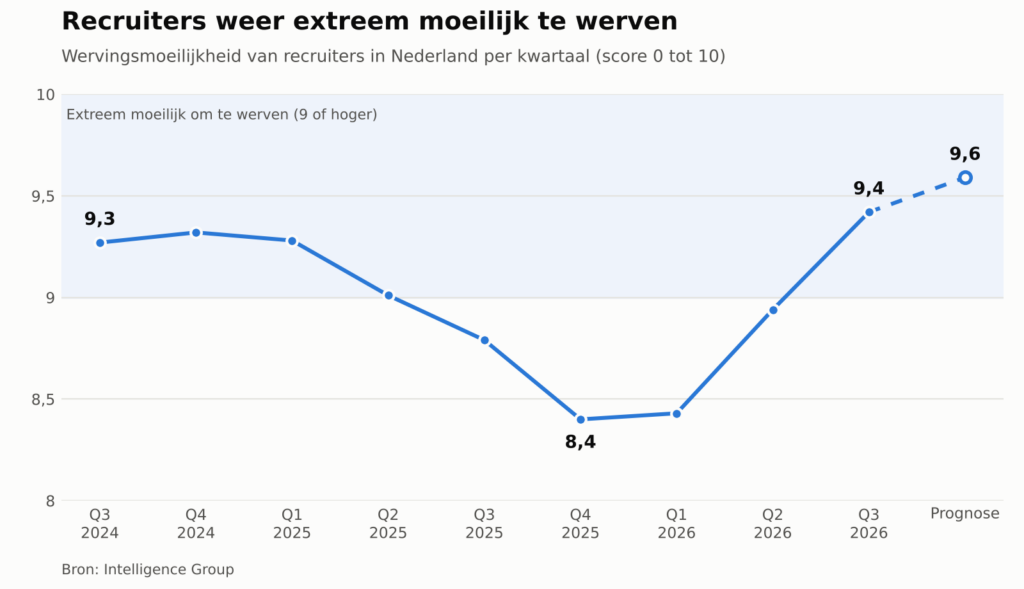
Although unemployment among recruiters has risen slightly in recent years, it remains exceptionally low at 2.1%. Additional figures from Intelligence Group help explain why. They classify recruiters as ‘extremely scarce’, with a scarcity ratio of 9 vacancies for every recruiter seeking work. Over the next 6 to 12 months, that scarcity is expected to increase to 12 vacancies for every recruiter seeking work.
The very people whose job is to recruit are themselves the hardest to recruit.
Recruiters therefore score 9.4 out of 10 for recruitment difficulty, with scores ranging from 9.1 to 9.6 in every province of the Netherlands. ‘Regular’ HR professionals are also still scarce, with a ratio of 2 to 1 and a recruitment difficulty score of 7.2, but the situation is considerably less extreme. Intelligence Group expects HR managers to shift from scarce to very scarce over the coming year.
Recruiters rarely search actively
The scarcity of recruiters may also be explained by the fact that few are actively looking for another job themselves. Only 4% say they are actively looking, compared with 11.7% of the total workforce. However, 56% say they are passively open to a new job. HR professionals are more active: 12.3% are actively looking and 49.5% are passively open to opportunities. HR advisers stand out, with 16.6% actively seeking work. They also change jobs more often: 22.5% moved to a new employer, compared with 15.5% of all workers. Among recruiters the figure was 17.8%, whilst among HR managers it was just 10.4%.
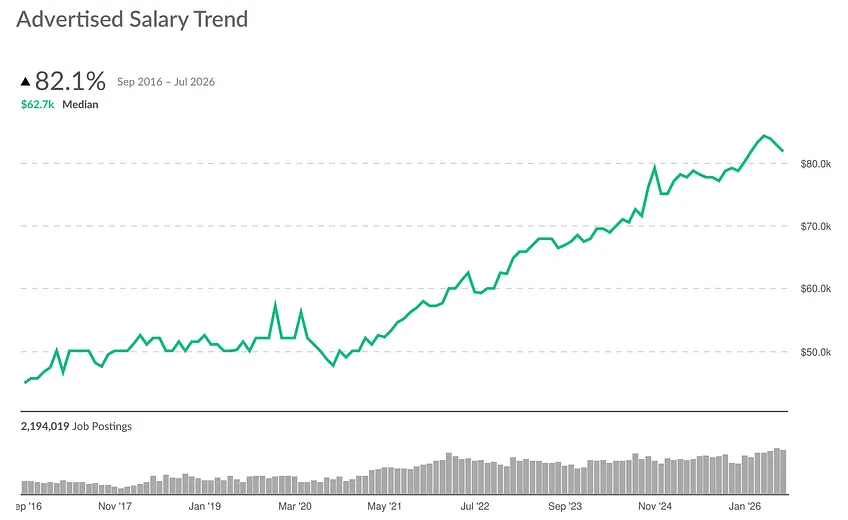
According to Intelligence Group, the median gross monthly salary for a mid-level recruiter is €3,870, and for a senior recruiter €4,100. HR advisers earn more on average: €4,750 at mid-level and €5,250 at senior level. A senior HR business partner earns €5,850, and a senior HR manager €6,620. Salary growth is limited, however, with annual increases of between 0.5% and 3.2%. For junior HR advisers, the median salary even fell slightly, by 0.7%.
A freelance recruiter now charges an average of €91 per hour.
Rates for flexible workers are rising faster. A freelance recruiter now charges an average of €91 per hour, 6.3% more than a year earlier. The average hourly rate for flexible HR professionals is €90 (+3.8%), and for HR managers it is €107 (+7.1%).
AI could take over a third of the work
Do HR professionals and recruiters really have little to fear from AI, as Bersin claims? Since early 2025, Intelligence Group has asked both the working population and HR professionals 2 questions every quarter. What percentage of your work do you think could already be done by AI or robots? And are you concerned that AI or robots will have taken over a large part of your work in 5 years’ time?
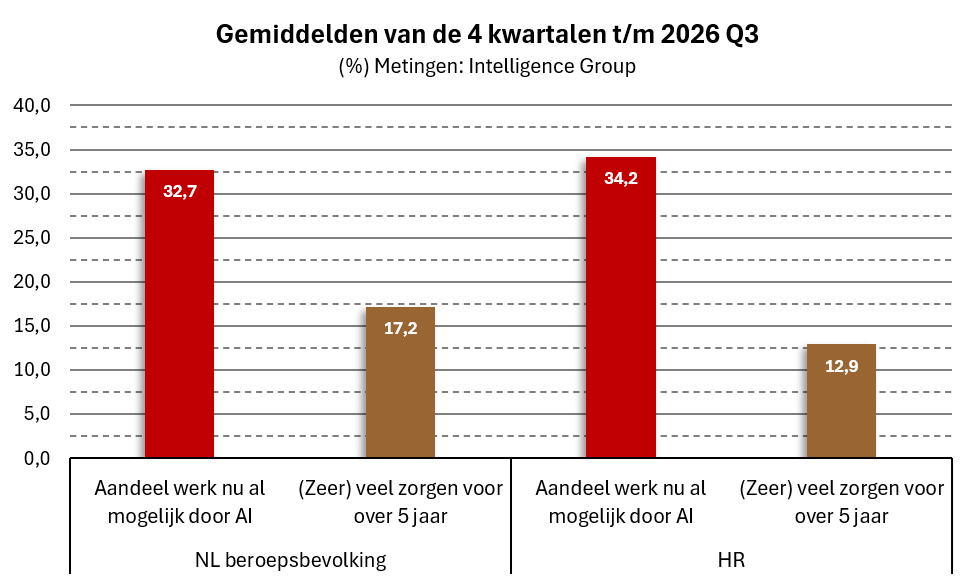
The results show that HR professionals estimate that AI or robots could already take over 34.2% of their work, slightly more than the figure for the working population as a whole (32.7%). According to Roders, this means that more than a third of their tasks consist of repetitive, routine work. ‘If AI can take that over, the result will at least be fewer tedious tasks’, he says. ‘But that is only a solution if the time freed up can then be spent on interesting, stimulating and valuable tasks.’
HR less concerned than average
The figures also show that only 12.9% of HR professionals are very or extremely concerned about their work in 5 years’ time. The figure is much higher for the workforce as a whole: 17.2%. Roders interprets this as a sign that AI taking over a significant proportion of tasks quickly will create room for more useful and interesting work. His advice to HR leaders and management teams is therefore: ‘Find out as quickly as possible which tasks AI can take over, but start with the professionals themselves.’
‘Find out as quickly as possible which tasks AI can take over, but start with the professionals themselves.’
First, ask employees which tasks they would like to do more of, because they are useful and interesting and are currently being neglected. Only then ask which tasks they would like to delegate to AI as quickly as possible. ‘By asking these questions in this way and in this order, you focus on the potential of both AI and your professionals’, he advises.
Read also
Related event
Intelligence Group – Eindejaarsactie 2026
Weet waar je doelgroep zit en wat ze willen Krijg 15 doelgroepanalyses in Giant en betaal er slechts 10. Alleen van 1 november tot en met 15 december 2026. Deze actie is maar 100 keer beschikbaar, dus wacht niet te lang.