Temporary agency work is often seen as an important stepping stone towards more sustainable employment. However, research by Ron Diris, Jordy Meekes and Olaf van Vliet of Leiden University, published in September as a discussion paper by the German research institute IZA, shows that this effect can sometimes be disappointing. If people start working as agency workers after a bankruptcy, they still appear to earn around 20% less per hour 7 years later than comparable people who went straight into employment with an employer.
Is temporary agency work really the stepping stone to a job it is often thought to be?
Temporary agency work can therefore help people get back into work quickly, but in the long term they pay a price for it, according to the study, which examined monthly microdata from Statistics Netherlands from 2010 to 2022. The researchers followed almost 80,000 employees from more than 4,000 companies that went bankrupt between 2012 and 2020. Around 12,800 of them initially started as agency workers afterwards, whilst more than 67,000 found a regular job straight away. The group consisted mainly of employees from manufacturing and construction.
Season as a natural experiment
Agency workers and permanent employees are, of course, not simply comparable. Those who end up in agency work are on average older, more often male, less highly educated and more likely to have a migrant background. This group also earned less than the other group before the bankruptcy.
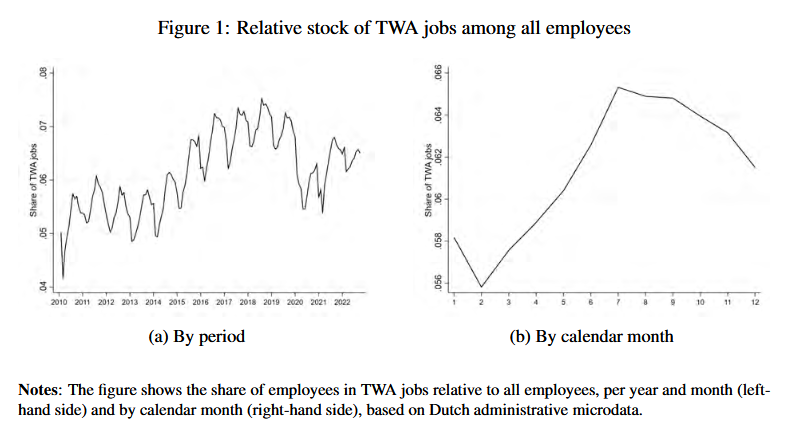
To filter out that effect, the researchers made use of the seasons. Demand for agency workers peaks in summer and falls in winter, and that pattern differs by sector. Whether you end up in an agency job after a bankruptcy therefore depends partly on the month in which your employer collapses. That moment has nothing to do with your own characteristics, allowing the researchers to say they can measure the real effect of agency work or permanent employment.
First: less work, then: lower pay
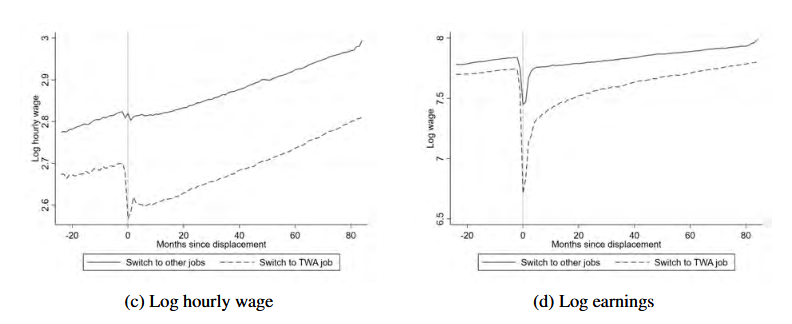
In the short term, agency workers are worse off: around one year after the bankruptcy, they work fewer hours and are less likely to be in work. After roughly 30 months, that difference has disappeared. This is not the case for pay, however. Hourly pay remains around 20% lower for up to 7 years (!) after the bankruptcy, and monthly income is around 18% lower. The likelihood of a permanent contract also remains around 20 percentage points lower in the long term. In addition, agency workers are much less likely to return to their former sector, have more and shorter jobs, and on average build up around 10 months less continuous employment.
Getting back into work quickly does not automatically mean being in better work.
Not everyone is affected equally severely. For men, hourly pay is around 27% lower. For women, the difference is small and not statistically significant, although the researchers say that estimate is uncertain. Employees of smaller bankrupt companies and employees in manufacturing also suffer greater wage losses after a bankruptcy. The biggest difference lies in pre-bankruptcy pay: the more someone earned beforehand, the greater the loss. Education level, remarkably, makes little difference.
Why does it work out so poorly?
Why does temporary agency work work out relatively so poorly? The researchers identify a number of patterns and explanations. Agency workers change jobs more often and generally have a weaker relationship with their employer. As a result, they accumulate less knowledge and experience specific to a company or sector, even though employers are willing to pay for precisely that.
Employers are happy to pay for knowledge and experience that agency workers build up less of.
Remarkably, even those who later leave agency work and continue in a ‘normal’ permanent job still have a pay disadvantage in some periods. This suggests that the damage does not end when the agency job ends. The researchers do note that the group leaving agency work is not a random group, and can therefore substantially influence the picture.
Dead end instead of stepping stone
For employees who involuntarily lose their jobs, temporary agency work therefore appears more likely to be a dead end than a stepping stone, the researchers conclude. Yes, agency work gets people back into work quickly, but it can harm their income in the long term. More jobs, they argue, do not automatically mean better opportunities. If those jobs are of low quality, they do little for the economy as a whole.

‘Temporary agency work is often more of a dead end than a stepping stone.’
It also concerns a sizeable group: during the 2010s, around 450,000 Dutch employees changed jobs after a bankruptcy, and about 90,000 of them ended up in an agency job. The outcome mainly applies to middle-aged men in manufacturing, however. Earlier studies often found more positive effects of agency work for young people and the long-term unemployed. The researchers still want to investigate whether reintegration advisers deliberately steer dismissed employees towards agency work, and what the consequences of that are.
Read more?
Related event

Arbeidsmarkttrends 2027-2030
We zijn uitverkocht. Maar goed nieuws! Arbeidsmarkttrends 2027-2030 is volgeboekt. Goed nieuws: op 28 januari 2027 organiseren we een tweede editie, met dezelfde sprekers en hetzelfde programma. Zorg dat je er alsnog bij bent. Bekijk de editie van 28 januari Al jaren geven de beste sprekers en specialisten een arbeidsmarktupdate en een doorkijkje naar de […]
Odido